
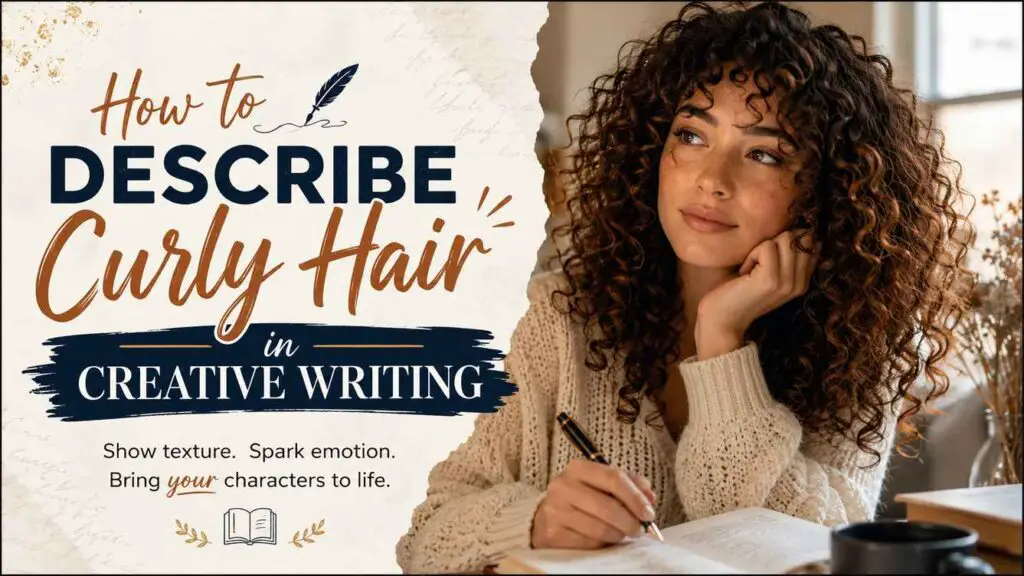
Curly hair covers a huge range of textures — loose waves, tight coils, everything shaped by humidity, product, and genetics in ways straight hair simply isn’t. “Curly hair” as a description does almost none of that variation justice. Below are the techniques for describing curly hair with real specificity, each with examples you can study and adapt.
How to Describe Curly Hair in Creative Writing
#1. Use Specific Curl Pattern and Texture
Naming the specific type of curl — loose waves, tight ringlets, dense coils — gives the reader a far more precise image than the general word “curly,” which covers an enormous range of actual textures.
Her hair fell in loose, easy waves, the kind that looked effortless even though it clearly wasn’t.
His curls were tight and springy, coiling back instantly the moment he stopped pulling on one to demonstrate.
Dense, defined coils framed her face, each one holding its shape with almost architectural precision.
#2. Show How Curls Respond to Humidity and Weather
Curly hair is famously reactive to moisture in the air, expanding, frizzing, or tightening depending on conditions. Describing this variation captures a quality unique to curly hair that a single static description misses entirely.
The humidity had doubled the size of it by noon, curls expanding into something closer to a halo than a hairstyle.
Rain sent it into full frizz within minutes, no amount of product able to keep up with the weather.
Dry winter air left it flatter and looser than usual, the curl pattern subdued in a way summer never allowed.
#3. Use Movement and Bounce
Curly hair moves distinctively — bouncing with each step, springing back after being pulled straight, shifting as a whole mass rather than falling in a single sheet. Capturing this specific motion brings the hair to life on the page.
Her curls bounced with every step, a half-second behind the rest of her, like they hadn’t quite caught up yet.
He stretched one curl out to its full length and let it snap back into place, a habit he’d had since childhood.
The whole mass of it shifted as one unit when she turned her head, rather than falling neatly like straighter hair would have.
#4. Show a Character’s Relationship to Maintaining It
The specific routine, products, or effort a character puts into their curls — or their decision to skip all of it entirely — reveals character and history, since curly hair often requires more deliberate care than straight hair does.
She’d spent years learning exactly which products actually worked for her curls, a process of trial and error longer than most people realized.
He’d stopped fighting it entirely by his thirties, letting it do whatever it wanted most days.
Her morning routine started with detangling alone, a ritual that took longer than the rest of getting ready combined.
#5. Use Curls to Reveal Family Resemblance
Since curl pattern often runs in families, noting a shared texture between relatives — a grandmother’s curls reappearing in a grandchild — can establish family connection quickly and specifically.
She had her mother’s exact curl pattern, tight and defined in a way that had skipped her sister entirely.
All three brothers had the same unruly waves, unmistakable proof of whose sons they were.
His daughter’s curls had come in exactly like his own baby photos, a detail that undid him more than he expected.
#6. Show Curls Escaping Attempts to Control Them
A single curl springing loose from a bun, or the whole style unraveling by the end of the day, adds a small, believable detail of imperfection and can carry humor or characterization depending on the context.
One curl had already escaped the bun by mid-morning, refusing to stay pinned no matter how many times she tucked it back.
The style she’d carefully done that morning had mostly given up by evening, curls reasserting themselves one by one.
He’d given up trying to flatten the one piece that always stuck up at the crown, deciding it simply had its own opinions.
#7. Use Touch to Convey Texture
Curly hair has a specific tactile quality — springy resistance, unexpected softness, a bounce felt as much as seen. Including this sensory detail through touch adds a layer most purely visual description skips.
It had more give than she expected, springing back gently under her fingers rather than staying flat.
He ran a hand through it and felt each curl resist slightly before giving way.
It was softer than it looked, a fact that seemed to genuinely surprise anyone who touched it for the first time.
#8. Contrast Curly Hair With a Character’s Expectations of It
A character who’s spent years wishing for straight hair, or who’s only recently learned to embrace their natural texture, adds emotional depth beyond a purely visual description, reflecting a broader relationship with self-image.
She’d straightened it every single day throughout high school, and only in her twenties had she finally stopped fighting what it actually wanted to do.
He used to hate the curls, until enough people told him they suited him that he eventually, grudgingly, agreed.
She’d finally learned the products that worked with her curls instead of against them, a small victory that had taken longer than she’d like to admit.
#9. Avoid Generic “Curly Hair” — Get Specific
The phrase covers such a wide range of actual textures that it barely conveys a specific image. Naming the exact curl type, density, or behavior keeps the description from feeling interchangeable across every curly-haired character in fiction.
It wasn’t just curly — it was tight, springy coils that shrank to half their stretched length the second she let go.
Calling it curly undersold it; it was loose, barely-there waves that only really showed up after a swim.
There was nothing generic about the texture — dense, voluminous, and entirely unbothered by anyone’s opinion of it.
Closing Thoughts
Curly hair earns its place as a specific, memorable detail when it’s described with real precision — the exact curl pattern, how it responds to weather, the texture felt through touch — rather than reduced to the single word “curly.” Tie it to family resemblance and a character’s own relationship to maintaining it, and even a single head of curls can carry real characterization.