
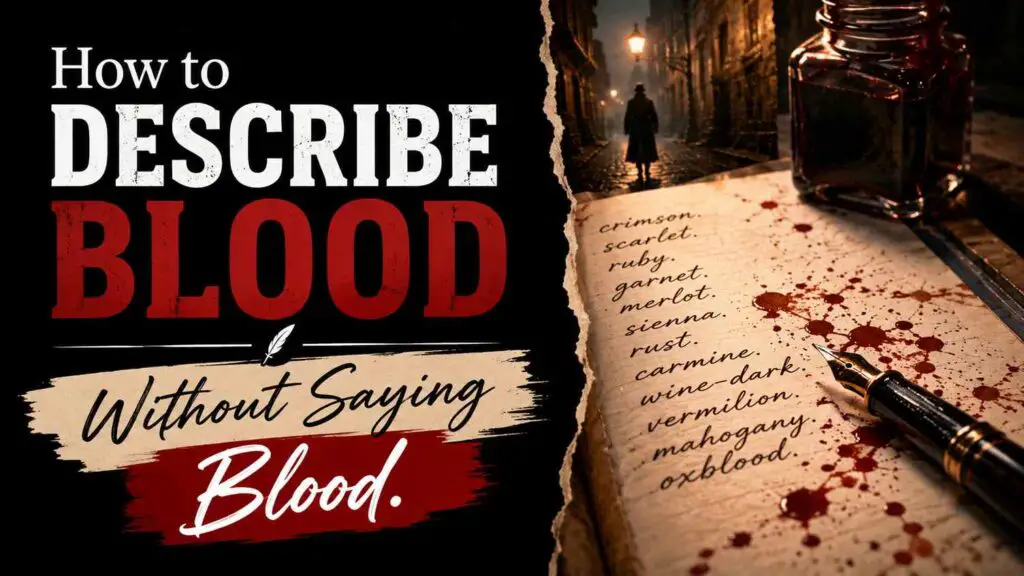
Sometimes the word itself is the problem — “blood” is so direct and so clinical that repeating it across a scene flattens the tension it’s meant to build, or announces a reveal a writer would rather let the reader arrive at on their own. Describing blood without naming it outright forces a kind of precision that the word itself lets you skip, and the result is often more unsettling for the indirection. Below are the techniques for evoking blood without stating it, each with examples you can study and adapt.
How to Describe Blood Without Saying Blood
#1. Use Color as an Indirect Stand-In
Naming the specific color — a deep red, a rust-dark stain — lets the reader draw their own conclusion without the word “blood” ever appearing. This indirection can feel more visceral, since the reader has to complete the image themselves.
Something dark had spread across the tile, a red so deep it looked almost black in the dim light.
A line of rust-colored droplets led from the doorway to the kitchen, spaced evenly, like footsteps.
The stain on his collar had dried to a deep, unmistakable brown.
#2. Name What It’s Touching Instead of the Substance Itself
Describing the effect — a soaked bandage, a stained shirt, a darkened patch of carpet — rather than the substance causing it lets the reader infer what’s there without a direct statement. This technique keeps the focus on consequence rather than the literal fact.
The bandage had soaked through twice already, and she was starting to run out of clean ones.
His shirt clung to his side, heavier and darker than it should have been.
The carpet beneath him had gone dark in a widening circle no one had noticed yet.
#3. Use Texture and Temperature as Clues
Describing warmth, stickiness, or a specific slickness lets the reader identify the substance through physical sensation rather than a direct label. This tactile approach also grounds the moment in a character’s immediate, embodied experience.
It was warmer than she expected, and stickier, coating her fingers before she understood what she’d touched.
Something slick had pooled beneath him, cooling fast against the tile.
Her hand came away wet, warm, and unmistakably not water.
#4. Let a Character’s Reaction Imply What They’re Seeing
A character’s physical or emotional response — recoiling, going pale, reaching instinctively for a towel — can communicate exactly what they’re looking at without narration ever naming it directly. The reaction itself becomes the description.
She stumbled back a step, one hand flying to her mouth, unable to look away from what covered the counter.
He grabbed the nearest towel without thinking, pressing it hard against the source before he’d even registered doing it.
Someone behind her gasped, and she didn’t need to turn around to understand exactly what they’d just seen.
#5. Use Smell to Suggest Without Naming
Blood’s specific metallic, coppery smell is recognizable enough that describing the scent alone lets a reader identify what’s present without the word ever appearing on the page.
A sharp, metallic smell hung in the air before she’d even flipped on the light.
Something coppery hit the back of his throat, unmistakable and unpleasant, the second he stepped through the door.
The smell alone was enough to make her hesitate at the threshold.
#6. Borrow Language From Adjacent Domains
Drawing comparisons to wine, paint, rust, or ink can describe blood’s color and texture vividly while keeping the language once removed from the literal substance. This borrowed vocabulary can also add a specific tonal register — elegant, industrial, ominous — depending on the comparison chosen.
It had the deep, wine-dark color of something spilled and left too long to dry.
The stain looked almost like paint at first, thick and glossy in the lamplight.
Rust-colored streaks ran down the door, dried and flaking at the edges.
#7. Use Restraint and Suggestion Over Direct Statement
Sometimes the most effective choice is to imply the presence of blood through the smallest possible detail — a single drop, a faint smear, a color glimpsed at the edge of vision — and let the reader’s imagination supply the rest.
A single dark drop had landed on the page, and she stared at it for longer than made any sense.
There was just a faint smear on the doorframe, easy to miss unless you already knew to look for it.
He caught sight of something dark at the edge of her sleeve and decided, for now, not to ask.
#8. Know When Avoidance Becomes a Distraction
Avoiding the word “blood” works best as a deliberate choice for a specific effect, not a rule applied rigidly throughout an entire manuscript. In scenes where directness serves the pacing better than euphemism, simply naming it plainly can be the stronger, more honest choice.
By the third paragraph of careful avoidance, it was clear the scene needed the word itself, not another workaround.
In the ER, nobody had time for euphemism. “There’s blood in his airway,” the nurse said, flatly, and moved.
The indirect version had worked for the slow reveal earlier in the chapter; this moment needed plain, unadorned clarity instead.
Closing Thoughts
Describing blood without naming it works when the substitute details — color, texture, smell, a character’s reaction — are specific enough to leave no doubt about what’s actually there. Use this indirection deliberately, for scenes that benefit from suggestion over statement, and know when to drop the technique entirely in favor of plain, direct language that better serves the moment.