
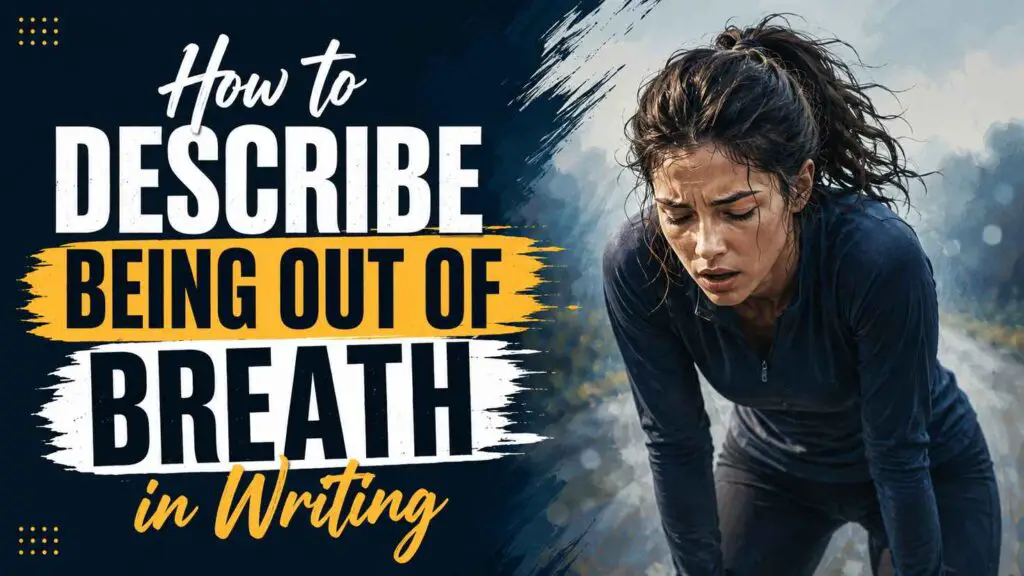
There’s a moment in almost every story where a character needs to catch their breath — after a chase, a fight, a climb, or even a wave of panic. How you describe that moment can make the difference between a scene that feels flat and one that leaves your reader a little breathless themselves. Vague phrases like “she was tired” or “he couldn’t breathe” tell the reader what’s happening, but they don’t let them feel it.
The good news is that there are countless ways to show breathlessness through sound, sensation, body language, and rhythm. Below is a list of techniques and phrases you can use to bring this physical state to life on the page.
Ways to Describe Being Out of Breath in Writing
#1. Gasping for Air
Gasping is one of the most immediate and visceral ways to show a character struggling to breathe. It works well in moments of sudden exertion or shock, because it suggests the body is reacting faster than the mind can process — the intake of air happens before conscious thought catches up. Use short, clipped sentences around this description to mirror the character’s broken rhythm, and consider what triggered the gasp, since that context sharpens the image.
In the first example below, the comparison to “forgetting how air worked” captures that involuntary, almost bewildered quality, while the second example ties the gasp to a specific physical cause — surfacing from water — which grounds the sensation in a concrete moment rather than leaving it abstract.
She doubled over at the top of the stairs, gasping like she’d forgotten how air worked.
He surfaced with a gasp, sucking in air as though the ocean had tried to keep it for itself.
#2. The Ragged, Uneven Breath
Ragged breathing suggests exhaustion that has gone on for a while — it’s not just about needing air, but about the body losing its usual rhythm entirely. This works well after prolonged exertion, like a long run or a drawn-out struggle, since it implies fatigue that has been building rather than hitting all at once. Sensory verbs like “scraping” or “jagged” help the reader feel the friction of each breath instead of just being told the character is tired.
The first example uses touch — the throat being scraped — to make the ragged quality physical, while the second example emphasizes duration and terrain, showing that the unevenness built gradually over the course of the climb.
His breath came in ragged pulls, each one scraping against the back of his throat.
By the time she reached the ridge, her breathing had turned jagged and uneven, catching on itself with every step.
#3. The Heaving Chest
Describing the chest itself — rather than the breath — draws attention to the physical effort behind each inhale. This technique is especially effective in third-person narration, where you can describe the body from the outside as if the reader is watching it labor, giving the scene a visual, almost cinematic quality. Verbs like “heave” and “rise and fall” put motion into a part of the body readers can picture clearly.
The first example focuses on the disjointed effort of the lungs working against each other, while the second example adds a small visual detail — the shirt moving with each breath — that makes the heaving chest something the reader can actually see.
Her chest rose and fell in sharp, uneven heaves, as though her lungs had forgotten how to work together.
His chest heaved beneath his shirt, each breath dragging his shoulders up with the effort.
#4. Words That Won’t Come Out
Breathlessness often interrupts speech, and showing a character struggling to talk while out of breath adds both physical realism and tension to dialogue. Broken sentences, dashes, and pauses can do a lot of the work here, letting the reader hear the gaps where breath should be. Pairing the fragmented dialogue with a small action beat — a hand on a wall, a pause before finishing a thought — reinforces that the character is fighting their own body just to get words out.
The first example uses a dash and an action beat to interrupt the sentence physically, and the second example splits a single word in half, showing just how little air the character has to spare.
“I—” he wheezed, pressing a hand to the wall. “Just—give me a second.”
“Wait—” she managed, the word splitting into two ragged halves before she could finish it.
#5. The Burning Lungs
Focusing on the internal sensation — the burn, the tightness, the ache — pulls the reader directly into the character’s body. This is a good choice when you want the reader to feel discomfort rather than just observe it, since internal sensations bypass the visual and go straight to something more immediate and uncomfortable. Comparing the sensation to heat, pressure, or injury gives it a sharper edge than simply saying breathing “hurt.”
The first example uses fire as a metaphor to convey intensity, while the second example leans on the idea of rawness and scraping, suggesting that the burn has left something behind rather than just passing through.
Every breath felt like swallowing fire, her lungs tight and burning with the effort of pulling in more air than they could hold.
A dull ache spread through his chest with every inhale, like his lungs had been scraped raw.
#6. The Whistling or Wheezing Breath
Sound is a powerful sensory detail, and a wheeze or whistle in someone’s breathing can suggest not just exhaustion but real physical strain — useful for scenes involving illness, injury, or extreme exertion. Because this sound is often audible to other characters in the scene, it can also become a source of concern or tension for whoever is listening, not just the person struggling to breathe. Comparing the sound to something familiar, like wind or machinery, helps the reader hear it rather than just read about it.
The first example draws on a natural comparison — wind through a window — to suggest something thin and strained, while the second example uses the more clinical word “rasped” to hint at real physical difficulty.
A thin whistle escaped with every breath he drew, like wind slipping through a cracked window.
Her breath rasped in and out, a faint wheeze catching at the end of every inhale.
#7. The Pounding Heart Paired with Breathlessness
Breathlessness rarely shows up alone — it’s often accompanied by a racing heartbeat. Pairing the two sensations together makes the description feel more complete and physically grounded, since it reflects how the body actually responds under stress or exertion. This combination is especially useful for scenes that mix physical exhaustion with fear or adrenaline, where the heartbeat can carry the emotional charge while the breath carries the physical one.
The first example ties the heartbeat directly to the rhythm of the breath, suggesting the two are working in tandem, while the second example lets the pulse dominate the character’s senses, showing just how consuming the moment has become.
Her heart slammed against her ribs in time with her breath, both of them racing to catch up with her.
His pulse hammered in his ears, drowning out everything but the sound of his own labored breathing.
#8. Comparisons and Similes
Sometimes the most effective way to describe breathlessness is through comparison — likening the sensation to something concrete and familiar. This can add both clarity and a bit of personality to your narrative voice, letting the comparison reflect the tone of the scene, whether that’s dread, exhaustion, or dark humor. Mechanical or industrial comparisons in particular can suggest a body pushed past its limits, working like a machine that’s about to fail.
The first example compares the character’s breathing to a bellows, emphasizing thinness and depletion, while the second example uses a rusted engine to suggest something straining and on the verge of breaking down entirely.
He sounded like a bellows losing its air, each breath thinner than the last.
Her breathing rattled like a rusted engine trying to turn over.
#9. The Body Language of Exhaustion
Breathlessness isn’t only about the lungs — it shows up in posture and movement too: hands on knees, a slumped back, a head thrown back to open the airway. These physical cues let you show the state without naming it directly, which is especially useful when you want to avoid repeating words like “breathless” or “panting” too often in a scene. Posture can also reveal how depleted a character feels, since a body that’s merely winded looks different from one that’s completely spent.
The first example uses a familiar, almost instinctive posture — hands on thighs — to show a character trying to recover, while the second example shows a more collapsed, passive stance that suggests the character has little energy left to hold themselves up.
She bent forward, hands braced on her thighs, head hanging low as she waited for the world to stop spinning.
He sagged against the doorframe, arms limp at his sides, chest still heaving from the effort.
#10. The Struggle to Recover
Finally, showing the slow return to normal breathing can be just as powerful as the breathlessness itself. It signals a shift in the scene’s tension and gives the reader a moment to exhale along with the character, which can be a useful way to close out an action sequence or ease into a quieter, more reflective beat. Describing this recovery gradually, rather than all at once, keeps it believable — bodies don’t snap back to normal instantly.
The first example uses a comparative structure, showing each breath as slightly calmer than the last, while the second example marks the recovery with a specific detail, the loosening in the chest, to show that the physical tension has genuinely eased rather than simply faded from the narration.
Slowly, her breathing began to even out, each inhale a little less desperate than the one before.
A few minutes passed before his breath steadied, the tightness in his chest finally letting go.
Closing Thoughts
Describing breathlessness well comes down to specificity — choosing the right sensory detail, whether it’s sound, sensation, or movement, to match the tone of your scene. A gasping breath after a jump scare reads very differently from the ragged breath of someone who has just run for miles, so it’s worth matching the technique to the emotional weight of the moment.
The best approach is often to combine a few of these techniques rather than relying on just one. Pair a physical sensation with a piece of body language, or let broken dialogue do the work alongside a racing heart. The more senses you engage, the more real the moment will feel — and the more your reader will find themselves holding their breath right along with your character.