
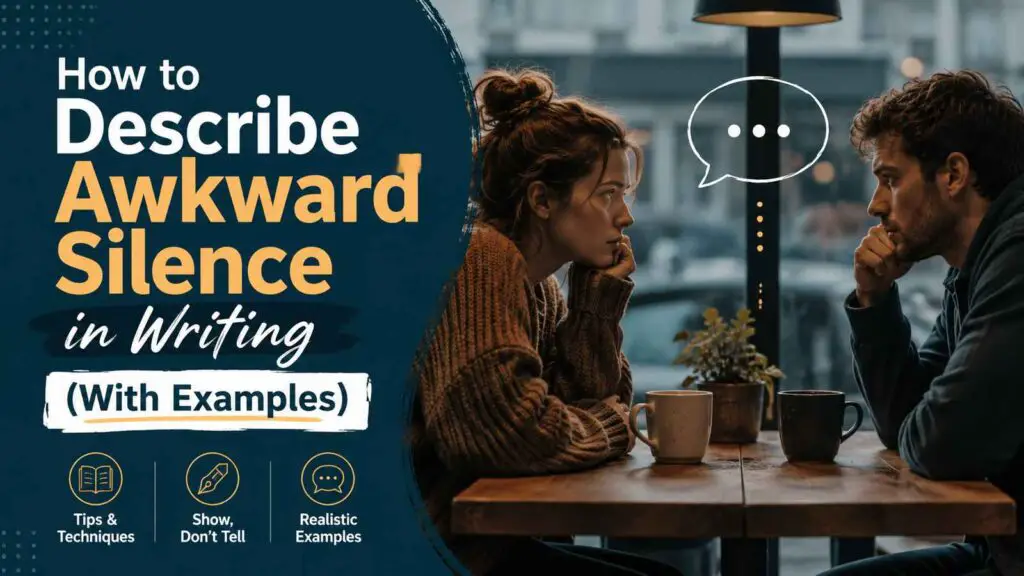
Awkward silence is one of the most effective tools a writer can use to create tension without adding more dialogue. It can reveal embarrassment, attraction, regret, fear, conflict, or uncertainty in ways that spoken words often cannot. A well-written moment of silence invites readers to pay closer attention to what the characters are feeling instead of simply telling them.
Rather than describing a silence as merely “awkward,” strong writing shows its impact through body language, pacing, setting, and subtle emotional cues. The best scenes allow the silence to become part of the story, communicating emotions that the characters cannot or will not express aloud.
Here are powerful ways to describe awkward silence in writing.
How to Describe Awkward Silence in Writing
Awkward silence becomes stronger when it is connected to body language, setting, pacing, and emotional pressure. Instead of simply saying that the room went quiet, show how the silence changes the moment. These techniques will help readers experience the discomfort along with your characters.
#1. Use Body Language
Body language is one of the most natural ways to show awkward silence. When people become uncomfortable, they often communicate more through their movements than through their words. Small actions such as fidgeting, avoiding eye contact, crossing arms, tapping fingers, shifting in a chair, or forcing a smile immediately suggest that something is wrong. Readers instinctively recognize these behaviors because they mirror real-life reactions to uncomfortable situations. By focusing on physical actions instead of directly stating the emotion, you allow readers to draw their own conclusions and become more invested in the scene. Combining several small gestures can make the silence feel increasingly tense without requiring a single line of dialogue.
Mara stared at the table, tracing the rim of her glass with one finger. Across from her, Daniel adjusted his collar for the third time and looked anywhere but at her.
Nina tucked a loose strand of hair behind her ear, then did it again moments later. Owen rubbed the back of his neck while neither of them found the courage to speak.
#2. Focus on Small Sounds
During an awkward silence, ordinary background noises suddenly become much more noticeable. A ticking clock, humming refrigerator, dripping faucet, or squeaking floorboard can seem unusually loud because nothing else is happening. Drawing attention to these sounds emphasizes the emptiness between characters and highlights just how uncomfortable the moment has become. It also slows the pacing, encouraging readers to linger in the silence instead of moving quickly to the next line of dialogue. Everyday sounds that would normally go unnoticed suddenly become important because they fill the emotional vacuum left by the lack of conversation.
The clock on the wall ticked too loudly. Somewhere in the kitchen, a faucet dripped once, then again. Nobody moved.
The air conditioner hummed steadily above them. A spoon clinked softly against a coffee mug, sounding far louder than it should have in the quiet room.
#3. Show Characters Avoiding Eye Contact
Eye contact often disappears when people feel embarrassed, guilty, ashamed, or emotionally vulnerable. Instead of looking at one another, characters may focus on the floor, a nearby object, or anything else that allows them to avoid confronting the situation directly. This simple behavior speaks volumes and reinforces the emotional weight of the silence. Avoiding eye contact also creates emotional distance between characters, making readers wonder what remains unsaid. Whether the silence follows an argument, an embarrassing mistake, or an unexpected confession, the lack of eye contact subtly communicates that the relationship has become strained.
He looked at her shoes. She looked at the window. Between them, the question sat unanswered.
Lena studied the faded wallpaper while Mark pretended to read a message on his phone. Neither dared to meet the other’s gaze.
#4. Use Short, Broken Sentences
The rhythm of your writing can reinforce awkward silence just as effectively as your descriptions. Short, clipped sentences slow the pace and create pauses that readers naturally feel. They mirror the hesitation and uncertainty experienced by the characters, making the silence itself feel longer and more uncomfortable. Breaking your prose into brief statements also prevents the scene from feeling rushed. Each sentence becomes another beat in the silence, allowing tension to build naturally until someone finally speaks or leaves the moment unresolved.
No one laughed. No one spoke. The smile on Evan’s face faded slowly.
She waited. He swallowed. Nothing came. The silence settled between them like a weight.
#5. Describe the Air or Room
The setting can reflect the emotional atmosphere of a scene. During an awkward silence, the room may suddenly feel smaller, colder, heavier, or strangely still. While the physical environment has not necessarily changed, describing it through the characters’ perceptions helps readers experience the emotional tension as though it has become part of the surroundings. This technique blends the character’s internal emotions with the external setting, making the silence feel almost tangible. Readers begin to sense that the environment itself is reacting to the uncomfortable moment.
The room seemed to shrink around them. Even the warm yellow light felt harsh now, exposing every nervous glance.
The conference room felt strangely airless. The walls seemed to press closer as every person waited for someone else to break the silence.
#6. Show Forced Politeness
People often try to cover uncomfortable moments with exaggerated politeness. They may force a smile, laugh weakly, make an unnecessary comment, or pretend everything is perfectly normal. These attempts usually fail, making the silence even more noticeable. Showing this contrast adds realism and often creates a mix of tension and subtle humor. Forced politeness works because readers can easily recognize when someone’s words and actions do not match their true feelings. The greater the effort to appear comfortable, the more obvious the awkwardness becomes.
“Well,” she said, smiling too quickly. “That’s interesting.” Her smile stayed there, stiff and useless, while everyone pretended to study their plates.
Tom chuckled under his breath and reached for another cookie. No one joined in, and his smile disappeared almost as quickly as it had appeared.
#7. Let the Silence Reveal Emotion
One of the greatest strengths of awkward silence is its ability to reveal emotions without explicitly naming them. Hurt, disappointment, anger, longing, or fear can all be communicated through what a character does—or chooses not to do—while remaining silent. This approach encourages readers to interpret the emotional subtext for themselves, making the scene more engaging and memorable. Instead of explaining what a character feels, show how they react during the silence, allowing their actions to carry the emotional weight.
When he said her name, she did not answer. She only folded the letter once, then twice, as if the paper needed all her attention.
Jacob reached across the table, but Emily quietly pulled her hand back and stared into her untouched cup of tea.
#8. Use the Silence After a Bad Remark
A poorly timed joke, an insensitive comment, or an accidental insult often creates immediate awkward silence. Instead of explaining that everyone felt uncomfortable, let the silence become the reaction. Readers will instantly understand that the words have landed badly without needing additional explanation. This technique is particularly effective because the silence itself becomes a form of dialogue. It tells readers that every character recognizes something has gone wrong, even if no one is willing to address it immediately.
“At least your father isn’t around to see this,” Greg said. The laughter died instantly. Claire’s fork stopped halfway to her mouth.
“I didn’t think anyone would miss him,” Sarah muttered. Every conversation around the table stopped, and even the music from the next room seemed to fade away.
#9. Stretch the Moment
Writers sometimes rush through silence because nothing is being said. In reality, allowing the silence to linger for a few moments can dramatically increase the emotional tension. Describing small actions, passing seconds, or hesitant movements gives readers time to feel the discomfort before the conversation finally resumes. Stretching the moment also builds anticipation because readers naturally expect someone to break the silence. Every additional second raises the emotional stakes and makes whatever happens next feel more significant.
A second passed. Then another. Ben opened his mouth, closed it, and reached for his water instead.
The elevator climbed floor after floor. The display numbers changed one by one, but neither passenger spoke until the doors finally opened.
#10. Contrast It With What Came Before
Awkward silence often has the greatest impact when it interrupts an energetic scene. A room full of laughter, lively conversation, or celebration that suddenly falls silent creates an immediate emotional shift. The sharp contrast draws attention to whatever caused the silence and makes the moment feel more dramatic. Readers notice the silence more clearly because they have just experienced the opposite atmosphere. This sudden transition can emphasize shocking news, an embarrassing mistake, or an emotional revelation with very little description.
Everyone had been talking at once a moment ago. Then Lily mentioned the divorce, and the table went still.
The party had been filled with music and laughter until Ryan announced he was leaving for good. The room fell silent, and every face turned toward him.
Closing Thoughts
Awkward silence is most effective when it is shown through action, sound, rhythm, and emotional tension. Instead of telling readers that a silence is uncomfortable, show what the characters do inside that silence.
A good awkward silence should feel active. It should reveal something, change the mood, or increase tension between characters. When written well, silence can become one of the most powerful parts of a scene.