
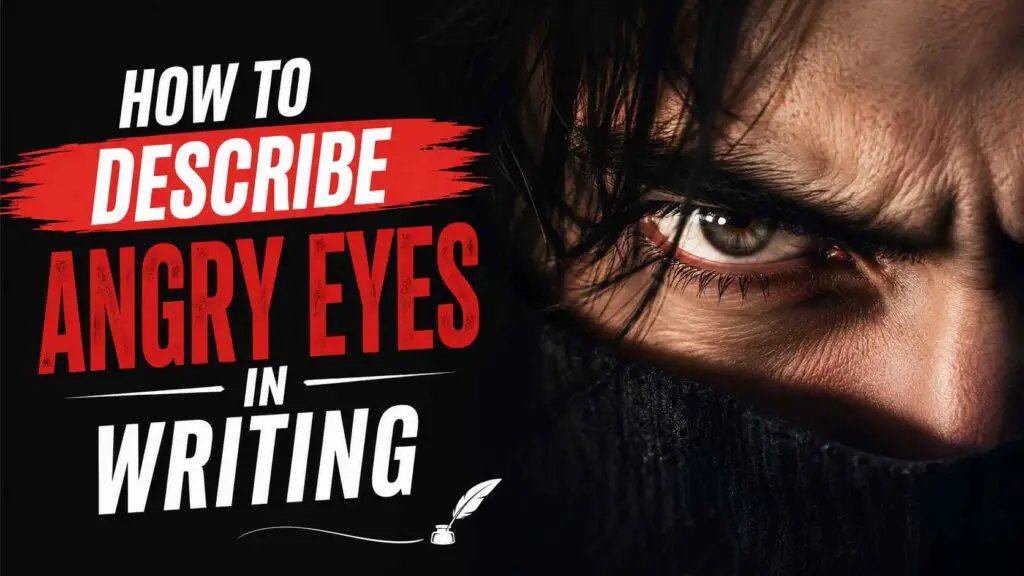
Eyes carry more emotional weight in fiction than almost any other physical feature, and anger is one of the easiest emotions to overwrite when describing them. “His eyes flashed with fury” has been used so often it barely registers anymore. Convincing angry eyes come from precision — the muscles around them, where they fix, how they move or refuse to. Below are the techniques for writing angry eyes that actually land, each with examples you can study and adapt.
How to Describe Angry Eyes in Writing
#1. Narrow the Focus, Not Just the Eyes
Anger often shows up as a narrowing of attention as much as a narrowing of the eyes themselves — a fixed, unblinking focus that excludes everything else in the room. Describing where the gaze locks, and what it ignores, does more work than describing the eyelids alone.
Her eyes fixed on him and didn’t move again, not even when the waiter set down the check between them.
He stared at the same spot on the wall behind her, unwilling to let his eyes land anywhere near her face.
His gaze narrowed to a single point — her hands, still holding the letter she shouldn’t have opened.
#2. Use Heat and Color as Sensory Cues
Anger has a physical temperature to it, and readers respond to descriptions that lean into heat, flush, or intensity of color rather than abstract fury. This grounds the emotion in something the reader’s own body has felt.
Her eyes burned, dry and hot, as if the anger itself had dried out every soft thing behind them.
The whites of his eyes had gone faintly pink, the strain of holding his temper visible even in the smallest details.
Her eyes went dark in a way that had nothing to do with the light in the room.
#3. Show the Eyes Fixing on a Target
Angry eyes rarely wander — they lock onto a cause, a person, an object that represents the source of the anger. Naming what the eyes fix on tells the reader exactly where the emotion is directed, which does more narrative work than describing the eyes in isolation.
His eyes went straight to the broken vase and stayed there, as if staring hard enough might undo it.
She looked at the phone in his hand and nowhere else, her eyes hard enough to leave a mark on the screen.
His gaze fell on his brother and held, unblinking, the way it used to when they were kids and someone had lied.
#4. Contrast Stillness in the Eyes With Movement Elsewhere
A powerful way to write controlled anger is to keep the eyes unnervingly still while the rest of the body betrays tension — clenched fists, a tapping foot, a tightened jaw. That contrast reads as more dangerous than an over-the-top physical description ever could.
Her eyes stayed perfectly calm even as her knuckles whitened around the edge of the table.
He didn’t blink once through the whole exchange, though his jaw worked steadily beneath a face gone otherwise still.
Her stare never wavered, even as her voice, when it finally came, shook with the effort of staying level.
#5. Use Eye Contact as a Weapon
The way angry eyes engage — holding a stare too long, refusing to look away, forcing another character to break contact first — can convey dominance and threat without a single line of dialogue. Eye contact becomes a form of confrontation in its own right.
She held his gaze until he looked away first, which was, in its own quiet way, exactly the point.
He refused to blink, daring her to be the one who broke first, and she was.
Her stare didn’t waver even as he stepped closer, as though looking away had simply stopped being an option she’d consider.
#6. Describe the Muscles Around the Eyes
The eyes themselves don’t do all the emotional work — the muscles surrounding them do just as much. A tightened brow, a hardened set to the lower lids, a twitch at the corner can convey barely restrained anger more convincingly than the eyes alone.
A muscle ticked at the corner of his eye, small and involuntary, the only visible crack in an otherwise still face.
Her brow drew down hard, carving a line between her eyes that hadn’t been there a minute earlier.
The skin around his eyes tightened until they seemed smaller, harder, less like his own.
#7. Use Metaphor Sparingly for Maximum Impact
A single well-chosen comparison can capture the intensity of angry eyes far better than stacking several together. Overused images — “eyes like fire,” “eyes like daggers” — have lost their power through repetition, so aim for something specific to the character and scene instead.
Her eyes had the flat, unreadable quality of a closed door, giving nothing away except that it was closed.
His stare had the weight of something about to fall, and everyone in the room seemed to feel it land.
Her eyes went sharp and precise, like something being aimed rather than simply looked through.
#8. Show Anger Eyes Shifting Into Something Else
Anger rarely stays pure for long — it can crack into grief, soften into exhaustion, or curdle into something colder. Tracking that shift in the eyes over the course of a scene adds emotional complexity and avoids letting the anger feel one-note.
The heat in her eyes cooled slowly into something flatter, more tired, as if the anger had simply run out of fuel.
His stare wavered for just a second, and beneath the anger she caught something closer to hurt before he blinked it away.
What had started as fury in his eyes settled, by the end of the call, into something colder and far more permanent.
#9. Tie the Description to What Triggered the Anger
Angry eyes land harder when the reader understands exactly what provoked them. Connecting the physical description to the specific insult, betrayal, or injustice that caused it keeps the anger from feeling generic and gives it narrative weight.
Her eyes hadn’t looked like that since the last time he’d broken a promise this exact size.
He hadn’t been angry about the delay — it was the lie about the delay that put that look in his eyes.
Her stare hardened the moment she recognized the handwriting on the envelope, before she’d even read a word of it.
Closing Thoughts
Angry eyes work on the page when the description goes beyond the eyes themselves — into what they fix on, how the surrounding muscles respond, and what triggered the emotion in the first place. Resist the reflex of a single stock phrase and instead show the anger through focus, stillness, and consequence, and readers will feel the heat behind the stare instead of just being told it’s there.