
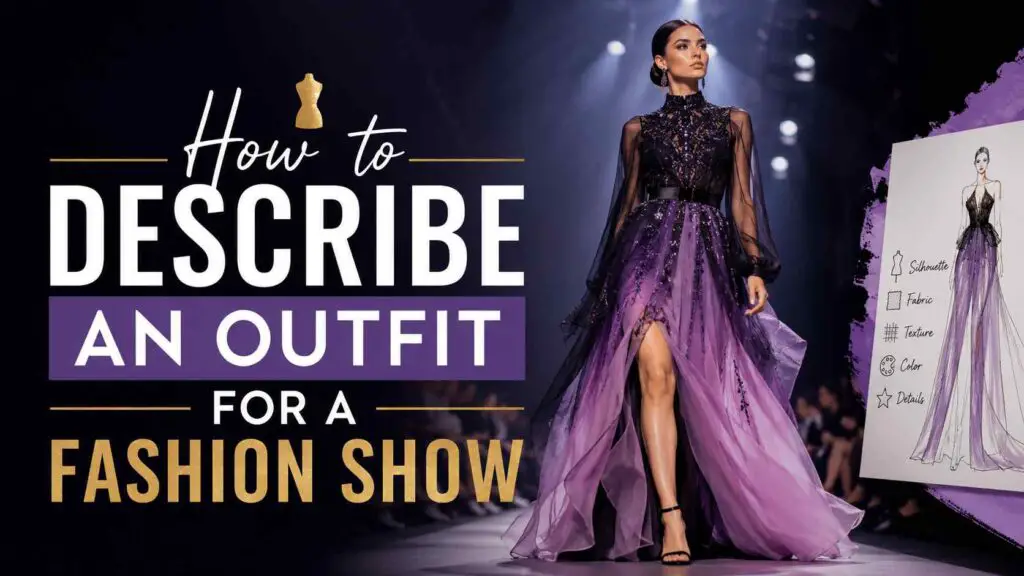
Describing an outfit for a fashion show — whether you’re writing runway commentary, show notes, press copy, or a scene set at one — is its own discipline, with its own vocabulary and its own pace. The description has to move as fast as the model, land the garment’s key idea in seconds, and use the technical language of construction and fabric without drowning the audience in it. Below are the techniques for describing runway outfits with real authority, each with examples you can study and adapt.
How to Describe an Outfit for a Fashion Show
#1. Lead With the Silhouette
The silhouette — the overall shape the outfit cuts against the runway — is what an audience reads first, before color or fabric registers. Naming it up front (columnar, A-line, oversized, sculpted) gives the listener the garment’s headline, and every detail after that has a frame to hang on.
A severe columnar silhouette in bone-white crepe, unbroken from shoulder to floor, cut to move like a single line of chalk.
The look opens wide and architectural — an oversized, sharp-shouldered coat that swallows the frame and makes the narrow trouser beneath it read as punctuation.
A classic hourglass, reintroduced without apology: nipped waist, padded hip, and a hem that stops exactly where the argument starts.
#2. Name Fabrics and Construction Precisely
Fashion writing earns its authority through material accuracy — duchesse satin, bias-cut silk, bonded wool, raw-edged organza — because fabric determines how a garment moves and holds light. One precise textile term does more convincing work than three decorative adjectives, and professionals notice immediately when it’s wrong.
Bias-cut silk charmeuse in oxblood, seamed to pour rather than hang, with a cowl back that arrives a full beat after the model does.
The jacket is bonded wool, seams sealed rather than stitched, giving the whole look the smooth authority of industrial design.
Layers of raw-edged organza, each one a slightly different white, so the dress reads as a single color with a history.
#3. Describe How the Outfit Moves
A runway outfit exists in motion — that’s the entire reason for the walk — and describing the swing, float, snap, or sway of the garment captures what a static photograph can’t. Movement description also tells the audience what the clothes will do on a living body, which is the real product.
The pleats stay disciplined until the turn, then open like a fan snapping shut in reverse.
The coat doesn’t sway — it swings, heavy and deliberate, arriving at each step half a second behind the shoulder that started it.
Every step sends the fringe into motion, and the dress spends the whole runway settling and never quite finishing.
#4. Anchor Color in Precise, Evocative Terms
Runway color deserves better than “red” or “green” — oxblood, pistachio, storm gray, and butter yellow each place an exact shade in the listener’s mind while setting a mood. Precise color language is also how collections get remembered and quoted, so the naming is part of the show’s afterlife.
The gown arrives in deep oxblood — red with the lights turned down — against hardware in tarnished brass.
A suit in pistachio, the exact pale green of the inside of the nut, worn with nothing that argues with it.
Storm-gray taffeta shot through with silver thread, so the dress changes weather as it walks.
#5. Place the Look Within the Collection’s Story
A runway look is one sentence in the collection’s larger argument — a theme, an era referenced, a designer’s ongoing obsession — and connecting the outfit to that narrative gives the description context and weight. The look means more when the audience knows what conversation it’s part of.
Look twelve continues the collection’s midnight-garden thread — the embroidery now overgrown, climbing past the waist it politely stopped at three looks ago.
Here the designer’s season-long argument with tailoring reaches its truce: the suit, finally, unstructured and at ease.
The closing gown gathers every motif of the evening — the raw hems, the storm palette, the single line of red — into one final sentence.
#6. Use Styling Details as the Finishing Argument
The styling — bare feet with couture, one glove, slicked hair, a deliberately wrong shoe — is where a show editorializes on its own clothes, and describing it completes the picture. These choices are intentional messages from the designer, and good commentary treats them as text rather than accessory.
The gown is shown barefoot, which tells you everything about how seriously it takes its own formality.
One elbow-length leather glove, worn alone — the single dark note the pale look needed to stop being polite.
Hair slicked flat and severe against all that volume below, so the drama stays where the designer put it.
#7. Keep the Pace of the Runway in Your Sentences
A model crosses the runway in seconds, and live or written commentary has to match that tempo — short, front-loaded sentences that land the key idea before the look is gone. Long, winding description belongs in a review; runway description works in the rhythm of the walk itself.
Black tuxedo, re-cut for one shoulder. That’s the whole idea, and it’s enough.
Silver mesh over slate jersey. Armor, but make it liquid.
A trench coat, floor-length, worn open over nothing but confidence and a very good slip.
#8. Avoid Empty Superlatives — “Stunning” Describes Nothing
“Stunning,” “gorgeous,” and “breathtaking” are applause, not description, and a paragraph built from them leaves the reader unable to picture a single garment. Replacing each superlative with the specific detail that earned it — the cut, the fabric, the one surprising choice — is what separates commentary from cheering.
Not “stunning” — say it: a floor-length coat in mirror sequins that turns the model into weather.
The dress didn’t need the word gorgeous; it needed someone to mention that the entire bodice was hand-knotted rope.
What actually stopped the room wasn’t beauty in general — it was the back of the gown, which turned out not to exist.
Closing Thoughts
Describing a fashion show outfit well means moving at the runway’s speed while landing precise information — silhouette first, then fabric, motion, color, and the styling choices that editorialize the look. Connect each outfit to the collection’s larger story, and trade every empty superlative for the specific detail that earned it, and your description will carry the authority the clothes deserve.