
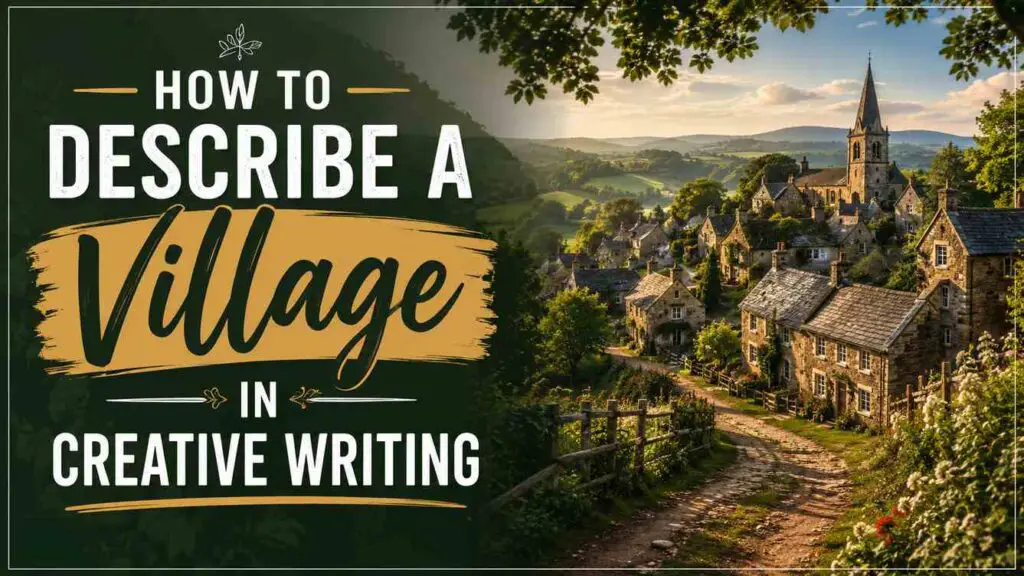
A village is older and more compact than a town — a settlement you can cross on foot in minutes, arranged around a green, a well, a church, or a harbor, where the buildings lean together like elderly relatives and the surrounding fields press right up against the last garden wall. Whether you’re writing the Cotswolds, a fishing village, or a fantasy hamlet on the map’s edge, the describing works the same way. Below are the techniques for bringing a village to life on the page, each with examples you can study and adapt.
How to Describe a Village in Creative Writing
#1. Arrange It Around Its Center
Villages organize around a heart — the green, the well, the church, the market cross, the harbor — with lanes radiating out like veins from it, and describing that geometry first gives the reader an instant mental map. Whatever stands at the center also rules the village’s calendar and gossip.
The village was arranged around its green the way a family arranges itself around a table — church at the head, pub at the foot, everyone else in their long-assigned seats.
Every lane in the village eventually delivered you to the well, whether you’d wanted to go there or not, which was also true of every conversation.
The harbor was the village’s front door, and the whole crooked huddle of cottages stood facing it, watching the weather come in like relatives.
#2. Let the Buildings Lean and Accumulate
Village architecture is accretion — cottages built from local stone, roofs of thatch or slate, walls out of true, extensions added over centuries — and describing the buildings as grown rather than constructed captures the organic charm. Local material matters: a village is the landscape rearranged into houses.
The cottages were built of the same gray stone as the hills, so the village looked less constructed than surfaced, like an outcrop that had developed chimneys.
No wall in the village stood quite straight; the buildings leaned into each other companionably, holding one another up like old men after a wedding.
The smithy had been a chapel, the chapel had been a barn, and the barn had been two other barns — village history filed by doorframe.
#3. Keep the Fields Pressing In
A village has no suburbs — the working land begins at the last garden gate, sheep graze against the churchyard wall, and the agricultural year runs through the streets — so describing the settlement means describing its constant negotiation with the fields around it. The village floats in its landscape like a boat.
The village ended mid-sentence — cottage, cottage, gate, and then barley to the horizon.
Twice a day the dairy herd came through the main street with the authority of scheduled transit, and traffic, such as it was, waited.
From the church tower you could see the whole parish: the village a knot of roofs, and around it the fields it existed to serve, stitched together by hedges.
#4. Sound the Bells and the Silences
Village acoustics are distinct — church bells structuring the day, rooks in the elms, a single tractor audible for a mile, the pub’s murmur leaking into the dusk — and the soundscape is intimate enough that individual sounds carry names. A village is quiet the way a sleeping house is quiet: full of identifiable breathing.
The bells counted the village through its day, and nobody owned a watch that mattered more than the tower.
She could hear one tractor working somewhere east, and could name the tractor, and from the gear changes, the mood of the man driving it.
At dusk the village made its usual sounds — hens being shut in, a gate, the pub door’s brief spill of light and laughter — the whole place talking itself to sleep.
#5. Populate It With Its Fixed Cast
A village runs on a small permanent cast — the vicar or priest, the publican, the oldest inhabitant, the woman who runs everything from behind the shop counter — and the cast is small enough that every member is load-bearing. In a village, there are no extras; every face has a name and a history.
The village had one shop, and Mrs. Penhallow ran it, and running it meant running most other things too, in ways that never appeared on any sign.
The publican knew every regular’s glass by the sound of the door, and pulling the wrong pint had happened twice in thirty years, both times deliberately.
Old Tam had been the village’s oldest inhabitant so long that being old was understood to be his profession.
#6. Run the Year Through It — Feast, Harvest, and Fair
Village time is circular — planting, harvest, the fete, the saint’s day, the winter market — and the communal calendar gives your setting rhythm and ready-made scenes where the whole cast assembles. A village described across its year is a village the reader has lived in.
The year turned on the harvest fair the way a door turns on its hinge, and everything in the village was either before-the-fair or after.
The fete committee had been at cold war over the cake tent since the previous rectory, and the village would have been genuinely sorry to see peace break out.
On the saint’s day the whole village walked the parish bounds, as it had for six hundred years, beating the same hedges their names were buried under.
#7. Layer In the Deep Past
Villages are old by definition — names in the churchyard matching names on the shop fronts, a Roman road under the lane, the plague year in the parish register — and letting deep time show through gives the setting resonance towns rarely have. In fantasy, this is where you seed the standing stones and the door nobody opens.
The churchyard held eleven Marlowes, and the shop till was worked by the twelfth, making change on top of her ancestors.
The lane bent for no living reason — the reason had been an oak, gone two centuries — and the village went on faithfully swerving around its ghost.
The standing stone in Miller’s field predated the church, the village, and possibly the language, and the cows would not graze within ten feet of it.
#8. Skip the Chocolate Box — Let Weather and Work In
The picturesque village of thatch and roses is a postcard until you add mud, weather, and labor — the lane’s winter flooding, the damp in the cottage walls, the hard economics of one bus a day — and the grit is what makes the charm credible. A village is a working machine that happens to be beautiful.
The postcards showed the thatch and the roses; they did not show the thatch’s insurance premiums, which were the actual topic at the pub.
November put the ford over the lane and the village back on its own resources, an island for the wet months, as it had always been.
It was beautiful the way working things are beautiful — like a boat, not like a painting of a boat.
Closing Thoughts
Draw the map first — center, lanes, last gate, fields — then wind the clock: bells, seasons, the fair, the flood. A village is small enough to know completely, which is exactly its gift to a writer; nowhere else can you put an entire world on a single page and have room left for the standing stone.