
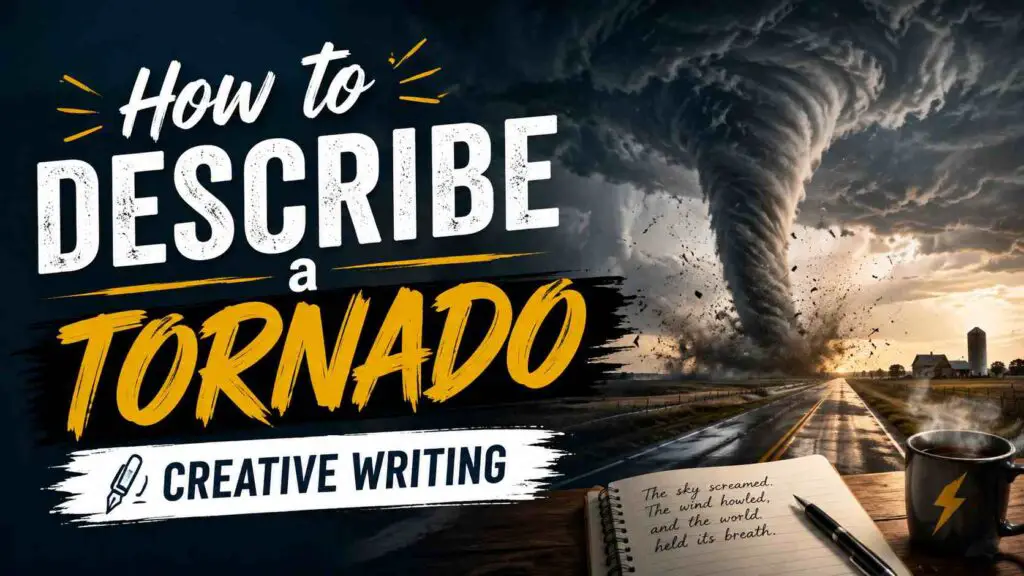
A tornado is nature’s most theatrical violence — a visible, walking storm that can erase one house and leave the next one’s porch swing swinging — and everyone who has survived one describes the same wrongness: the green sky, the freight-train roar, the ears popping, the minute of unbearable stillness first. For a writer, it’s a complete three-act structure delivered by the atmosphere: the eerie warning, the impossible event, the sorted debris. The craft is honoring what witnesses actually report instead of what disaster movies invented. Below are the techniques for describing a tornado in creative writing, each with examples you can study and adapt.
How to Describe a Tornado Creative Writing
#1. Write the Wrong Sky — the Warning Act
Tornado weather announces itself in wrongness — a sky gone green-black, air thick and electric, hail on a warm day, clouds rotating where clouds shouldn’t — and locals read these signs like scripture. The warning act is pure dread on the page: everything is still fine, and nothing is fine.
The sky went the green of old bruises, a color with no good history in it, and Dad stopped the mower mid-row and stood looking west with his whole body.
Hail came first — sudden, marble-sized, bouncing off June grass — ice from a sky that had been ninety degrees an hour ago, and nobody had to say what that combination meant.
The clouds weren’t drifting; they were turning — a slow, wide rotation like water deciding about a drain — and the county siren began its flat moan.
#2. Use the Stillness — the Held Breath Before
Survivors consistently report the pause — wind dying to nothing, birds silent, air pressure felt in the ears, a stillness that feels aimed — and that suspended minute is the scene’s best suspense. The world going quiet before its loudest event is a contrast no writer should waste.
The wind quit all at once, like a conversation stopping when you enter the room, and in the new stillness her ears popped and the dog began to whine at nothing.
Nothing moved. The wheat stood straight, the flag hung dead, and the air pressed on them like deep water — the whole afternoon holding its breath for something it could already see.
It was the quiet that sent Grandma to the cellar — not the sky, the quiet. “Storms shout,” she said, going down the steps. “It’s the whisper that means it.”
#3. Describe the Funnel as a Living Shape
The funnel itself is hypnotic and weirdly graceful — a rope, an elephant’s trunk, a wedge filling the horizon — snaking down, retracting, touching, and darkening as it eats soil and debris. Witnesses describe fascination as much as fear; characters should stare a beat too long, because people do.
It came down out of the wall cloud like a finger trying the ground — touch, lift, touch again — and where it finally committed, it went from white to brown, dressing itself in the field.
Far off it looked almost delicate, a gray rope swaying between cloud and prairie, and it was two miles wide of graceful and coming up the highway.
He knew he should run and stood filming instead, thumb shaking, because the thing was beautiful the way avalanches are beautiful — briefly, and at someone’s expense.
#4. Get the Sound Right — the Train That Never Arrives
The freight-train comparison is universal among survivors because it’s accurate — a deep, sustained roar that grows without passing — layered with hail rattle, cracking timber, and the house’s own groans. Use the cliché knowingly (characters reach for it because it’s true) and build the other layers around it.
Everyone said freight train and they were right, except a train passes — this roar only grew, a locomotive forever arriving, and under it the higher notes: glass, timber, the barn coming apart in paragraphs.
In the cellar the roar had a body to it, a sound they felt through the earth floor and the soles of their feet, and the house above them creaked like a ship taking a wave.
She would tell people afterward that the worst sound wasn’t the roar — it was the nail-by-nail shriek of the roof reconsidering its attachment to the house.
#5. Shelter the POV — Write It From the Cellar
The most honest tornado scene often sees nothing — a family in a cellar or bathtub, tracking the storm entirely by sound, pressure, and the shaking of the structure above — and blindness under a mattress outperforms any panoramic view. What passes overhead, guessed at in the dark, is terror at its purest.
They heard the storm arrive at the house the way you hear a stranger try the doors — porch, then windows, then everything at once — and the mattress over them became the whole sky.
In the dark under the stairs she counted her children by touch, twice, while the house above them was inventoried by something with no list.
The pressure dropped and every door in the house opened at once, politely, as if for a guest, and then the guest came in.
#6. Honor the Randomness of the Damage
Tornado damage is famously arbitrary — one house gone to its slab, the neighbor’s wind chimes intact; a truck in a tree, a china cabinet untouched — and that lottery logic is the disaster’s signature. Write the surreal juxtapositions truthfully; survivors catalog them for the rest of their lives.
The Hendersons’ place was a clean slab with a doormat on it. Next door, the Kowalskis’ tomatoes hadn’t lost a stake.
The storm had taken the roof, the truck, and the west wall, and left her grandmother’s teacups in their hutch, unchipped, facing the new view.
They found the tractor in the creek and a photograph from their kitchen eleven miles away, returned by a stranger who’d found it in her beans — the storm’s filing system, absurd and absolute.
#7. Write the Emergence — First Light on the New World
The scene after the cellar door opens is the story’s pivot — sunlight, absurdly, is common; the landscape rearranged; neighbors emerging and counting each other; the first names called across the debris. Survivors describe a specific quiet and a specific smell — rain, gas, pine sap from shattered trees — and the inventory begins.
They came up into sunshine — that was the obscene part, the sky rinsed blue and innocent — over a yard where the barn had been replaced by the view behind it.
The neighborhood emerged door by door, everyone counting everyone, names called across the wreckage and answered, each answer lowering someone’s shoulders an inch.
The air smelled of rain and split pine and, faintly, gas — and over it all lay that huge post-storm hush, the world with its ears still ringing.
#8. Let the Community Carry the Aftermath
Tornado stories end in casseroles and chainsaws — neighbors clearing each other’s trees, church basements filling with donations, the peculiar intimacy of strangers sorting your scattered letters from their hedges — and the response measures the community as the storm measured the buildings. Recovery scenes are where the disaster becomes a story about people.
By noon there were fourteen chainsaws running on their road, none of them hired, and his wife was crying for the first time all day — not about the roof, about the chainsaws.
Strangers kept arriving at the fence with their scattered belongings — a quilt, tax papers, the wedding album from a field two miles east — the county quietly reassembling their house from its pockets.
The church basement smelled of coffee and drywall dust for a month, and the sign-up sheet for the Hendersons ran to four pages before anyone told the Hendersons it existed.
#9. Skip the Disaster-Movie Version
Film has stocked the tornado with flying cows, outrun-it-in-a-truck chases, and heroes lashed to pipes — spectacle that survivors don’t recognize. The honest version is stranger and better: the stillness, the arbitrary damage, the sunshine after. Trust the witnessed details over the rendered ones; readers who’ve been in one will know which you chose.
The draft had him outrunning the funnel on the highway; the revision had him in the ditch like the radio said, hands over his head, learning what the word “helpless” was for.
Nothing flew majestically. Things simply left — the grill, the swing set, the neighbor’s boat — each one there and then not, like words deleted from a sentence.
Write the teacups, the note said, not the flying cow. The survivors always mention the teacups.
Closing Thoughts
A tornado hands you its structure: the green sky and the terrible stillness, the roar that never passes, the blind minutes under the mattress, the sunlit ruin, the chainsaws by noon. Follow that arc honestly and the scene nearly writes itself — the craft is mostly restraint, choosing the witnessed detail over the rendered spectacle. If you’ve never been near one, read survivor accounts until the patterns repeat: the ears popping, the doors opening politely, the teacups untouched. Those recurring details are the storm’s true signature, and putting them on the page is how readers in tornado country will know you did the work.