
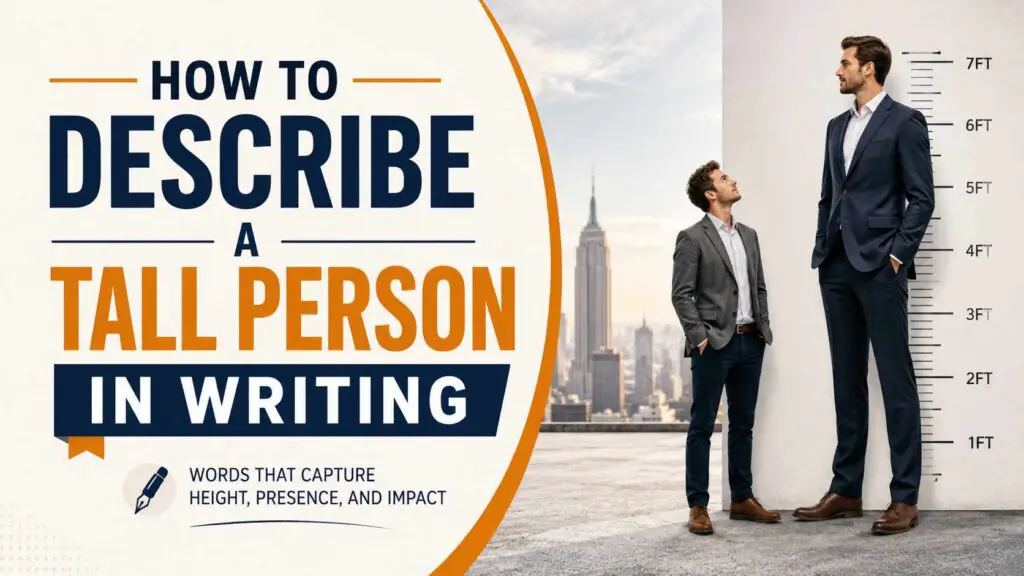
“He was tall” is a fact; what fiction needs is the experience of tallness — the doorframe duck, the furniture that fits wrong, the way a crowd reorganizes around height, the view from up there that nobody else in the scene has. Height is one of the few physical traits the whole world responds to constantly, which makes it a gift to any writer willing to describe the responses instead of the number. Below are the techniques for describing a tall person vividly, each with examples you can study and adapt.
How to Describe a Tall Person in Writing
#1. Skip the Number — Show the World Not Fitting
“Six-foot-five” is data the reader forgets in a page; the doorway duck, the airplane seat origami, the shower head at chest height are experiences the reader keeps. The world is built for average, and a tall character’s daily friction with it describes height better than any measurement.
He came through the cottage door the way tall men do — a small bow to the lintel, performed ten thousand times, thought about never.
The rental car took him a full minute to put on, folding in by sections, knees arriving at the steering wheel like unwelcome guests.
In every hotel shower she’d ever met, the water hit her collarbone, and she washed her hair in a kind of curtsy.
#2. Describe the Build That Carries the Height
Tall comes in kinds — the lanky assemblage of elbows, the towering bulk that fills doorways, the willowy drape, the storklike angularity — and the build determines whether the height reads as graceful, looming, or comic. Naming the kind of tall is the difference between a silhouette and a person.
He was built like scaffolding — long straight lines, visible joints, an architecture of elbows that chairs had never once accommodated.
Hers was the willowy sort of height, a tallness that draped and folded, all one continuous line from ankle to jaw.
He wasn’t just tall; he was tall in every direction, a man built to doorframe specifications, and rooms felt managed when he stood in them.
#3. Use Other People’s Necks and Eyes
Height is measured socially — the conversation partner tilting back, the child staring straight up, strangers’ eyes finding the tall person first in any room — and other people’s physical adjustments report the height continuously. The tall character is the one everyone else’s posture points at.
Talking to him at a party involved a slight backward lean, and long conversations left a crick — people budgeted their necks around him.
The toddler stopped mid-tantrum to stare up at her, head all the way back, mouth open, recalculating the size of people.
Every stranger’s gaze did the same journey — eyes, then up, a small elevator ride of surprise.
#4. Write the View From Up There
A tall point-of-view character has a literal perspective — seeing over crowds, reading the tops of shelves, knowing everyone’s roots and bald spots — and using that vantage in scenes makes the height functional rather than decorative. What the tall character can see that others can’t is free plot.
From her altitude the crowd had geography — she watched the argument start near the bar and route itself toward the door like weather she could forecast.
He spotted the lost kid from forty feet away over six rows of shelving, which is how he ended up employee of the month.
Concerts, parades, arrivals gates — she saw everything first, and had spent her whole life narrating for shorter friends: he’s here, she’s crying, they’ve got balloons.
#5. Choreograph How the Height Moves
Tall movement has signatures — the long stride companions jog to match, the unfolding from chairs in stages, grace or its complete absence amplified by the extra inches — and motion reveals whether the character owns their height or apologizes for it. An awkward tall walk and a commanding one are different biographies.
Walking anywhere with him was light cardio; one of his strides was a sentence and hers were punctuation, hurrying to keep up.
He got out of the armchair the way deck furniture gets put away — in stages, with occasional creaking.
She crossed the room like a tall ship coming into harbor, unhurried, certain of her clearances.
#6. Show the Posture That Height Taught
Years of tallness train the body — the habitual stoop from decades of doorways and low ceilings, the hunch adopted at thirteen to be less visible, or the full unapologetic vertical — and posture records the character’s whole relationship with being seen. The slouch is history; so is its absence.
He carried a permanent five-degree apology in his shoulders, installed sometime in middle school and never removed.
At sixty she still stood every inch of it, spine like a flagpole — her mother had forbidden slouching, and the prohibition had outlived her mother.
You could date the stoop like tree rings: the doorways of the old house, the bunks of the ship, forty years of leaning down to hear people.
#7. Write the Social Weather Around Height
Height generates constant social response — the same three jokes from strangers (“how’s the weather up there”), instant basketball assumptions, being asked to reach things by people who don’t say hello first — and the tall character’s practiced patience with all of it is characterization. So is the day the patience runs out.
“You must play basketball,” said the fourth stranger that week, and she gave him the smile she kept in the drawer for exactly this.
In the grocery store he was public infrastructure — three times an aisle, someone pointed at a top shelf, and he had never once minded, which said more about him than the height did.
She’d heard every weather-up-there joke by age twelve; what she’d never heard was anyone ask what it was actually like.
#8. Use Height as Presence — or Its Owner’s Burden
Tallness amplifies whatever it’s attached to — authority becomes command, shyness becomes conspicuous, anger becomes alarming even when quiet — and the gap between how the character feels and how their size makes others feel is rich territory. The gentle giant apologizing for scaring people is a whole arc in one trait.
He’d learned to sit down early in every meeting, having discovered at nineteen that his standing disagreement read as a threat he never intended.
All she wanted was to be unnoticed, and she was six-foot-one, and those two facts had been at war since seventh grade.
When the tall quiet man finally raised his voice, the room didn’t just listen — it braced.
#9. Set the Height Against Others for Instant Contrast
Height only exists in comparison, and staging the tall character against specific others — the partner a foot shorter, the crowd they breach like a mast, the one person who meets their eyes level and changes everything — makes the trait visible scene by scene. Contrast is the height’s native language.
Photos of the two of them always looked like a rescue in progress — her head at his sternum, his arm a roof over her.
Across the crowded terminal he was easy to track, a lighthouse moving through a harbor of heads.
Then the new hire walked in and looked at her dead level, eye to eye, and after twenty years of looking down at everyone she found she’d forgotten what to do with that.
#10. Retire “Towered” as the Only Verb
“He towered over her” is tall description’s single overworked verb, deployed until it means nothing and flattens every tall character into the same looming shape. The fixes are specificity and variety — loomed, unfolded, stooped, cleared, overlooked — or better, a concrete detail that makes the verb unnecessary.
He didn’t tower — towering takes intent — he just happened, upward, the way silos happen on a flat horizon.
The draft said “she towered over the desk”; the revision said the desk lamp lit her from below like a footlight, and the interview felt staged in her honor.
Find another verb, the note said — or cut the verb and tell me his shadow reached the far wall at noon.
Closing Thoughts
Ask any genuinely tall person and they’ll tell you: the height isn’t a number, it’s a thousand small negotiations a day — lintels, car seats, necks, jokes, the impossibility of an anonymous entrance. That’s the material. Write the negotiations and the reader will do the measuring themselves, and they’ll come out closer to the truth than any figure in feet and inches.