
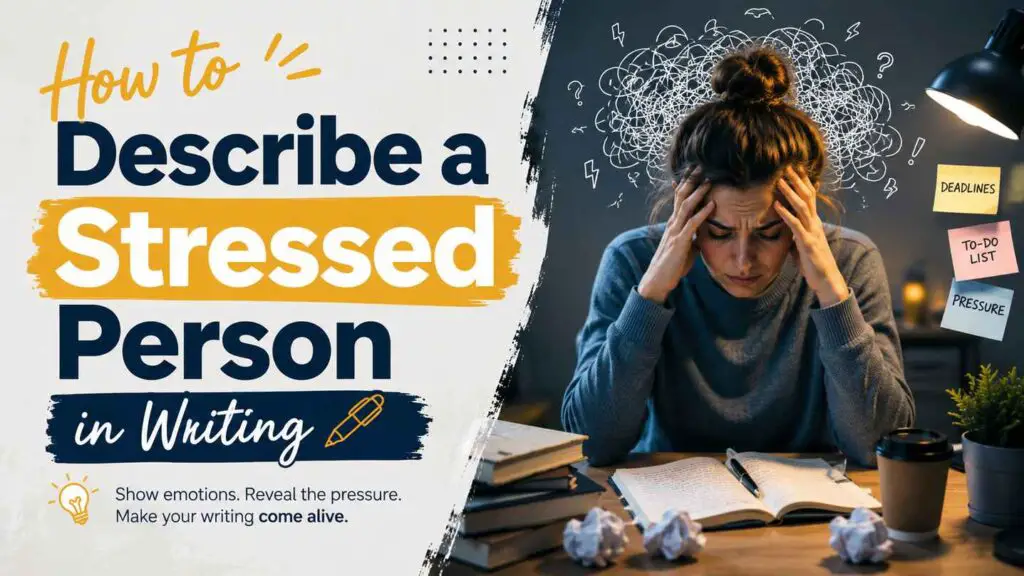
Stress is different from a single moment of nervousness — it’s cumulative, wearing a person down over days or weeks rather than flaring up and passing in an afternoon. Writing a genuinely stressed character means showing that accumulation: the sleep they’re not getting, the patience they’ve run out of, the small failures piling up because there’s simply too much to hold at once. Below are the techniques for capturing that sustained pressure convincingly, each with examples you can study and adapt.
How to Describe a Stressed Person in Writing
#1. Show the Body’s Cumulative Wear
Chronic stress shows up physically over time — tension held in the shoulders, a persistent headache, a face that looks tired even after rest. Describing this accumulated wear conveys sustained pressure more effectively than a single moment of visible strain.
Her shoulders had been up near her ears for so long she’d nearly forgotten what it felt like to drop them.
He’d had the same dull headache for two weeks straight, background noise he’d simply learned to work around.
She looked tired in a way that a full night’s sleep hadn’t managed to fix, not once, in longer than she could remember.
#2. Use Sleep and Appetite Disruption
Stress frequently disrupts basic routines — a character lying awake running through tomorrow’s problems, or losing interest in food entirely. Showing this disruption grounds the stress in concrete, physical consequence rather than abstract worry.
She lay awake running through the same three problems in a loop, no closer to solving any of them by two in the morning than she’d been at ten.
He’d stopped noticing whether he was hungry, eating on a schedule rather than an appetite.
Coffee had replaced actual sleep as her primary strategy, and even that was starting to stop working.
#3. Show Shortened Patience in Ordinary Interactions
A stressed character often snaps at small, unrelated frustrations — a slow line, a minor interruption — in a way that reveals how thin their patience has actually worn, even when the trigger has nothing to do with the real source of pressure.
She snapped at the barista over something so minor she felt embarrassed about it before she’d even reached the door.
He nearly lost his temper over a slow elevator, a reaction so disproportionate even he noticed it.
Her patience with the kids had thinned to almost nothing lately, and she hated herself a little more each time it showed.
#4. Use Physical Habits That Signal Overload
Stress often produces a specific, repeated physical habit — nail-biting that’s returned after years, jaw clenching, a hand pressed to the temple. These small, particular tells reveal accumulated pressure more convincingly than a direct statement of it.
She’d started biting her nails again, a habit she thought she’d left behind in college.
His jaw ached by the end of most days now, clenched so consistently he’d stopped noticing he was doing it.
Her hand found her temple automatically whenever the phone rang, bracing before she’d even answered it.
#5. Show a Character’s Environment Reflecting Their State
A stressed character’s surroundings often mirror their internal overload — an inbox with hundreds of unread messages, dishes piling up, a car that hasn’t been cleaned in months. This external evidence conveys stress without narrating it directly.
Her inbox had passed four hundred unread messages weeks ago, and she’d simply stopped trying to catch up.
Dishes had colonized most of the counter, a low-grade project he kept meaning to address and never quite getting to.
Her desk had disappeared entirely under a landscape of sticky notes, each one representing something she hadn’t gotten to yet.
#6. Track Stress Through a Character’s Mental Load
Showing a character mentally cataloguing everything they still need to do — during a conversation, at a moment of supposed rest — reveals how completely stress has occupied their thinking, even when they’re outwardly trying to be present elsewhere.
Even as she nodded along to the conversation, half her mind was still running through tomorrow’s deadlines in order of severity.
He tried to relax on the couch and found himself mentally drafting an email instead, unable to fully switch either mode off.
The list kept running in the background no matter what she was actually doing, an engine that never quite shut off.
#7. Use Small Failures to Reveal Accumulated Pressure
A stressed character forgetting something small but uncharacteristic — a birthday, a set of keys, an appointment — shows the cost of divided attention more convincingly than a direct statement about being overwhelmed.
She forgot her own sister’s birthday for the first time in her life, a fact that horrified her more than she let on.
He left his keys in the door twice that week, small failures that would have embarrassed him in any other season.
She missed the dentist appointment entirely, not because she forgot exactly, but because it had simply gotten crowded out.
#8. Show Others Noticing Before the Character Admits It
Having a friend, partner, or coworker point out visible stress a character has been minimizing themselves adds an outside perspective and can push a story toward a needed confrontation or moment of honesty.
“You haven’t stopped moving in an hour,” her roommate said, not as an observation so much as a quiet accusation.
His coworker asked, gently, when he’d last taken a full weekend off, and he genuinely couldn’t answer.
“You look exhausted,” her mother said, in a tone that made clear she’d noticed weeks ago and had simply been waiting for the right moment to say so.
#9. Avoid Generic “She Was Stressed” — Show the Specific Cost
The phrase states a condition without showing what it’s actually taking from the character. Naming the specific, concrete cost — the sleep, the patience, the forgotten birthday — gives the reader something real to measure the stress against.
It wasn’t just that she was stressed — she hadn’t slept more than five hours a night in three weeks.
Calling him stressed undersold it; he’d canceled dinner with his own parents twice in one month.
There was nothing generic about what it was costing her — she could list, specifically, everything she’d let slide to keep up.
Closing Thoughts
A stressed character convinces the reader when their pressure is shown as cumulative and specific — disrupted sleep, shortened patience, small uncharacteristic failures piling up — rather than stated once as a general condition. Let the environment and other characters reflect what the stress is actually costing, and reach past “she was stressed” for the concrete price of it, and readers will feel the weight your character is carrying instead of just being told it’s there.