
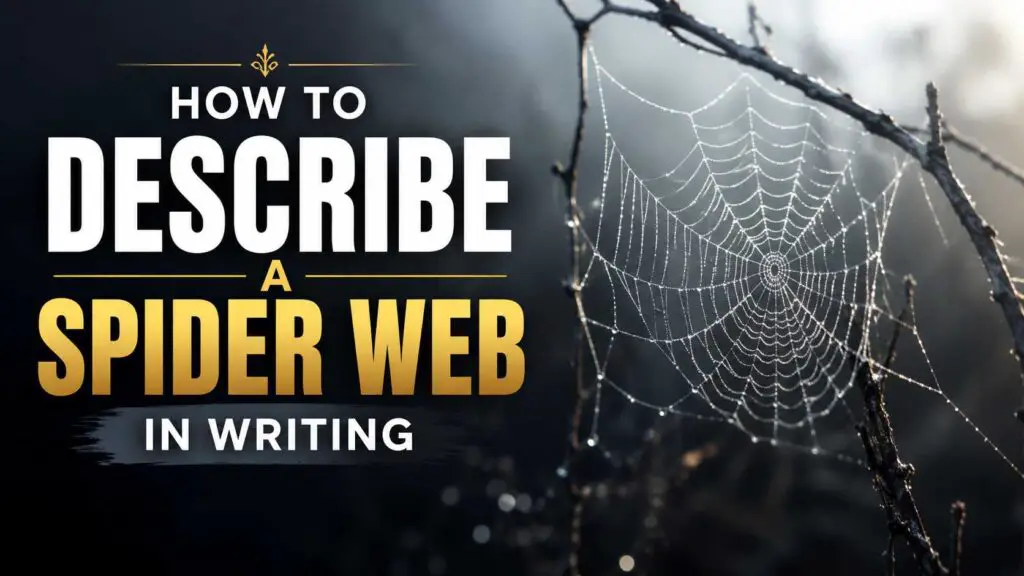
A spider web is one of the most versatile objects a writer can hang in a scene — it can mean abandonment, patience, artistry, menace, or fragile perfection depending entirely on the light you throw on it. The same structure that says “no one has opened this door in years” can, dewed and sunlit, stop a character mid-step with beauty. Below are the techniques for describing a spider web so it earns its place in the scene, each with examples you can study and adapt.
How to Describe a Spider Web in Writing
#1. Make It Visible Through Light
A web is nearly invisible until light finds it — backlit at dawn, silvered by a flashlight beam, flashing into existence when the sun drops to the right angle — and describing that sudden appearance is more dramatic than describing the object. The web that materializes out of empty air startles character and reader together.
The web didn’t exist until she moved her head, and then the whole doorway was suddenly strung with light.
His headlamp swept the cellar and the dark bloomed with silver rigging, dozens of webs the darkness had been hiding.
At that one hour of the afternoon, the sun came low through the barn slats and lit the web like a cathedral window nobody had commissioned.
#2. Honor the Engineering
An orb web is precision work — radial spokes anchored first, then the sticky spiral laid in patient rounds, the whole structure tensioned like a drum — and describing the architecture with respect gives the humble object real presence. Readers who’ve never looked closely at a web will look at the next one they pass.
Up close it was rigging, not lace — anchor lines thick as sewing thread, spokes trued to the center, the spiral wound with machine patience.
The web spanned four feet of stairwell, moored to banister, wall, and light fixture — a suspension bridge built overnight by something the size of a thumbnail.
She touched one anchor line and the whole structure answered, every strand trembling in ordered sympathy.
#3. Dress It in Dew, Dust, or Frost
What a web wears tells time and mood — morning dew strings it with glass beads, dust and lint mean long abandonment, frost turns it to white wire — and the dressing carries the scene’s emotional temperature. A jeweled web and a furred gray one are opposite omens built on the same frame.
Dew had beaded every strand overnight, and the web hung in the fence corner like a necklace display no jeweler could afford.
These webs were old — sagging gray hammocks of dust in every corner, less trap now than upholstery.
The frost had found the web first, printing it in white against the dark hedge, winter’s first engraving.
#4. Use the Face-First Walk-Through
Walking face-first into an unseen web is a universal, involuntary experience — the sudden clinging touch, the frantic swiping, the phantom crawling that lasts ten minutes — and it’s the fastest way to make a reader’s own skin participate in the scene. Nobody reads that moment without a shiver of recognition.
The web took him across the face at the shed door, and he performed the ancient dance — swatting, spitting, dignity gone in one second flat.
She felt the strands cling from eyebrow to chin, impossibly fine and impossibly everywhere, and for the next ten minutes every stray hair was a spider.
He walked through it in the dark and froze, one question suddenly urgent: where was the owner.
#5. Let the Web Report on the Room
Webs are evidence — across a doorway they testify no one has passed; in a mailbox, that no one writes; over machinery, that the work stopped — and using them forensically lets setting tell story without narration. A single web in the right location can carry a paragraph of exposition.
A web sealed the study door at every hinge, the house’s own notary confirming that no one had entered since the funeral.
Webs laced the truck’s side mirror to the fence — the definitive answer to how long he’d been gone.
The piano’s lid wore a web from corner to corner, and that told the visitor more about the marriage than the wife ever would.
#6. Show It as a Working Trap
A web is a hunting instrument, and showing it in operation — the strike of a fly hitting silk, the telegraphed vibration, the spider’s swift arrival — gives the pretty object its true, slightly chilling function. The wrapped bundles hanging in older webs are the record of the trap’s success.
The fly hit the web with a tiny violence, and the whole structure rang like a struck net; the spider was on it before the buzzing stopped.
Little silk parcels hung in the web’s lower stories, neatly wrapped, the pantry of a patient hunter.
Nothing about the web moved for an hour, which was the point — it was a machine made entirely of waiting.
#7. Deploy It as Metaphor — Carefully
The web is a ready-made metaphor for schemes, entanglements, and networks — so ready-made that “web of lies” has worn to nothing — and it pays to either refresh the comparison with specifics or run it in reverse. Sometimes the strongest move is letting a literal web quietly mirror the plot without the narrator pointing.
Her scheme had the architecture of the barn webs she’d watched as a girl: anchor points first, and every line leading, eventually, to the center where she sat.
He felt the tug from three states away — some strand he hadn’t known he was attached to, telegraphing that something had landed.
While the detective explained the conspiracy, a spider in the window corner went on building, and nobody in the room mentioned the resemblance.
#8. Skip the Halloween Shorthand
Cobwebs draped on everything is haunted-house wallpaper — decoration the reader’s eye slides past because a thousand stories have hung it there before. One precisely observed web, given light, location, and a fresh detail, unsettles or enchants far more than a ceiling full of generic gray swags.
It wasn’t the cobwebs in the corners that stopped her — every old house had those. It was the new web across the cellar door, glistening and finished, in a house that was supposed to be empty.
The set decorator’s version was gray festoons everywhere; the real abandoned house had exactly one perfect orb in the kitchen window, catching the morning like a signature.
Forget the drapery, the notes said. One web, described like a snowflake, will do more than forty yards of spook-house lace.
Closing Thoughts
Next time you pass a web strung in a fence corner, stop for a minute. Notice how it vanishes and reappears as you shift your head, which strand carries the tension, what the owner has wrapped and stored. That minute of looking is the whole craft — a web on the page is only ever as good as the attention you paid to one in the world.