
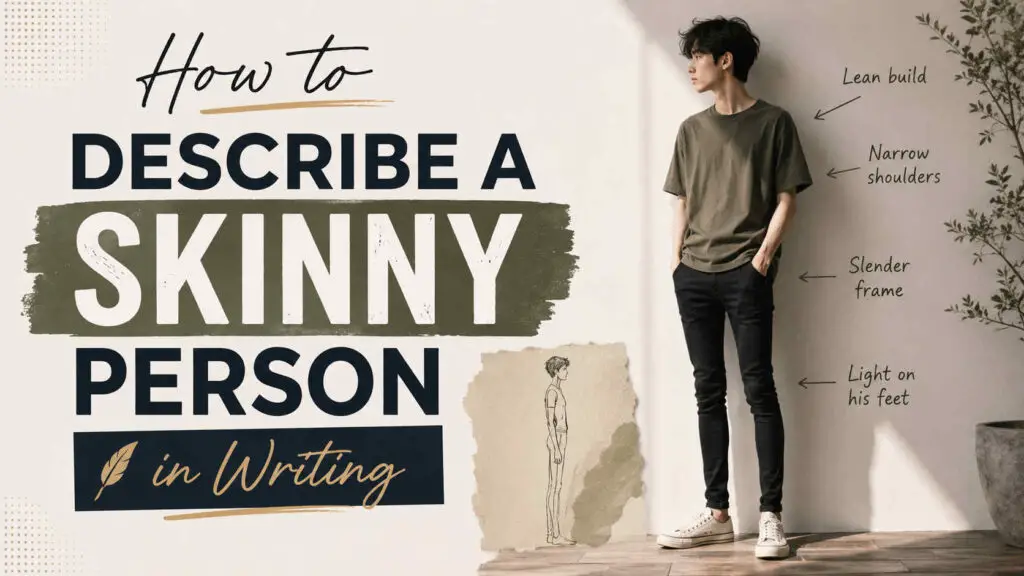
Skinny characters show up everywhere in fiction, but writers often lean on the same tired words — “thin,” “lanky,” “bony” — until the description loses all texture. A truly memorable skinny character isn’t just described; they’re shown through the details that surround them: the way fabric moves on their frame, the shape of their hands, the reactions of the people around them. The goal is to make the reader feel the physical reality of the character without turning the passage into a clinical inventory of measurements. Below are proven techniques for making a skinny character’s build feel vivid, specific, and alive on the page.
How to Describe a Skinny Person in Writing
#1. Compare Their Frame to Everyday Objects
Comparisons ground abstract descriptions in something the reader can picture instantly. Instead of simply stating a character is thin, comparing their limbs, torso, or posture to familiar objects — a broom handle, a wire hanger, a sapling bent by wind — gives the reader an immediate mental image and adds a touch of personality to the prose. The trick is choosing objects that also hint at the character’s nature: fragile things suggest vulnerability, rigid things suggest tension or discipline.
His arms looked like they’d been whittled from driftwood, all knots and no meat.
She moved through the doorway sideways, as if her body were a coat rack someone had forgotten to hang a coat on.
Under the oversized sweater, his shoulders formed a wire hanger, sharp and angular, waiting for something to fill them out.
#2. Show How Clothes Hang Off Them
Clothing is one of the most natural ways to reveal a thin build without directly commenting on the character’s body. Sleeves that swallow the hands, belts cinched to the last hole, waistbands that gather in folds — these details do the descriptive work indirectly, which usually reads as more sophisticated than a flat statement of size. This method also lets you weave in characterization, since the state of the clothing (too big, borrowed, safety-pinned) can say something about the character’s circumstances.
The jacket hung off her like it belonged to someone twice her size, the shoulder seams drooping past her arms.
He’d punched a new hole in his belt last month, and already the leather bunched up like an accordion at his hip.
Her jeans gathered in soft folds at the ankle, cinched tight with a shoelace where a belt should have been.
#3. Highlight Visible Bone Structure
Nothing communicates thinness as directly as the visibility of bones beneath skin — collarbones, ribs, knuckles, the ridge of a spine. This technique works best in moments of physical intimacy or vulnerability, such as an embrace, an illness, or a change of clothes, when the reader is naturally positioned to notice such details. Use it sparingly, though; overused, it can tip into gratuitous or uncomfortable territory rather than simply descriptive.
When she hugged him, his shoulder blades pressed into her palms like the wings of a folded bird.
His collarbones jutted out above the neckline of his shirt, sharp enough to rest a coin on.
Each knuckle stood out on his hand, a small mountain range under thin, papery skin.
#4. Describe the Way They Move
Movement reveals build just as effectively as static description, and it has the added benefit of keeping the scene active rather than pausing for a description. A thin character might move quickly and lightly, seem to fold into chairs, or take up little space when walking through a crowd. Focusing on motion lets you show the physical trait while the story keeps progressing.
She slipped between the market stalls without turning sideways once, as if she simply wasn’t there to bump into.
He folded himself into the armchair like a jackknife closing, all elbows and knees finding their place.
Her footsteps barely registered on the porch boards, light as a bird testing a branch.
#5. Use Other Characters’ Reactions
Sometimes the most powerful description isn’t the physical detail itself but how other characters respond to it — a mother urging another plate of food, a doctor frowning at a chart, a friend joking about needing to feed them up. This indirect method externalizes the trait through dialogue and behavior, which often feels more natural than narrated physical description, especially in first-person or tightly limited points of view.
“Have you eaten anything today?” his aunt asked, the same question she’d asked every day that week.
The tailor took one look at him and sighed. “There’s nothing here to take in. I’ll have to remake it from scratch.”
“You’re disappearing on me,” she said, tugging at the loose fabric bunched at his waist.
#6. Focus on Hands and Wrists
Hands and wrists are small, expressive details that can carry an outsized amount of descriptive weight. A wristwatch that slides freely, fingers that look too long for the hand, veins visible beneath thin skin — these specifics feel observational rather than clinical, as though the narrator has actually studied the character up close. This technique works particularly well for close third-person or first-person narration.
His watch spun loosely around his wrist, the strap punched with an extra hole that still wasn’t enough.
Her fingers looked too long for her hand, like a pianist’s stretched thin by years of scales.
Blue veins traced faint rivers across the back of his hand, visible even in dim light.
#7. Contrast Them With Someone Else
Placing a thin character beside someone of a different build is an efficient way to communicate size without a single descriptive sentence devoted to it. The contrast does the work implicitly, through comparison, and it can also carry emotional or narrative weight — a big brother protecting a small one, a soldier towering over a starved prisoner, a dancer beside her sturdier understudy.
Next to his brother’s broad frame, he looked like an afterthought, a sketch someone had forgotten to finish shading in.
She stood a full head shorter than her sister and half as wide, a shadow cast by someone else’s light.
The bodyguard’s forearm was thicker than the boy’s entire thigh.
#8. Reference Their Eating Habits or Appetite
Weaving in small, specific details about how a character eats — pushing food around a plate, finishing meals in a few bites, forgetting to eat entirely — offers insight into their build while also hinting at possible causes, whether it’s a fast metabolism, stress, illness, or neglect. This approach adds depth, since eating habits can suggest backstory without any exposition.
He ate like the meal was an inconvenience, three bites and a shrug before pushing the plate away.
She could count on one hand the number of full meals she’d had that week, and still have fingers left over.
By the time the others were on seconds, he’d barely made a dent in his first plate, already looking for a reason to leave the table.
Closing Thoughts
The best descriptions of a skinny character rarely rely on a single adjective doing all the heavy lifting. Instead, they layer in small, specific details — a hanging sleeve, a visible collarbone, a worried glance from another character — until the reader forms a vivid picture without ever feeling lectured to. Mix and match these techniques depending on the scene, the point of view, and the emotional tone you’re going for, and the physical trait will start to feel like a natural, integrated part of the character rather than a box you had to check off.