
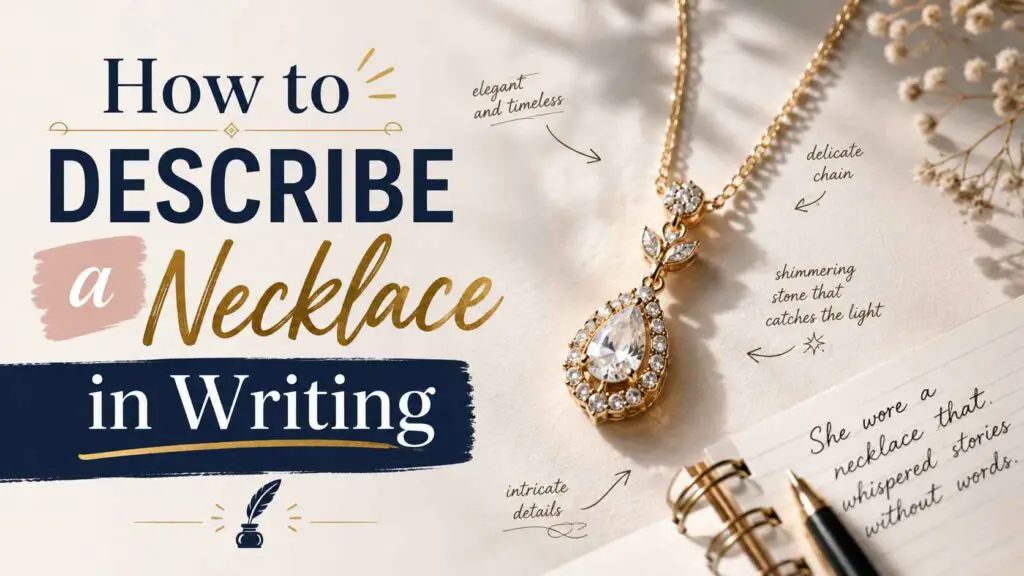
Of all jewelry, the necklace is the most intimate and the most public at once — worn at the throat, over the pulse and the breastbone, visible to everyone and touching skin all day. It’s the piece most often given rather than bought for oneself, most often fastened by someone else’s hands, and most often reached for in nervousness, prayer, or grief. That combination — display, touch, and gift — makes a necklace one of fiction’s richest small objects. Below are the techniques for describing a necklace in writing, each with examples you can study and adapt.
How to Describe a Necklace in Writing
#1. Place It on the Body — the Throat’s Geography
A necklace is defined by where it sits — choker-tight at the throat, a pendant at the collarbones’ notch, a long chain reaching the sternum, beads lying along the neckline’s edge — and the position sets its character: armor, ornament, or secret. Describe the piece against the anatomy, and it stops floating in a jewelry-box void.
The pendant found the notch between her collarbones and lived there, rising slightly when she laughed, a small tenant with the best view in the house.
The chain was long enough to disappear under the work shirt, which was the point — the necklace was for her sternum to know about, not the sales floor.
The choker sat close as a held breath, and she was aware of it at every swallow — jewelry you wore the way you wear a decision.
#2. Write the Clasp Moment
The necklace’s signature scene is fastening — head bowed, hair lifted, someone else’s fingers working the tiny clasp at the nape — an act of service and closeness no other jewelry requires. Who fastens whose necklace, and how their hands behave doing it, is intimacy choreographed by hardware.
She lifted her hair and bowed her head, and he managed the clasp on the third try, his hands suddenly twice their size, and neither of them breathed like it was nothing.
Her granddaughter’s small fingers fought the clasp for a full minute, tongue out, and the old woman stood statue-still at the mirror, being dressed for the wedding by the future.
Forty years of mornings, and he had fastened it every one of them — the clasp his first small work of the day, her lifted hair the signal that the day could start.
#3. Open the Locket — the Necklace That Carries Cargo
Pendants and lockets are containers — a photograph trimmed small, a curl of hair, a saint, a vial, initials worn smooth — and the cargo converts ornament into reliquary. What hangs at a character’s chest all day is what they’ve chosen to keep over their heart; open it for the reader at the right moment.
The locket held a photograph trimmed with nail scissors to fit — a man’s face cut down to an oval, the rest of that day cut away with the borders.
Inside was a curl of baby hair, fine as thread, from a head that was now fifty-three and balding and calling her every Sunday.
The saint on the medal had been rubbed featureless by three generations of worried thumbs, doing his patient work anonymously now.
#4. Use It as the Hand’s Home — the Nervous Reach
Necklaces are touched all day — the pendant slid along its chain in thought, gripped in fear, worried during hard phone calls, the beads counted like a rosary whether they are one or not — and the reach for the throat is one of the body’s most legible tells. A character’s hand at their necklace is a mood report.
Through the whole diagnosis her hand was at the small gold cross, not praying exactly, just holding the rail.
She ran the pendant back and forth along its chain while she listened, a small zipper of thought, and her staff could gauge the meeting’s trouble by the speed.
When the phone call turned, his thumb found the dog tags through his shirt — an old address, checked the way you check for keys.
#5. Stage the Gift — Given, Refused, Returned
A necklace is the gift jewelry par excellence — the velvet box shape everyone recognizes, the fastening that follows acceptance, the piece worn once to please and never again, the one never taken off from that day forward. How often the gift is subsequently worn is a message its giver reads obsessively.
She wore his necklace exactly twice a year — his birthday and their anniversary — a schedule he had mapped precisely and never once mentioned.
The girl wore the drugstore heart from her father every single day of fourth grade, including picture day, over the dress her mother had planned around it in vain.
The necklace came back in a padded envelope with no note, and its silence, arranged in tissue paper, said the whole thing.
#6. Break It — the Scatter Scene
A necklace’s failure is spectacular — the string of beads letting go and hailing across a floor, the chain snapped in argument or grabbed in violence, the frantic hands-and-knees harvest afterward — and the scatter is drama, comedy, or omen depending on the room. Pearls bouncing down church steps is a whole scene pre-loaded.
The string gave at the second dance, and forty years of pearls went across the parquet in a soft white hail, and the whole reception dropped to its knees laughing and harvesting.
He grabbed her wrist and caught chain instead; it parted with a tiny sound like a decision, and the pendant hit the floor between them and stayed there, being looked at.
For weeks after, beads kept surfacing — under the stove, in a boot, one in the dog — the necklace conducting its long diaspora through the house.
#7. Pass It Down — the Necklace as Lineage
Necklaces descend through families with ceremony — clasped onto a bride by her mother, promised across generations, photographed at every throat it has occupied — and because it’s worn at the heart-line, the inheritance reads as blessing or burden more than property. The same necklace on a fourth throat is a dynasty in one image.
There were photographs of the garnets at four different throats — 1912, 1948, 1979, and today — the faces changing above them, the stones keeping their one dark opinion.
Her mother fastened it, as her mother had fastened it, and in the mirror the bride watched the whole line of them assemble briefly at her collarbones.
The necklace was promised to Ana, which everyone knew, and it sat in its box through six family Christmases like a small unexploded will.
#8. Avoid the Display-Case Description
“A beautiful diamond necklace glittered at her throat” is a caption, not a description — no weight, no history, no hand reaching for it. The repair is the necklace’s three native registers: place it on the body, give it cargo or provenance, and let a hand touch it once. A necklace that is only looked at isn’t finished being written.
The draft had diamonds glittering at her throat; the revision had her checking the clasp twice at the taxi window — borrowed, insured, and terrifying — and the necklace finally entered the story.
Not “a lovely gold chain” — say it had worn faint and thin at the back from fifty years of clasps, the necklace’s own neck bowed by service.
Give it one of three things, the note said — a body, a cargo, or a hand — and ideally all three by the last page.
Closing Thoughts
The necklace earns its special place among jewelry through three facts no other piece shares: it lies over the pulse, it usually arrives as a gift, and it takes a second pair of hands to put on. Every technique above is one of those facts unfolded — the throat’s geography, the clasp moment, the locket’s cargo, the nervous reach, the scatter, the lineage of throats. Write any two and your necklace will outperform a page of glitter. And if the scene allows it, always write the clasp: heads bow for it, hair is lifted for it, and readers hold their breath for it, every single time.