
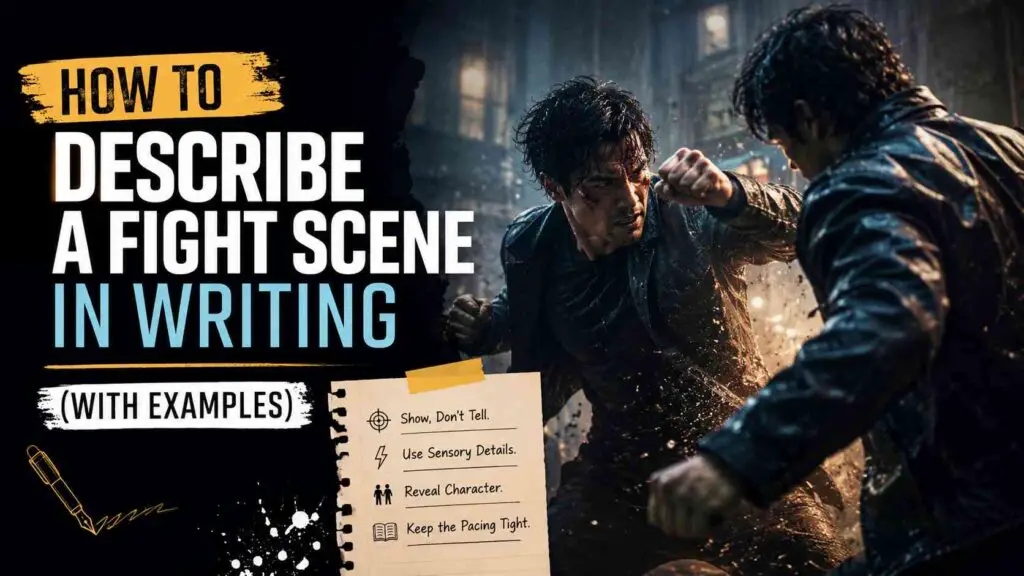
A fight scene lives or dies on precision. Readers can tolerate almost any amount of violence if they can track who’s hitting whom and why it matters, but they lose interest fast in a blur of generic punches thrown by characters who could be anyone. The best fight writing treats choreography, pacing, and stakes as equally important as the blows themselves. Below are the techniques for writing fight scenes that stay clear, visceral, and emotionally grounded, each with examples you can study and adapt.
How to Describe a Fight Scene in Writing
#1. Choreograph Before You Write
Working out the physical geography of a fight before drafting it — who’s positioned where, what’s within reach, how the space constrains movement — prevents the confusing continuity errors that plague rushed action writing. A clear mental map lets you describe only what matters instead of everything that’s technically happening.
He’d backed himself into the corner between the bar and the pool table without meaning to, and now there was nowhere left to retreat to.
She kept the desk between them deliberately, circling it whenever he tried to close the distance.
The alley was too narrow for either of them to really swing, which was the only reason he was still standing.
#2. Use Short, Percussive Sentences for Impact
Sentence length can mimic the rhythm of a fight itself — short, clipped sentences during the exchange of blows create urgency and speed, while longer sentences slow things down for a pause or a strategic reset. Matching syntax to pace makes the fight feel kinetic on a level readers register unconsciously.
He swung. She ducked. The bottle shattered against the wall behind her.
A fist. A block. Another fist, this one landing.
He caught his breath in the half-second she gave him, circling wide, buying time neither of them could really afford.
#3. Ground the Fight in a Specific Setting
A fight that could be happening anywhere reads as generic. Anchoring the action in a specific, textured location — a cramped kitchen, an icy parking lot, a crowded subway platform — gives the choreography obstacles and opportunities that make the scene feel unrepeatable.
The kitchen counter dug into his back with every shove, cutlery rattling in the drawer beside his hip.
Ice made every step a gamble, and neither of them could afford to plant their feet for long.
The platform was too crowded to swing freely, forcing them both into something closer to a shoving match than a real fight.
#4. Show the Body’s Physical Cost in Real Time
Fights are exhausting, and showing that exhaustion accumulate — burning lungs, shaking arms, a grip growing weaker — keeps the scene physically honest. A fighter who’s still moving with total precision three minutes in reads as unconvincing rather than impressive.
Her arms had started to shake by the third exchange, adrenaline the only thing still holding her fists up.
His lungs burned with every breath now, each one louder than he wanted his opponent to hear.
Her grip on the pipe had gone slick with sweat, and she wasn’t sure how many more swings she had left in her.
#5. Use Sensory Detail Beyond Sight
A fight is loud, painful, and often smells specific — sweat, blood, cheap cologne, spilled beer. Layering in sound, smell, and touch alongside the visual choreography makes the reader feel present in the scene rather than watching it from a distance.
The crunch of cartilage under his fist was audible even over the noise of the crowd.
She could taste copper before she registered where the blood was actually coming from.
Someone’s cologne hung thick over the whole scuffle, absurdly, cutting through everything else happening in that alley.
#6. Vary Rhythm Between Action and Beats of Thought
Constant fast-paced action can numb a reader over a long fight scene. Interrupting the physical exchange with brief flashes of strategy or fear gives the pacing texture and reminds the reader there’s a thinking person behind each blow.
He had maybe two good hits left in him, and he needed to make them count.
She realized, somewhere in the middle of it, that she was actually going to lose this one.
If he could just get to the door, none of the rest of this would matter.
#7. Show a Fighter’s Strategy, Not Just Blows
A fight described purely as a sequence of hits quickly becomes repetitive. Showing tactical decisions — feints, footwork, exploiting an opponent’s weak side — adds intelligence to the scene and characterizes the fighter through how they think under pressure.
She feinted left, waited for him to bite, and put everything into the right hook instead.
He’d noticed the limp early and made a point of staying on that side for the rest of the fight.
She backed toward the stairs on purpose, betting he wouldn’t think to check his footing until it was too late.
#8. Use the Environment as a Weapon
Objects in the setting — a chair, a broken bottle, an unstable railing — give a fight scene unpredictability and specificity beyond fists alone. Using the environment also reinforces the earlier work of grounding the fight in a real, textured location.
He grabbed the barstool without thinking and swung it in one motion, more instinct than plan.
She shoved him into the bookshelf, and the avalanche of hardcovers did more damage than her fists had managed all fight.
The railing gave way under his weight at exactly the wrong moment, and suddenly the fight had a whole new problem.
#9. Track the Emotional Stakes Alongside the Physical Ones
The most memorable fight scenes matter beyond who wins — they carry emotional weight tied to the relationship between the fighters or what’s at risk beyond the immediate violence. Reminding the reader of that stake mid-fight keeps the scene from becoming purely mechanical.
It wasn’t really about the money anymore, not after what he’d said about her sister.
She hated that some part of her still didn’t want to hurt him, even now, even after everything.
He kept thinking, absurdly, of every birthday they’d spent together, right up until the moment she hit him again.
#10. Know When to Cut Away
Not every fight needs a blow-by-blow account. Sometimes cutting away at the height of the action, or summarizing the ending quickly, serves the pacing better than exhaustive detail — especially when the emotional aftermath matters more than the mechanics of how it ended.
She didn’t remember the last punch landing. She just remembered the silence that came after it.
By the time the police arrived, it was already over, and nobody in the room seemed eager to explain how.
The rest of the fight passed in a blur he’d never fully be able to reconstruct, not even for himself.
Closing Thoughts
A fight scene earns its place on the page when it’s choreographed with clarity, paced with intention, and tied to stakes that matter beyond who’s left standing. Ground the action in a specific setting, let the body pay a visible cost, and know when restraint serves the scene better than another blow, and your fights will land with real weight instead of blurring into generic violence.