
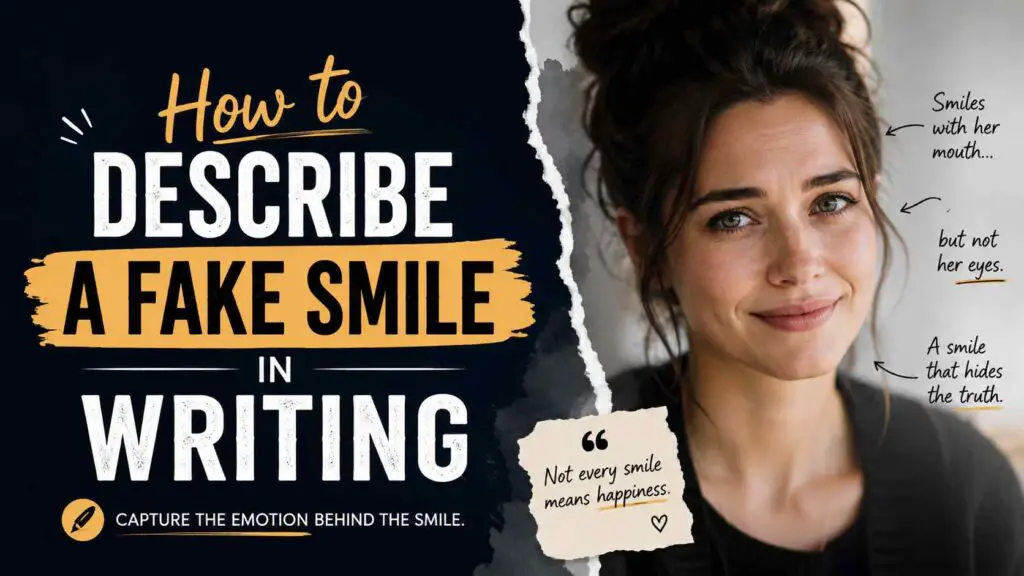
A fake smile is one of the most efficient tools a writer has for showing a gap between what a character feels and what they’re willing to let others see. The trouble is that “her smile didn’t reach her eyes” has been used so often it now reads as a shortcut rather than an observation. A convincing fake smile needs more — timing, effort, the specific emotion it’s covering for. Below are the techniques for writing one that actually lands, each with examples you can study and adapt.
How to Describe a Fake Smile in Writing
#1. Show the Mismatch Between Mouth and Eyes
A genuine smile engages muscles around the eyes as much as the mouth, and a fake one often fails to do so. Describing that specific disconnect, rather than naming it directly, lets the reader notice the falseness the way another character would.
Her mouth curved upward on cue, though nothing above her cheekbones seemed to have gotten the message.
His eyes stayed flat and watchful while the rest of his face performed something closer to warmth.
She smiled with her whole mouth and none of the rest of her, a trick he’d learned to spot years ago.
#2. Use Timing to Reveal Insincerity
A smile that arrives a beat too late, or one that snaps into place too quickly and too perfectly, reads as rehearsed rather than spontaneous. Timing often gives away a fake smile more reliably than its shape does.
The smile arrived half a second after it should have, the delay just long enough to notice.
It snapped into place the instant the camera turned toward her, too fast to have been anything but rehearsed.
He held it a beat too long after the joke had finished landing, like he’d forgotten to take it down.
#3. Describe the Effort Behind the Expression
A fake smile often costs a character something to maintain — a slight strain around the mouth, a jaw held tighter than it needs to be. Showing that effort makes the performance visible without requiring the narrator to state outright that the smile is false.
She could feel the effort of it in her cheeks by the end of the reception, muscles she hadn’t realized she was working so hard.
His jaw stayed tight the entire time, the smile clearly costing him more than it was giving back.
She held the expression like a weight she’d been asked to carry across the room without setting down.
#4. Contrast the Smile With the Rest of the Face
Placing the smile beside a detail from elsewhere on the face — a furrowed brow, tension at the temples, a paleness that doesn’t match the cheerful expression — highlights the performance through contradiction. This works especially well when the rest of the face is quietly telling the truth.
The smile was warm enough, but a small line had appeared between her eyebrows that no amount of cheer was covering.
He’d gone slightly pale under the friendly expression, as if the smile were the only thing holding the rest of his face together.
Her smile said one thing; the white-knuckled grip on her purse strap said something else entirely.
#5. Use a Fake Smile to Mask a Specific Emotion
A fake smile means something different depending on what it’s covering — grief, anger, humiliation, fear all wear the same expression differently. Tying the performance to a specific underlying emotion gives it narrative weight beyond a generic note of dishonesty.
She smiled through the toast to keep from crying in front of people who hadn’t earned the right to see it.
His smile widened the angrier he got, a habit that had confused people his entire life.
She kept smiling through the humiliating question, mostly to deny the room the satisfaction of watching it land.
#6. Show Other Characters Seeing Through It
Having another character notice and react to the falseness of a smile — a raised eyebrow, a pointed question, a quiet moment of solidarity — externalizes what the reader has already suspected. This validation adds relational depth and can carry subtext dialogue doesn’t need to state.
Her best friend caught her eye across the room and didn’t buy the smile for a second.
“You don’t have to do that with me,” he said quietly, and she let the smile drop like something she’d been holding up too long.
Nobody else at the table noticed, but her mother had been reading that particular smile since she was six years old.
#7. Use the Smile’s Sudden Appearance or Disappearance
A smile that snaps on the instant someone turns to look, or vanishes the moment they turn away, reveals its performative nature through its dependence on an audience. This behavior implies the smile was never really about feeling anything at all.
The smile vanished the second the door closed behind the last guest, gone as if it had never been there.
It reappeared instantly when someone called her name, a switch flipped so fast he almost missed the gap.
She dropped the expression the moment she turned toward the window, her face settling into something far more honest.
#8. Track a Fake Smile Cracking Under Pressure
A fake smile doesn’t have to hold for an entire scene — showing it falter, twitch, or briefly fail under repeated pressure adds tension and reveals exactly how much a character can withstand before the performance breaks down.
The smile held through the first two questions and faltered visibly on the third.
It twitched at the corner, just once, the only sign that the joke had actually cost her something.
By the end of the toast, the smile had thinned into something closer to a grimace he no longer bothered disguising.
#9. Use Fake Smiles in Professional or Social Performance
Certain settings — customer service, networking events, family gatherings — practically require a performed smile, and showing a character deploy it as a professional tool reveals something about the social pressures they’re navigating. This context gives the fake smile a systemic quality rather than a purely personal one.
She had a specific smile reserved for difficult customers, one that had taken years of practice to perfect.
He shook the hand and delivered the smile that came standard with every introduction at these events.
The whole family had the same holiday smile, passed down like a recipe nobody had ever actually enjoyed making.
#10. Avoid Overused Phrases Like “Didn’t Reach Her Eyes”
The phrase has appeared in enough fiction that it now reads as a placeholder rather than an actual observation. Reaching for a more specific, unexpected physical detail keeps a fake smile from becoming an interchangeable stock description.
It wasn’t that the smile failed to reach her eyes — it was that her eyes seemed to be doing something else entirely, some private calculation of their own.
Calling it forced undersold it; it looked less like a smile than a decision he’d made about his face.
There was nothing wrong with the smile itself, exactly — it just looked like something borrowed for the occasion and not yet returned.
Closing Thoughts
A fake smile convinces the reader when it’s built from specific, physical evidence — mismatched timing, visible effort, a contradiction elsewhere on the face — rather than a single worn-out phrase. Tie it to the emotion it’s actually covering, and let it crack under enough pressure, and even a small, polite smile can carry real dramatic weight.