
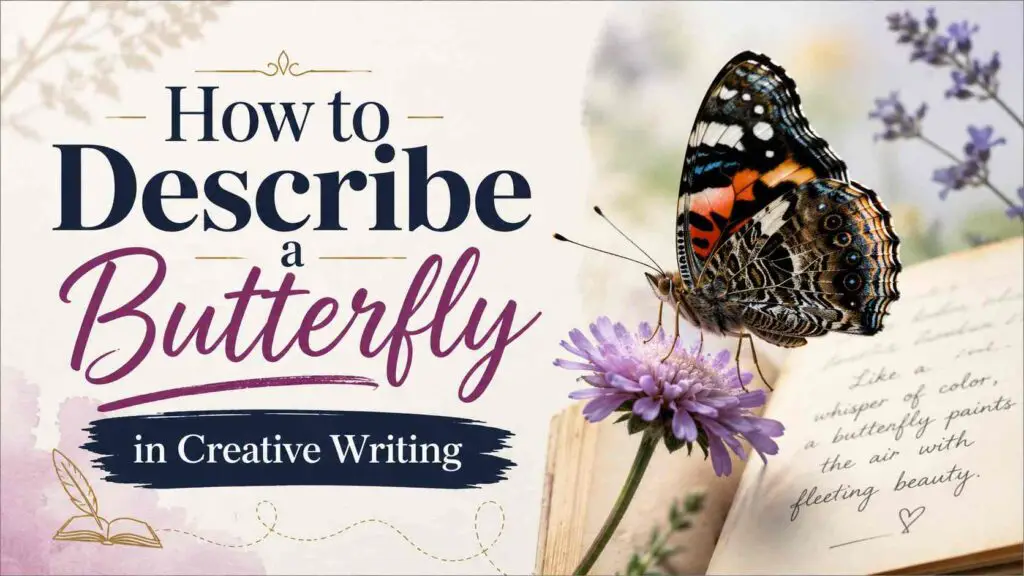
Butterflies show up so often as a shorthand for beauty or transformation that it’s easy to reach for the symbol without actually describing the insect. A butterfly rendered with real specificity — its exact markings, its unpredictable flight, the particular way light catches its wings — does far more work than the word alone, whether it’s meant to carry symbolic weight or simply exist as part of a vivid setting. Below are the techniques for describing a butterfly with precision, each with examples you can study and adapt.
How to Describe a Butterfly in Creative Writing
#1. Use Specific Species and Markings, Not Generic “Butterfly”
Naming the exact species — monarch, swallowtail, cabbage white — and its distinctive markings carries far more visual information than the generic word “butterfly” ever could. This specificity also lets a writer choose associations deliberately, since different species carry different cultural and visual connotations.
A monarch drifted past, its black-veined orange wings unmistakable even at a distance.
A swallowtail landed on the fence post, its wings edged in a blue so dark it looked almost black until the sun caught it.
Cabbage whites scattered across the garden in loose, unhurried clusters, small and plain against the brighter flowers.
#2. Describe the Flight Pattern, Not Just the Wings
A butterfly’s movement — erratic, unpredictable, drifting rather than direct — is often more distinctive than its coloring. Capturing that specific, halting flight pattern brings the insect to life on the page in a way a static description of its wings alone can’t.
It moved in loose, uneven loops, as if it kept changing its mind about where it was actually headed.
It dropped suddenly toward the flowerbed, then rose again just as abruptly, following a logic only it seemed to understand.
It drifted rather than flew, riding the breeze more than fighting it.
#3. Use Color and Light Together
A butterfly’s wings often shift in appearance depending on the angle of light — iridescent from one direction, flat and dull from another. Describing this interaction between color and light captures a quality unique to certain wing structures that a static color description misses.
Its wings flashed an impossible blue when it caught the light just right, then dulled to gray the instant it turned.
The orange seemed to deepen and glow as the sun hit it directly, then faded back to something more ordinary in the shade.
Sunlight passed straight through the thinnest part of its wing, briefly lighting it up like stained glass.
#4. Show the Butterfly Interacting With Its Environment
A butterfly landing on a specific flower, a shoulder, or a puddle of mud grounds it in a real setting rather than presenting it as a floating, abstract symbol. This interaction also gives the moment a concrete visual anchor.
It settled on the edge of a puddle, wings folded, drawing minerals from the mud with a patience that seemed almost deliberate.
It landed briefly on her shoulder, weightless, gone again before she’d even had time to look down.
It worked its way methodically across the lavender, pausing at each cluster just long enough to matter.
#5. Use a Butterfly as a Symbol Without Overexplaining It
If a butterfly is meant to carry symbolic weight — transformation, fragility, a departed loved one — letting the image do that work quietly, without an explicit statement of meaning, keeps the moment from feeling heavy-handed. Trust the reader to make the connection.
A single monarch circled the headstone twice before drifting off toward the tree line, and nobody at the funeral mentioned it out loud.
It emerged from the chrysalis slowly, wings crumpled and useless at first, nothing like what it would become in an hour.
The butterfly landed on the closed casket for exactly as long as it took someone to notice, and then it was gone.
#6. Capture the Stillness of a Landed Butterfly
A butterfly at rest, wings closed or slowly opening and closing, offers a different kind of description than one in flight — quieter, more detailed, closer to portraiture. This stillness gives a writer room to describe fine detail a moving insect wouldn’t allow.
It sat motionless on the leaf, wings slowly opening and closing in a rhythm that seemed almost like breathing.
Its wings stayed folded upright, showing only the pale, mottled underside, nothing like the color it had flashed a moment ago.
It stayed perfectly still on the windowsill for nearly a minute, as if gathering the strength to move again.
#7. Use Texture and Fragility in Close Description
A butterfly’s wings are dusted with tiny, powdery scales that rub off at the slightest touch, and describing that fragility — a residue left on a fingertip, a torn edge — adds a tactile dimension most visual description skips entirely.
A faint dust came off on her fingertip where the wing had brushed against it, fine as pollen.
One wing had a small tear along the edge, evidence of some close call it had apparently survived.
It felt impossibly light against his palm, barely a weight at all, gone the second he exhaled.
#8. Show a Character’s Reaction to Noticing One
How a character responds to spotting a butterfly — pausing mid-conversation, reaching for a phone to photograph it, ignoring it entirely — reveals something about their state of mind or personality, and gives the moment narrative purpose beyond pure description.
She stopped mid-sentence, distracted entirely by the monarch that had just landed on the table between them.
He barely glanced at it, too preoccupied to notice something that, on any other day, might have made him smile.
She held perfectly still, holding her breath, as if the wrong movement might scare it off before her daughter got to see it.
#9. Avoid Overused Metaphors — Transformation, Freedom, etc.
Butterflies have been used as a shorthand for transformation and freedom so consistently that leaning on those associations directly can feel like a cliché rather than an insight. Grounding the description in specific, unexpected physical detail instead keeps the image from feeling borrowed.
She resisted the urge to call it a metaphor for anything. It was just a butterfly, and it was, on its own, enough.
Nobody said the word “transformation” out loud, though it hung there anyway, unavoidable and a little embarrassing.
It wasn’t freedom she thought of, watching it go. It was just a small, specific relief that it had made it that far at all.
Closing Thoughts
A butterfly earns its place on the page when it’s rendered with the same specificity as any other detail — a named species, a particular flight pattern, a texture that rubs off on skin — rather than treated as a shorthand symbol. Let the image carry its meaning quietly if it needs to carry one at all, and even a brief glimpse of a butterfly can feel vivid and unmistakably real.