
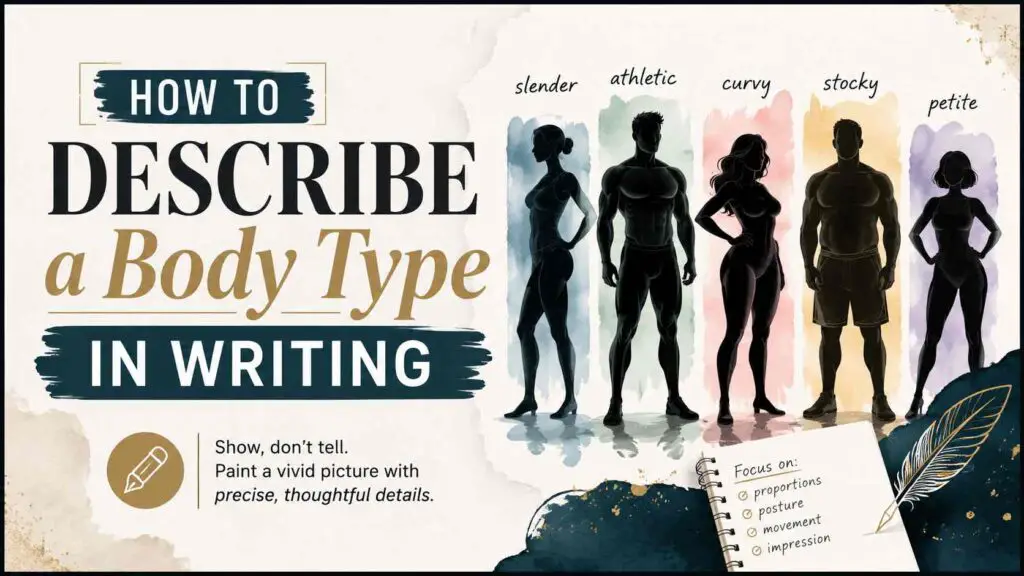
Body type is one of the first things a reader registers about a character, which is exactly why it’s so easy to get lazy with. “Tall and thin” or “short and stocky” tells the reader what to picture without giving them any reason to care. A body reads as real when it’s shown doing something, taking up space in a particular way, or carrying history in its posture — not when it’s summarized in a single descriptive tag. Below are the techniques that make body type description feel specific and alive, each with examples you can study and adapt.
How to Describe a Body Type in Writing
#1. Show Build Through Movement, Not Measurement
Rather than stating a character’s height or frame directly, let their body type reveal itself through how they move through space — ducking under a doorway, filling a chair, moving quickly despite their size. This approach avoids the flat, catalog feel of listing physical stats and instead lets the reader infer build the way they would in real life: by watching someone act.
He had to angle his shoulders to clear the doorway, a habit so old he no longer noticed himself doing it.
She slipped between the crowded tables without brushing a single chair, small enough that the room seemed to part for her without trying.
He lowered himself into the chair carefully, the way a larger man learns to, testing the frame before trusting it.
#2. Use Clothing and Fit as a Mirror
How clothes sit on a body — straining at the seams, hanging loose, tailored close — is a natural, unforced way to communicate build without ever stating it outright. This technique also does double duty by hinting at class, self-image, or how comfortable a character is in their own skin.
The jacket had fit him once, before the gym became a daily habit, and now it pulled tight across his back with every movement.
Her clothes always hung a size too big, not from carelessness but because anything closer felt like being looked at.
The uniform had clearly been altered twice already, taken in at the waist to keep it from swallowing his narrow frame.
#3. Let Other Characters’ Reactions Do the Describing
Sometimes the most efficient way to convey body type is through how other characters respond to it — stepping aside, glancing twice, underestimating someone’s strength. This keeps the narration from stalling on physical description and instead builds the character’s presence through social effect.
Conversations at the bar quieted slightly whenever he walked past, the kind of reflexive deference his size had earned him without asking for it.
People always looked faintly surprised when she lifted the crate herself, as if her frame had promised something her arms didn’t deliver.
The tailor took one look at him and reached for the largest bolt of fabric on the shelf without being asked.
#4. Use Specific, Grounded Detail Instead of Generic Adjectives
Words like “fat,” “skinny,” or “muscular” do the least amount of work possible, because they ask the reader to fill in the picture themselves. Specific, sensory details — the width of a wrist, the way a shirt collar sits, the sound of footsteps — build a much sharper, more individual image.
His wrists were thick enough that the watch he wore looked almost comically small against them.
Her collarbones stood out sharply above the neckline of her dress, delicate in a way that made people want to protect her without knowing why.
His footsteps landed heavy and even on the stairs, a sound she’d learned to recognize before he came into view.
#5. Tie Body Type to Function and History
A body often reflects what it has been used for — labor, sport, illness, inactivity — and grounding description in that history makes the physical detail feel earned rather than decorative. This technique also opens the door to backstory without slowing the scene down for exposition.
His forearms were thick and scarred in a way that had nothing to do with a gym, built instead from twenty years of hauling nets.
She still carried a dancer’s posture, spine straight and shoulders set, though it had been years since she’d stood in a studio.
The illness had left him narrower than he used to be, his clothes hanging off a frame that hadn’t caught up to the person still living in it.
#6. Avoid Over-Explaining — Trust a Single Precise Image
One well-chosen detail beats an entire paragraph of description. Piling on adjectives to describe a body type often has the opposite of the intended effect, flattening the image instead of sharpening it. Choose the detail that says the most and let it stand alone.
He was built like someone who’d spent a lifetime being underestimated in doorways.
She had the kind of frame that disappeared easily in a crowd, which she’d long since decided suited her fine.
His hands alone gave him away — broad, calloused, twice the size they needed to be for anything but the work he did.
#7. Reflect Body Type Through Self-Perception
How a character feels about their own body — pride, discomfort, indifference, a complicated mix of all three — adds emotional depth that a purely external description can’t reach. This technique is especially useful for interiority-heavy scenes, where physical self-awareness can carry as much weight as dialogue.
She caught her reflection in the shop window and looked away fast, the way she always did, before the old inventory of complaints could start.
He’d stopped hunching his shoulders somewhere in his thirties, finally deciding his height wasn’t something to apologize for.
She flexed her hand absently, still not quite used to how much stronger it looked than it used to.
#8. Use Contrast to Sharpen the Image
Placing two different body types side by side — in a doorway, at a table, in a fight — makes each one more vivid by comparison. Contrast forces specificity, since vague description collapses the difference between the two characters instead of highlighting it.
Beside her brother’s broad frame, she looked almost delicate, though anyone who’d sparred with her knew better.
He was a full head shorter than the man across the table, but he held himself like the size difference hadn’t occurred to him.
The two of them made an odd pair in the doorway, one stooping to fit through it, the other barely reaching the handle.
#9. Let Body Type Evolve Over the Story
If a character’s body changes over time — through training, illness, aging, or trauma — tracking that change can mark the passage of time and reinforce character growth without a single line of exposition. A shift in build becomes a visible record of what the character has been through.
The soft edges he’d carried into training were gone by winter, replaced by a leanness that made his old shirts look borrowed.
Grief had thinned her down in a way exercise never had, and people kept commenting on it as though it were something to congratulate.
Years at a desk had softened the frame that once moved crates for a living, though his hands still remembered the weight.
Closing Thoughts
Describing body type well means resisting the shortcut of a single adjective and instead showing build through movement, clothing, history, and self-perception. Anchor these details to how a character functions in the world and how they feel about their own body, and readers won’t just picture a shape — they’ll understand something true about who that character is.