
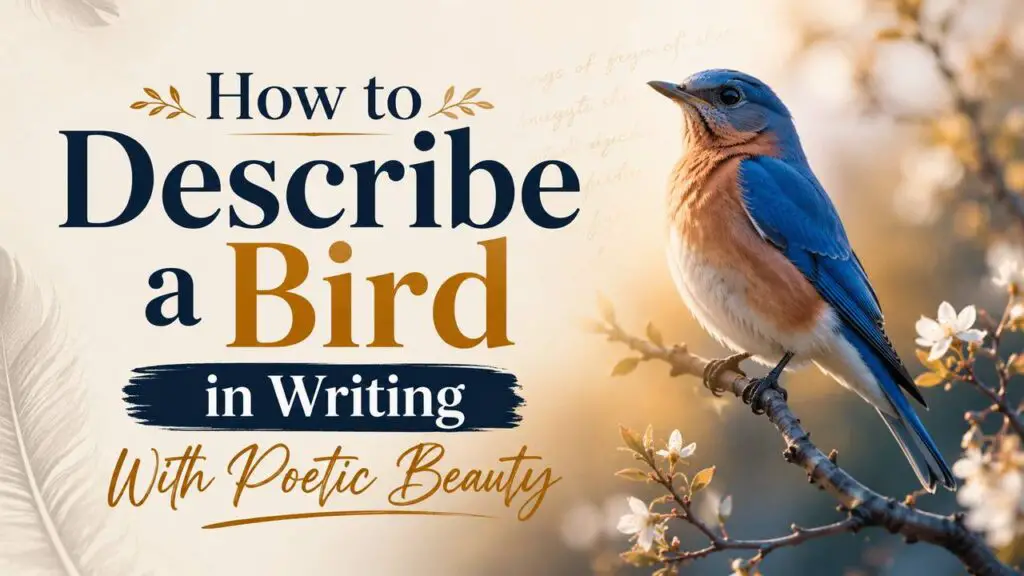
Birds have inspired writers, poets, and storytellers for centuries. Their songs, graceful movements, vivid colors, and ability to soar through the sky make them one of nature’s most captivating subjects. Whether a bird appears briefly in the background of a scene or plays a symbolic role in a story, the right description can leave a lasting impression on the reader.
Describing a bird beautifully goes beyond listing its physical features. It involves capturing its movement, voice, surroundings, and the emotions it evokes. By combining sensory details with thoughtful comparisons and imagery, you can transform a simple bird into a memorable part of your writing.
The following techniques will help you describe birds with poetic beauty while making your scenes more vivid and engaging.
How to Describe a Bird in Writing
#1. Describe Its Colors
A bird’s colors are often its most striking feature, but vivid writing goes beyond naming simple shades like blue, brown, or yellow. Instead, compare its feathers to familiar images from nature or everyday life that readers can easily picture. Think about how light changes the appearance of the feathers and whether they shimmer, glow, fade, or blend into the surrounding landscape. Rich comparisons make colors feel alive instead of merely observed.
The bird wore a coat of midnight blue, its feathers shining like pieces of the evening sky.
A small red bird flashed through the branches like a spark blown from a hidden fire.
#2. Describe Its Movement
Birds rarely stay still for long, making movement one of the most powerful ways to describe them. Notice whether the bird glides effortlessly, darts between branches, hops across the ground, or circles high overhead. The rhythm and speed of its movement can influence the mood of the scene, making it feel calm, energetic, elegant, or unpredictable. Strong action verbs help readers imagine the bird in motion rather than simply seeing it frozen in place.
It lifted from the fence with a soft rush of wings, rising as if the wind had called its name.
The swallow cut through the air like a dark ribbon, quick and graceful against the pale sky.
#3. Describe Its Song
A bird’s song can become the emotional heartbeat of a scene. Rather than simply stating that the bird chirped or sang, think about the quality of its voice. Was it cheerful, haunting, gentle, lonely, sharp, or soothing? Consider how the sound interacts with the environment, whether it breaks the silence, echoes through the trees, or blends into the sounds of nature. Describing both the sound and its emotional effect creates a more immersive experience.
Its song spilled through the morning like drops of silver falling into silence.
From the highest branch, the bird sang a thin, aching note that made the quiet feel deeper.
#4. Describe Its Feathers
Feathers add texture, detail, and personality to a bird. Observe whether they appear smooth, glossy, fluffy, weathered, or windswept. Think about how they respond to sunlight, rain, or the breeze. Describing these small details helps readers picture the bird more clearly and gives your writing a richer, more tactile quality.
Its feathers lay smooth as polished silk, catching the light with every tiny turn.
The bird puffed itself against the cold, becoming a small ball of trembling down.
#5. Describe Its Eyes
A bird’s eyes can communicate curiosity, intelligence, caution, or quiet confidence. They often reveal more personality than any other feature. Instead of simply describing their color, focus on the way they move, what they seem to notice, or the feeling they create. Comparisons can make even a brief description feel vivid and memorable.
Its black eyes shone like wet seeds, bright with quick and secret thoughts.
The hawk watched from above with golden eyes, still and sharp as sunlight on a blade.
#6. Describe Its Place in the Scene
A bird becomes more meaningful when it feels connected to its surroundings. Rather than describing it in isolation, show where it rests, flies, or feeds. The environment can reinforce the mood of your writing, whether the bird is perched on an old fence at sunrise, drifting across a quiet lake, or silhouetted against storm clouds. Integrating the bird into the setting makes the entire scene feel more natural and complete.
A lone bird sat on the church roof, small and dark against the soft gray morning.
Across the lake, white birds drifted on the water like petals loosened from a flower.
#7. Describe the Emotion It Creates
Birds often influence the emotional atmosphere of a scene. A soaring eagle may inspire awe, while a lone bird singing at dusk may evoke longing or melancholy. Think about how the bird affects the people in the scene or the mood of the moment. Allow its presence to deepen the emotional impact rather than simply adding visual detail.
When the bird rose into the open sky, something in her heart rose with it.
The caged bird sang softly, as though remembering a forest it could no longer see.
#8. Use Symbolism
Birds have long been used as symbols in literature and poetry. Depending on the context, they can represent freedom, hope, peace, resilience, transformation, loneliness, or spiritual guidance. Symbolism is most effective when it grows naturally from the story instead of feeling forced. Let the bird’s actions or presence quietly reinforce the deeper meaning of the scene.
The bird disappeared beyond the hills, carrying the last light of the day with it.
It perched outside the window like a small promise, patient and bright in the rain.
Closing Thoughts
Describing a bird in writing is about more than naming its color or species. It is about noticing how it moves, sings, shines, and changes the feeling of a scene. A well-described bird can bring beauty, symbolism, and life into your writing.
The best descriptions use clear images, sensory details, and emotional meaning. When written with care, even a small bird can make a sentence feel alive.