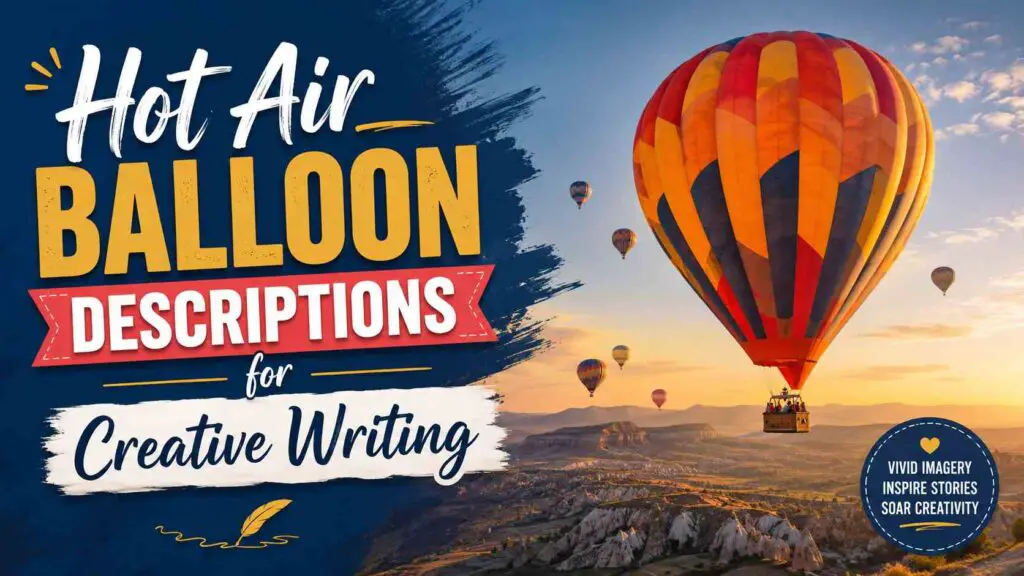
A hot air balloon is the gentlest extreme experience there is — a wicker basket, a bag of heated air, and a mile of nothing underfoot — and it gives writers a rare combination: spectacle on the ground (the inflation, the massed festival launches) and intimacy aloft (four strangers, one burner, and a silence between blasts that no other aircraft offers). The samples below are ready-made balloon descriptions — dawn inflation, the moment of lift, the drift over farmland, the burner’s roar, the landing, the festival sky — each a complete paragraph to study and adapt.
Here are the sample flights, one paragraph at a time.
Hot Air Balloon Descriptions for Creative Writing
#1. The Dawn Inflation
At five-forty the balloon was sixty feet of nylon lying dead in the wet grass, and the crew woke it in stages — first the fan roaring cold air into its mouth until the envelope stirred and swelled like something dreaming, then the burner’s first long blast, a dragon clearing its throat, and the fabric began to live. It came up off the field slowly, hugely, a building deciding to stand, colors emerging from the crumple as the dark released them — red, gold, a green that had no business at that hour — until it stood tugging at the basket, round and vast and faintly breathing, blotting out its own patch of paling stars. The passengers, coffee cooling in their hands, went quiet at the size of it. Photographs had prepared them for beautiful. Nothing had prepared them for big.
#2. The Moment of Lift
There was no moment of takeoff — that was the shock of it. No runway, no acceleration, no announcement from the ground that it was done with them; the pilot fed the burner two long blasts, and the field simply, politely, began to leave. The grass detached. The crew’s upturned faces tilted and shrank. She had braced for the lurch of every other machine she’d ever ridden and the balloon declined to provide one — they were three feet up, then thirty, then a hundred, rising the way a bubble rises through honey, and her stomach, finding nothing to object to, gave up and joined the view. Below, their shadow slid off the launch field and began its long ripple across the hedges. “We’ve left,” she said, stupidly, and the pilot smiled the smile of a man who heard exactly that sentence every single dawn of his working life.
#3. The Silence Between Burns
When the burner cut out, the silence arrived like a held breath made of altitude — total, sunlit, and moving at the exact speed of the wind, which meant no wind at all touched them: they were of the air now, not in it, and the stillness in the basket was the stillness of being carried. Sounds came up from the world instead. A dog, barking at their shadow, arrived clear as a phone call from a thousand feet down. A tractor turned at a hedge. Someone’s screen door slapped. The passengers found themselves whispering without agreeing to, the way people whisper in churches and snowfalls, and the pilot let the quiet run long past necessity — it was, he knew, the actual product; the view was just its packaging — before reaching up, almost regretfully, for the next long roar.
#4. The Drift Over Farmland
From eight hundred feet the county resolved into its true shape — a quilt someone had been sewing for three hundred years, fields in imperfect rectangles of green and gold and plowed brown, stitched with hedgerows and hemmed by the river’s silver seam. The balloon took it at walking pace, which was the revelation: not the blur of a plane window but a slow proprietary drift, low enough to count sheep (the sheep, unimpressed, declined to be counted), to smell woodsmoke from a farmhouse chimney, to watch their own shadow cross a barn roof and startle the pigeons off it. The pilot named the farms as they came. A woman hanging washing looked up, shaded her eyes, and waved with the pillowcase, and the whole basket waved back with the enthusiasm of royalty — six strangers suddenly representing the entire sky.
#5. The Burner’s Roar Up Close
Nothing about the brochure had mentioned the violence of the burner. When the pilot pulled the lever, a dragon stood up in the middle of their quiet — a six-foot spear of blue-orange flame driving into the envelope’s mouth with a roar that canceled conversation and a heat that arrived instantly on every upturned face like an opened oven. Ten seconds, fifteen; the basket’s shadows jumped and shivered; and then off, and the silence slammed back twice as deep. The rhythm became the flight’s heartbeat — roar, hush, roar, hush — the passengers learning to time their sentences to the gaps like people talking through a bell tower at noon. The children aboard, after the first flinch, decided it was the best part and began requesting it. The pilot, who privately agreed, obliged whenever the altimeter gave him half an excuse.
#6. The Landing in a Stranger’s Field
The landing was agriculture, not aviation. The pilot read the fields ahead like a man choosing a parking spot in a crowded lot — that one’s beans, that one’s wet, that one, the stubble, that’s ours — and brought them down the last hundred feet in a long shallow glide, radioing the chase crew, coaching the basket: knees bent, hold the rope handles, face the direction of travel, nobody’s ever ready. The stubble came up. The basket kissed, hopped once like a skipped stone, dragged ten yards with the envelope leaning ahead of them like a huge tired sail, and settled on its side in the gentlest crash any of them would ever attend. They climbed out laughing into a stranger’s field. The stranger himself arrived by tractor within minutes, as farmers somehow always did, less surprised than proprietary — this being, it emerged, the third balloon his stubble had caught in twenty years, and the champagne tradition well understood by all parties.
#7. The Festival Sky at Mass Ascension
At seven the field let them all go at once, and the sky filled the way a snow globe fills — forty, sixty, ninety balloons rising in slow motion through the pink morning, spheres of every allegiance: stripes and rainbows, a purple cow, a flying strawberry three stories tall, all of them climbing at their own gentle rates into a sky that had room and light for everything. From the ground it was a spectacle; the crowds tipped back in lawn chairs went quiet, then pointed, then simply watched. From the baskets it was a society — pilots calling across the gaps, burners answering each other like roosters, the strawberry drifting past close enough to read its sponsor and wave to its passengers. The morning light came through the envelopes and lit them from within, ninety stained-glass suns, and for half an hour the sky over one ordinary county was the most crowded and courteous place on earth.
#8. The Old Pilot’s Last Flight of the Season
The last flight of October went up with two paying passengers and forty years of habit — the pilot’s hands doing the checks in their worn order, tank gauges, karabiners, the igniter’s click and catch, a liturgy older than his knees. The season’s final light lay long and cold across a county he had crossed a thousand times and never once by the same road, that being the balloon’s whole covenant: the wind decides, you consent. He took them up through a skein of geese heading the other way on business of their own. He let the silence run longer than the paying customers knew was generous. And at landing, envelope down and breathing its last warm air into the dusk, he stood a moment with his hand on the wicker while the crew packed — an old man and an old basket at the end of another year of borrowed sky — then turned to help fold the fabric, because the one rule outlasting all the others was that the balloon gets put away properly, every time, as if there will always be a spring.
Closing Thoughts
Eight flights, one physics: the balloon’s magic is subtraction — no lurch, no wind in your face, no engine except the dragon’s intermittent roar — so every sample works the contrasts that remain: roar against hush, spectacle against intimacy, a mile of air against wicker at knee height. Steal the structure of the experience itself, which is a ready-made plot: wake the envelope, lose the ground politely, drift at walking pace, land in a stranger’s beans. And keep the pilot’s covenant at the center — the wind decides, you consent — because that surrender, rare in machines and rarer in characters, is what your reader is actually buying the ticket for.