
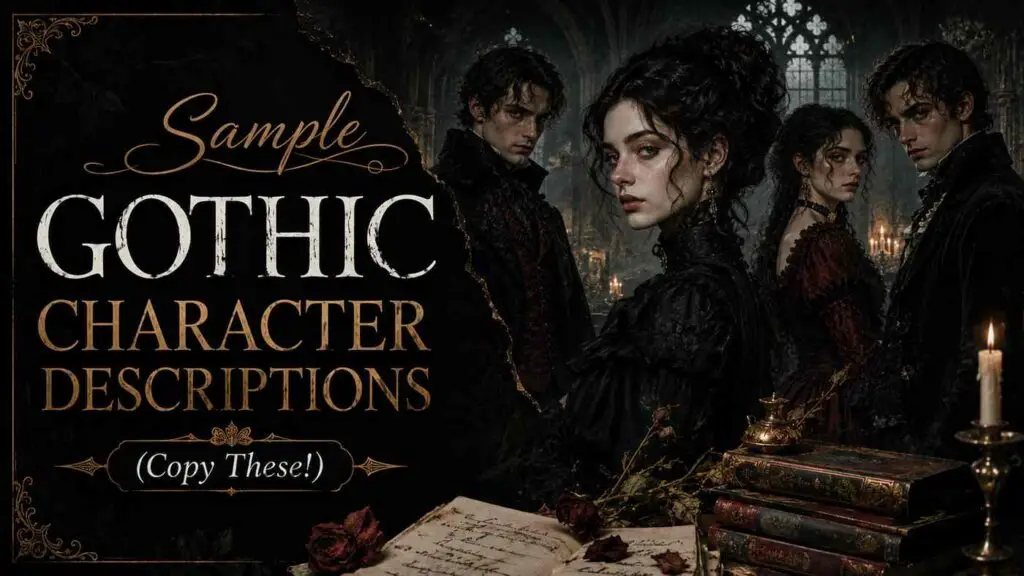
Gothic characters are built from shadows, secrets, inner conflict, and haunting atmosphere. They often carry emotional wounds, hidden motives, or a mysterious connection to the dark world around them. A strong Gothic character description should do more than explain how someone looks. It should reveal mood, tension, and the sense that something is not quite right.
Below are sample Gothic character descriptions that can be used for inspiration, adaptation, or creative writing practice.
Sample Gothic Character Descriptions
#1. The Pale Heiress
She moved through the candlelit hall as though she belonged to another century. Her skin was pale enough to catch the glow of every flame, and her dark dress trailed behind her like spilled ink. Around her throat, she wore a silver locket that no one had ever seen opened.
Her eyes were calm, but not peaceful. They held the stillness of someone who had already lost everything and feared nothing more. Servants whispered that she never slept, only sat beside the window until dawn, watching the ruined garden as if waiting for someone buried there to return.
The heiress inherited the estate after a series of unexplained family deaths that occurred over the span of a single winter. Some claimed it was a tragic coincidence. Others believed the old family curse had finally awakened. Since taking ownership of the manor, she had become increasingly withdrawn from society, refusing invitations and rarely leaving the property.
Despite her cold appearance, she possessed a sharp intellect and a deep understanding of her family’s history. She spent countless hours in the manor’s forgotten library, studying journals, letters, and records dating back centuries. She seemed determined to uncover a truth that previous generations had worked hard to conceal.
As a character in a Gothic novel, she can serve as a tragic heroine, a mysterious ally, or even an unreliable narrator. Her hidden knowledge, family secrets, and emotional isolation make her ideal for stories involving curses, forbidden romance, ancestral sins, and supernatural mysteries.
#2. The Brooding Stranger
He arrived at the village on a night of heavy rain, with no luggage except a worn leather satchel and a black coat soaked through at the shoulders. His face was sharp, hollowed by sleeplessness, and his eyes carried the strange brightness of a man pursued by memory.
No one knew his name at first. He paid in old coins, spoke only when necessary, and always chose the darkest corner of the room. Yet wherever he went, dogs growled, lamps flickered, and people felt the sudden urge to confess things they had long kept hidden.
The stranger carried scars that extended far beyond the physical. Although polite when addressed, he seemed perpetually distracted by thoughts he refused to share. Several villagers claimed to hear him speaking alone late at night as though engaged in conversation with an unseen companion.
Rumors spread quickly. Some believed he was fleeing the law. Others suspected he had escaped from an asylum or abandoned monastery. The most fearful whispered that he was connected to a terrible event that had occurred decades earlier and had somehow remained unchanged by time.
This character works particularly well as a mysterious protagonist, antihero, or catalyst for the novel’s central conflict. His arrival can trigger long-buried secrets, awaken supernatural forces, or force other characters to confront their own hidden sins.
#3. The Mad Widow
The widow lived alone in the west wing of the crumbling estate, where the mirrors were covered and the clocks had all been stopped. She dressed every morning in faded mourning clothes, though her husband had been dead for twenty years.
Her hair, once golden, had turned the color of ash. She spoke softly to empty chairs and set a place at dinner for the man she insisted would return. Some said grief had broken her mind. Others believed she knew he had never truly left the house.
The rooms she occupied had become frozen in time. Dust gathered on furniture that was never moved. Fresh flowers appeared beside her husband’s portrait every morning despite the fact that no garden remained on the property. When questioned about them, she simply smiled and changed the subject.
Although many considered her insane, she often displayed moments of startling clarity. She could recall conversations from decades earlier with perfect accuracy and occasionally revealed information she should have had no way of knowing. These unsettling insights made others wonder whether she was delusional or genuinely communicating with something beyond the veil of death.
She is an excellent Gothic character because she exists between tragedy and mystery. Her grief can conceal clues, supernatural abilities, or dangerous secrets that become increasingly important as the story unfolds.
#4. The Cursed Nobleman
Lord Ashbourne had the beauty of a portrait and the coldness of a tomb. His face was refined, almost flawless, but there was something unnatural in its stillness. He rarely smiled, and when he did, it seemed like an expression learned from watching others.
The villagers feared his ancient family line. Every generation had produced wealth, tragedy, and sudden death. Lord Ashbourne carried that inheritance like a second shadow. He walked with perfect control, yet his eyes betrayed a man chained to something older and darker than guilt.
He spent most of his days managing the estate and avoiding social interaction. Visitors noticed that certain rooms in the manor remained permanently locked and that servants avoided discussing his ancestors. Whenever family history was mentioned, an uncomfortable silence settled over the room.
Privately, the nobleman struggled against a fate he believed was inevitable. Whether the curse was supernatural, psychological, or entirely fabricated remains uncertain. What matters is that he believes in it completely. Every decision he makes is shaped by the fear that he will repeat the sins of those who came before him.
This character is ideal for stories involving doomed romance, inherited evil, moral conflict, and the tension between destiny and free will.
#5. The Haunted Governess
Miss Vale was young, but sorrow had already touched her features. Her plain black dress, tightly pinned hair, and careful manners made her seem respectable at first glance. Yet her hands trembled whenever she passed the nursery door.
She had come to the manor to teach two silent children who never played, never laughed, and often stared at corners where nothing stood. At night, Miss Vale wrote frantic letters she never sent. Each page began sensibly and ended with the same desperate line: “The house is watching me.”
Before arriving at the estate, she had endured a personal tragedy that left her vulnerable and eager for a fresh start. The position seemed like a blessing. Instead, it became a source of mounting terror. Strange footsteps echoed through empty corridors. Children’s laughter emerged from locked rooms. Portraits appeared subtly altered from one day to the next.
Despite her growing fear, Miss Vale possesses remarkable determination. She refuses to abandon the children and becomes increasingly committed to uncovering the truth behind the manor’s strange history.
She functions well as a Gothic protagonist because readers can experience the mystery through her perspective. Her combination of vulnerability, intelligence, and courage creates an effective emotional anchor for supernatural stories.
#6. The Sinister Caretaker
The caretaker was a bent old man with a lantern in one hand and a ring of rusted keys in the other. His beard was yellowed with age, and his eyes were small, wet, and watchful. He knew every locked room in the manor, though he claimed to remember very little.
He spoke in riddles and warnings. He never entered the chapel after sunset and refused to go near the cellar stairs. When questioned, he only smiled with cracked lips and said that some doors were locked to keep people out, while others were locked to keep something in.
For decades, he has served the estate through changing owners, mysterious deaths, and unexplained disappearances. He appears loyal, but it is never entirely clear where his true allegiances lie. He seems to know more than anyone else and carefully controls what information he reveals.
His greatest strength as a character is ambiguity. He can function as a mentor, gatekeeper, witness, villain, or reluctant ally. Readers should constantly question whether he is protecting the household from evil or protecting evil from discovery.
#7. The Tragic Bride
She was found standing at the altar long after the guests had fled, still wearing her wedding gown. The lace was torn, the veil hung crooked over her face, and rainwater dripped from the hem of her dress onto the chapel floor.
Her beauty had not faded, but it had become terrible. She looked less like a bride than a ghost rehearsing the final moment of her life. Since that night, she had never spoken her husband’s name. But every year, on the anniversary of the wedding, someone heard weeping from the chapel.
No one could agree on exactly what happened during the ceremony. Accounts varied wildly. Some claimed the groom vanished. Others insisted he died before reaching the altar. A few whispered that the bride herself was responsible for the tragedy.
Years later, she remains trapped emotionally and psychologically within that single catastrophic day. She wanders the estate grounds at night, revisiting places connected to her lost future. Her inability to move forward makes her both heartbreaking and frightening.
This character is particularly effective in stories centered on obsession, betrayal, grief, and the destructive consequences of unresolved trauma.
#8. The Silent Child
The child was small, pale, and unnervingly still. He did not run through the halls or ask questions like other children. Instead, he sat for hours with his hands folded in his lap, staring at the portrait above the fireplace.
His voice, when he used it, was soft and old-fashioned. He knew things he should not know: the location of hidden letters, the names of the dead, and the words whispered in locked rooms. The adults called him strange. The servants called him cursed.
The child rarely displayed emotion, making it difficult for others to understand what he was thinking. Yet he possessed an uncanny awareness of the fears and secrets of those around him. He often made innocent observations that exposed uncomfortable truths.
Whether his knowledge originates from supernatural gifts, psychological trauma, or communication with spirits can remain ambiguous throughout the story. This uncertainty creates tension and allows the character to function as both a source of clues and a source of dread.
He works especially well as a mysterious secondary character whose presence gradually reveals deeper layers of the novel’s central mystery.
#9. The Fallen Priest
Father Marlow had once been a respected man, but now he looked like a soul worn thin by forbidden knowledge. His robes hung loosely on his frame, and his eyes were ringed with exhaustion. He carried a Bible in one hand and a flask in the other.
He no longer preached about salvation. Instead, he muttered about signs, punishments, and the sins buried beneath the village church. Some believed he had lost his faith. Others feared he had seen proof of something worse than damnation.
Years earlier, he had investigated a series of unexplained events that left him permanently changed. Whatever he discovered shattered his certainty and replaced it with relentless doubt. Since then, he has lived in a state of spiritual conflict.
His struggle between belief and despair makes him a compelling Gothic figure. He may possess crucial knowledge about the supernatural threat facing the characters, yet his emotional and psychological instability makes him difficult to trust.
He is particularly useful in stories that explore faith, corruption, forbidden knowledge, and the limits of human understanding.
#10. The Mysterious Lady in Black
She appeared only at funerals, always dressed in black from veil to glove. No one had invited her, yet she stood at the edge of every graveyard service, silent and unmoving beneath the yew trees.
Her face was never fully visible. Those who glimpsed it claimed she was either very young or impossibly old. She never wept, never spoke, and never stayed after the coffin was lowered. But within a month of her appearance, another death always followed.
Attempts to identify her always failed. Records contained no trace of her existence. Travelers claimed to have seen her in distant towns decades apart without any sign of aging. Her presence became woven into local folklore and superstition.
She serves as an excellent embodiment of mystery within a Gothic narrative. Whether she is a ghost, an omen, a supernatural being, or simply a misunderstood woman can remain unresolved. The uncertainty surrounding her identity makes her unforgettable.
Whenever she appears, readers should immediately sense that something tragic, terrifying, or transformative is about to occur.
Closing Thoughts
Gothic character descriptions work best when they combine appearance, atmosphere, and mystery. The most memorable characters are not simply dark or frightening. They suggest hidden pain, buried secrets, moral conflict, or supernatural danger.
A strong Gothic character should feel like part of the setting itself. The house, the weather, the shadows, and the past should all seem connected to them. Whether the character is a haunted governess, a cursed nobleman, or a silent child, the goal is to make readers feel that there is more beneath the surface than they are being told.