
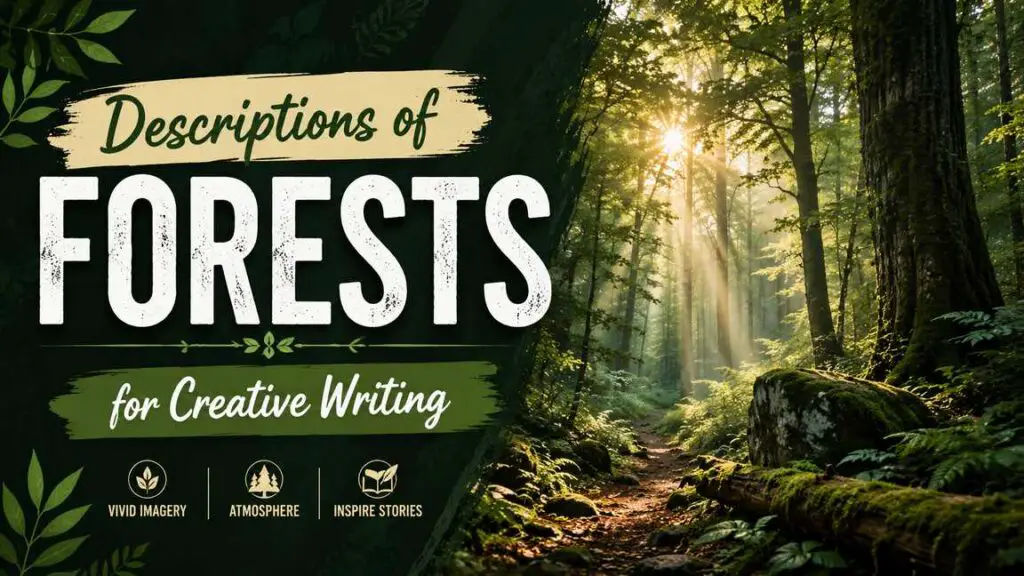
A forest is the one landscape that surrounds — you don’t look at it, you’re absorbed by it, ceiling and walls and floor all alive and all indifferent to your presence. That immersion is what forest description must deliver and what the stock phrases (“dense, dark woods”) never do, because they describe the forest from outside, as an obstacle on a map. Inside, the forest is layered light, deep sound, soft floor, and a persistent sense of being one small warm thing among ten thousand tall patient ones. Write from inside the immersion and the reader walks in with you.
Here’s how to describe the woods from within.
Descriptions of Forests for Creative Writing
#1. The Edge Is a Border Crossing
Forests begin abruptly — light, temperature, sound, and smell all change within ten steps of the treeline. Write the crossing as an event with a threshold: the field’s brightness behind, the green dim ahead, and the moment the outside world’s noise is replaced by the forest’s.
Ten steps past the treeline the field’s hot brightness was gone as if a door had closed — green dimness, cooler air, the highway’s hum traded for a hush with birds in it.
The forest edge stood along the meadow like a dark tide line, and entering it was wading in — shade to the knees, then the shoulders, then over her head somewhere past the first oaks.
Behind him the gate, the car, the century; ahead, under the first branches, something older that had no opinion about any of them.
#2. Light Arrives in Coins and Shafts
Forest light is processed by the canopy — falling as moving coins on the floor, standing in slanted shafts where a tree has fallen, going green as it filters. Write what the canopy does to the sun and the forest’s ceiling becomes visible without the reader ever looking up.
Light came down through the canopy in coins that moved with the wind, sliding over the path, over her hands, minted and spent and minted again.
Where the old beech had fallen, a single shaft of full sun stood in the dimness like a pillar in a dark hall, and everything in it — midges, dust, one lit fern — burned briefly holy.
By midsummer the light reached the floor pre-owned — filtered through two stories of leaves, arriving green and secondhand, the forest keeping the best of it upstairs.
#3. The Floor Is Its Own Country
Underfoot the forest is deep — leaf litter over mold over roots, moss upholstering the fallen, fungus running its quiet salvage. Write the floor’s softness, smell, and industry; the forest’s ground level is where its decay-and-renewal economy shows.
The floor gave underfoot like a mattress of years — this autumn on top, every earlier autumn below — and each step released the cellar smell of the whole arrangement working.
The fallen trunk had been down long enough to grow its own garden — moss shoulder to shoulder, ferns rooted in the bark, a line of ants running its length like traffic on a green viaduct.
After rain the mushrooms stood everywhere overnight — white buttons, orange shelves, one baroque monster by the stump — the forest’s basement staff suddenly visible, briefly, in daylight.
#4. Depth Is Felt as Enclosure
The forest’s scale works opposite to the desert’s — not distance but depth, trunks behind trunks until sight gives out, every direction offering the same green recession. Write the enclosure honestly: for one character it’s shelter, for another the walls of a trap, and the trees are neutral.
In every direction the trunks stood behind trunks behind trunks until seeing simply gave up — no horizon, no distance, just depth, the forest closing its ranks at forty meters wherever she looked.
The wood held him the way deep water holds a swimmer — on all sides, indifferently — and he found he kept touching trees as he passed, the way you touch a rail.
To the child it was walls and it was fort — the same green enclosure, terror or shelter depending entirely on whether her brother was in sight.
#5. The Sound Is Layered and Legible
Forest sound comes in strata — wind working the canopy like distant surf, birdsong at mid-height, the floor’s small rustles — and its interruptions carry meaning: the silence after a snapped branch, the jay’s alarm passing word along. Write the layers, and the sudden quiet that means something noticed you.
The wind ran the canopy overhead like surf on a far reef — constant, oceanic — while down at her level the forest kept its smaller books: a wren ticking, leaf-rustle, something modest resettling itself under the holly.
A branch cracked away to the left, and the wood did what it does: went briefly, comprehensively quiet, every small musician waiting to see what the percussion meant.
The jay saw them first and said so, loudly, twice — and the news traveled ahead of them through the trees, relayed station to station, so that they walked all afternoon through a forest that had already been told.
#6. Name the Forest’s Kind and Keeper
Beech cathedral, pine plantation, tangled oakwood, rainforest — each forest type has its own light, floor, and mood, and many have keepers: foresters, rangers, poachers, the family that’s coppiced one wood for generations. Specify the forest and its human relationship, and generic “woods” become a place.
The beechwood ran clean and pillared as a cathedral — smooth gray columns, a floor of copper leaves, almost no undergrowth — a forest you could stroll like an aisle.
The plantation pines stood in ruled rows, dark and identical, a forest with a barcode — and walking its grid corridors she missed, acutely, the old wood’s disorder.
Harker had thinned this wood as his father had, oak by chosen oak, and he walked it the way a man walks a herd — knowing individuals, planning decades, mourning particular trees by name.
#7. The Forest Runs on Deep Time
A forest is a slow event — centuries visible in girth, fallen giants nursing new rows, clearings healing over decades. Set human scenes against the forest’s timescale and both gain: the wood outlasting every character is the quiet fact under all forest fiction.
The oldest oaks predated the road, the church, and the country’s current name, and the afternoon’s picnic spread its blanket inside their patience like a mayfly renting a cathedral.
Along the fallen giant’s trunk grew a straight line of young trees, rooted in their ancestor — the forest’s succession plan, running on schedule, a century per clause.
The bomb crater from the war was a mossy dell now, fringed with birches, and only the parish’s oldest walkers still called it anything but beautiful.
#8. Being Watched Is Standard
The forest’s population mostly observes unseen — deer frozen mid-chew, eyes at dusk, the certainty of being noticed by things you can’t see. Write the asymmetry honestly (you are the loudest, blindest thing in the wood) and it serves wonder or menace equally.
The deer had been watching them for a full minute before anyone saw it — mid-chew, motionless, entirely unimpressed — and when it finally moved, three more they’d never seen moved with it.
She was, she understood, the loudest thing for a mile — every step a broadcast, every snapped twig a press release — a giant blundering through rooms of held breath.
At dusk the feeling arrived on schedule: nothing seen, nothing heard, only the skin’s old certainty that the forest’s attention had shifted, and that some of it was now pointed here.
#9. Thin Out the Dense Dark Woods
“The dense, dark forest loomed menacingly” — the stock kit describes a wall, not a wood, and spends menace it hasn’t earned. The repair is interior specificity: one light effect, one sound layer, one watcher — details from inside the immersion. A forest built from within can then loom all it likes, and the reader will feel it.
Stock: the dark woods loomed. Interior: under the hemlocks the afternoon ran twenty minutes ahead of the meadow’s — dusk arriving early, pooling under the branches — and she checked her watch twice, sure it was lying.
Nothing loomed; the wood simply stopped answering — the path fainter, the birdsong thinner, the light greener — subtraction, not menace, which was worse.
The forest wasn’t dense; it was deep — you could walk it easily in any direction, and that was precisely the trouble.
Closing Thoughts
The invitation, as ever, beats the instruction: find a wood — any wood, the city park’s back acre will do — walk in past the point where you can’t see the entrance, and stand still for five minutes. Log what actually happens: the light’s coins moving, the canopy’s surf, the small sounds resuming around you as the forest decides you’re furniture. That resumption — the wood accepting you back into its business — is the feeling every forest description is chasing, and no writer who has stood inside it once ever again writes “dense, dark woods.” Go stand in it.