
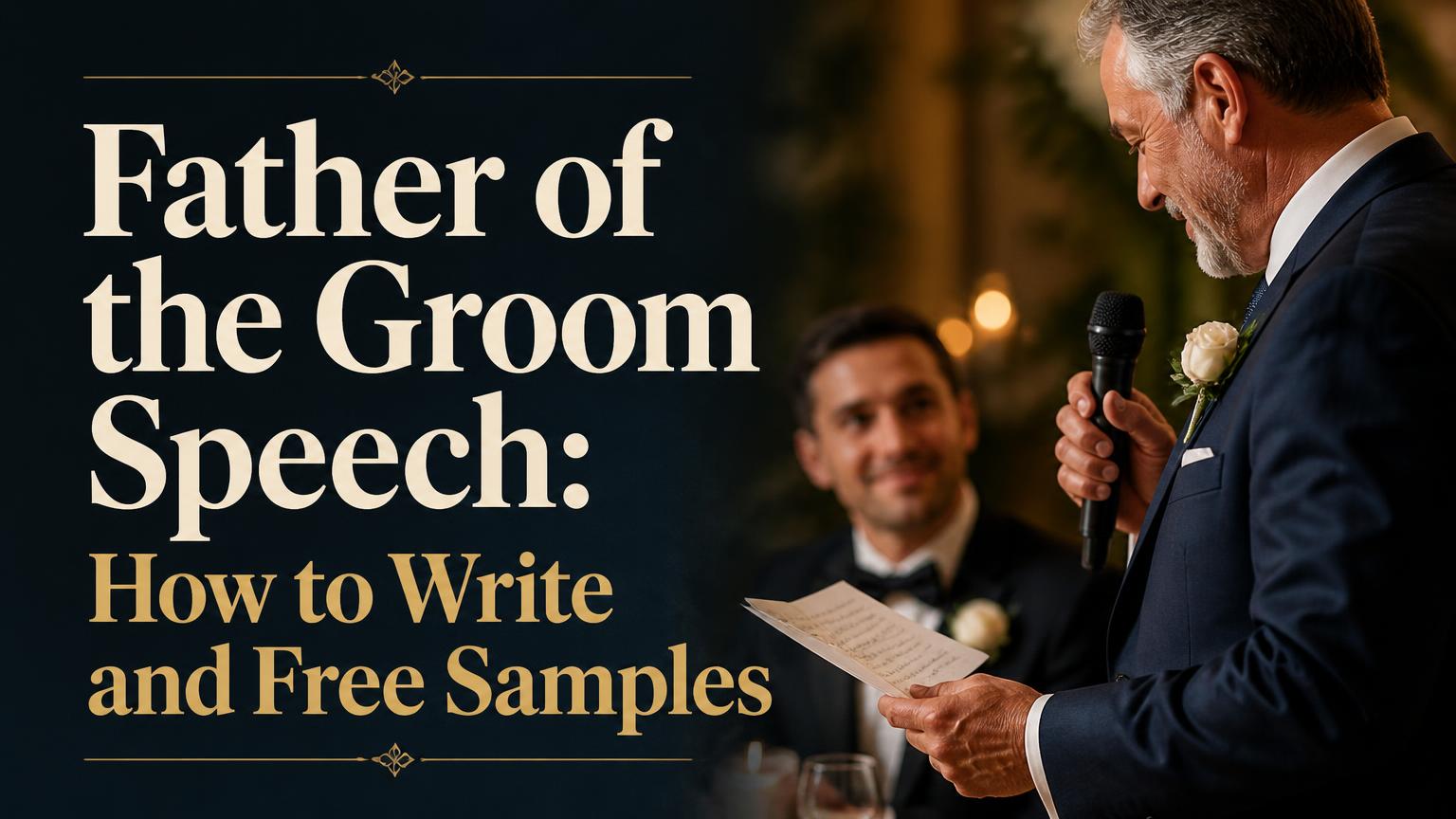
A father of the groom speech should celebrate the couple, reflect honestly on your relationship with your son, and welcome his partner and their family. The best speeches are personal without becoming private, warm without becoming overly sentimental, and brief enough to keep the celebration moving. Below, you will find a practical writing process followed by two free father of the groom speech samples. Use the examples as written or adapt them with your own memories, family details, and natural speaking style.
Father of the Groom Speech: How to Write One
Step 1. Decide What You Want to Say
Before writing individual sentences, choose the main message you want guests to remember. You might want to express pride in your son, welcome his partner, reflect on how he has grown, or share your hopes for their marriage. A speech usually feels stronger when it has one clear emotional center rather than a collection of unrelated stories and compliments.
Consider the audience as well. Guests may include relatives, friends, colleagues, and members of the other family who do not know your son as well as you do. Give them enough background to understand your memories, but keep the focus on the couple and the occasion. Your role is not simply to describe your son; it is to honor the marriage they are beginning together.
Step 2. Choose Two or Three Specific Memories
Specific memories make a father of the groom speech sound genuine. Think about moments that reveal your son’s character rather than merely listing his achievements. You might remember his determination during a difficult period, his kindness toward someone else, a family tradition, or an early sign of the qualities he brings to his marriage.
Choose stories that are suitable for every guest in the room. Avoid embarrassing childhood incidents, private family disagreements, stories involving former partners, or jokes that could make the couple uncomfortable. A short, well-chosen memory is more effective than several anecdotes. If you use a placeholder such as [Specific Memory], replace it with a true detail that can be explained in two or three sentences.
Step 3. Welcome and Honor the Couple
A wedding speech from the groom’s father should not become a long tribute to the groom alone. Speak directly about the couple and acknowledge the person your son has chosen to marry. Thank the partner for the happiness, companionship, and qualities they bring to his life, without suggesting that one person has “completed” the other.
It is also thoughtful to welcome the partner’s family and thank those who helped bring the wedding together. The wording will depend on the families, traditions, and setting. You do not need to follow a fixed formula, but recognition should feel sincere rather than ceremonial. Mention what you have observed about the couple’s relationship: their respect, patience, humor, teamwork, or ability to support one another.
Step 4. Organize the Speech Around a Simple Structure
A reliable structure is a brief welcome, a personal reflection about your son, an acknowledgment of his partner, a few thoughts about the couple, and a warm closing toast. This gives the speech a recognizable beginning, middle, and ending without making it sound mechanical.
Use transitions so the speech moves naturally. For example, you might say, “As proud as I am of the man my son has become, I am equally grateful for the person beside him,” before turning to his partner. Keep each section connected to the central message. If a story does not support your purpose or help guests understand the couple, leave it out. A focused speech is easier to deliver and more meaningful to hear.
Step 5. Keep the Tone Warm, Appropriate, and Brief
Most father of the groom speeches work well at about three to five minutes, depending on the wedding schedule and the number of other speakers. At an ordinary speaking pace, that is roughly 360 to 700 words, although pauses and emotion may affect the timing. Ask the couple or wedding coordinator whether a specific limit has been set.
Humor can add warmth, but it should never come at the couple’s expense. Avoid jokes about marriage being a trap, the groom losing his freedom, money, drinking, past relationships, or disagreements between families. Gentle humor about your own experiences is usually safer. Aim for a tone that sounds like you: formal if the occasion calls for it, conversational if that feels more natural.
Step 6. Edit for Speaking and Rehearse Aloud
A speech that looks polished on the page may feel awkward when spoken. Read it aloud several times and listen for long sentences, repeated words, formal phrases you would never normally use, and places where the emotional shift feels abrupt. Replace complicated language with direct wording. Mark pauses after important memories and before the final toast.
Practice enough to become familiar with the speech without trying to memorize every word. Print it in a large, readable font or use cue cards with clear paragraph breaks. Look up regularly, especially when addressing the couple. If emotion makes it difficult to continue, pause, breathe, take a sip of water, and resume when you are ready. You may also choose not to speak publicly; asking someone else to deliver your words is perfectly acceptable.
Father of the Groom Speech Samples
#1. A Heartfelt Speech About Pride, Love, and Family
Good evening, everyone.
Thank you all for being here to celebrate [Son’s Name] and [Partner’s Name]. A wedding brings together two people, but it also brings together families, friends, memories, and hopes for the future. Looking around this room, I am reminded how fortunate they are to have so many people supporting them today.
As [Son’s Name]’s father, I have had the privilege of watching him grow from a boy with endless questions into the thoughtful and dependable man standing here today. Like every child, he has had moments when things did not go according to plan. But he has always had the ability to learn, keep going, and care deeply about the people around him.
One memory that comes to mind is [Specific Memory]. At the time, it may have seemed like an ordinary family moment. Looking back, I can see qualities in him that are still present today: his determination, his good humor, and his willingness to be there when someone needs him. Those qualities have served him well, and they are qualities I know he brings to his marriage.
[Partner’s Name], I want to thank you for the happiness and companionship you share with my son. It is clear to everyone who knows you that your relationship is built on affection, respect, and genuine friendship. We are grateful not only for the love you give him, but also for the warmth and kindness you have shown to our family.
To both of you, marriage will include wonderful days, ordinary days, and days that require patience. Through all of them, I hope you continue to listen to one another, make room for laughter, and remember that you are on the same side. The strength of a marriage is often found in the small, consistent ways two people care for each other.
[Son’s Name], I am proud of the man you have become. [Partner’s Name], we are delighted to welcome you. May your life together be filled with trust, good conversations, shared adventures, and the quiet comfort of knowing you have chosen each other.
Please raise your glasses to [Son’s Name] and [Partner’s Name]. May your marriage bring you lasting happiness and may the love you celebrate today continue to grow throughout the years. Cheers.
#2. A Warm and Conversational Tribute to the Newlyweds
Good evening, everyone.
I was told that, as the father of the groom, I should offer some wise advice about marriage. I considered preparing a long list, but then I remembered that [Son’s Name] has been giving me advice about technology for years, so perhaps we should call it even.
What I can offer is a few reflections from someone who has watched him grow. When [Son’s Name] was younger, he had a strong sense of what he wanted. That could make family discussions interesting, but it also showed us that he was determined, independent, and willing to stand by what mattered to him. Over time, those qualities became steadiness, responsibility, and a real concern for other people.
I saw another side of him when [Specific Memory]. What stayed with me was not simply what he did, but the way he did it. He did not need attention or praise. He simply recognized what was needed and tried to help. That quiet kind of character is one of the things I admire most about him.
Then [Partner’s Name] became part of his life, and we saw him become even more open, patient, and content. [Partner’s Name], thank you for loving my son as he is, for encouraging him to grow, and for bringing your own warmth and perspective to our family. We are very happy that you are here, and not only because you have helped him become better at answering messages.
What I admire about the two of you is the way you seem to enjoy both the important moments and the ordinary ones. A strong marriage is not made only of celebrations like this. It is built in daily conversations, shared decisions, forgiveness, teamwork, and the ability to make each other laugh when life becomes difficult.
[Son’s Name] and [Partner’s Name], I hope you always protect that friendship at the heart of your relationship. Keep being curious about each other. Keep making plans, even when they change. And remember that a good life is made from many small moments that are appreciated while they are happening.
To [Partner’s Name] and your family, thank you for sharing this day with us. To my son, I want you to know how proud I am of you. Please raise your glasses to the newlyweds. May your home be filled with kindness, your future with adventure, and your marriage with more happiness than either of you can imagine today. Cheers.
Closing Thoughts
A strong father of the groom speech does not depend on elaborate language or a perfect performance. It depends on sincerity, a few carefully chosen details, and genuine attention to both people being celebrated. Use one of these samples as a starting point, then replace general wording with memories and observations that belong to your family. Keep the speech focused, rehearse it aloud, and finish by offering the couple a warm, confident toast.