
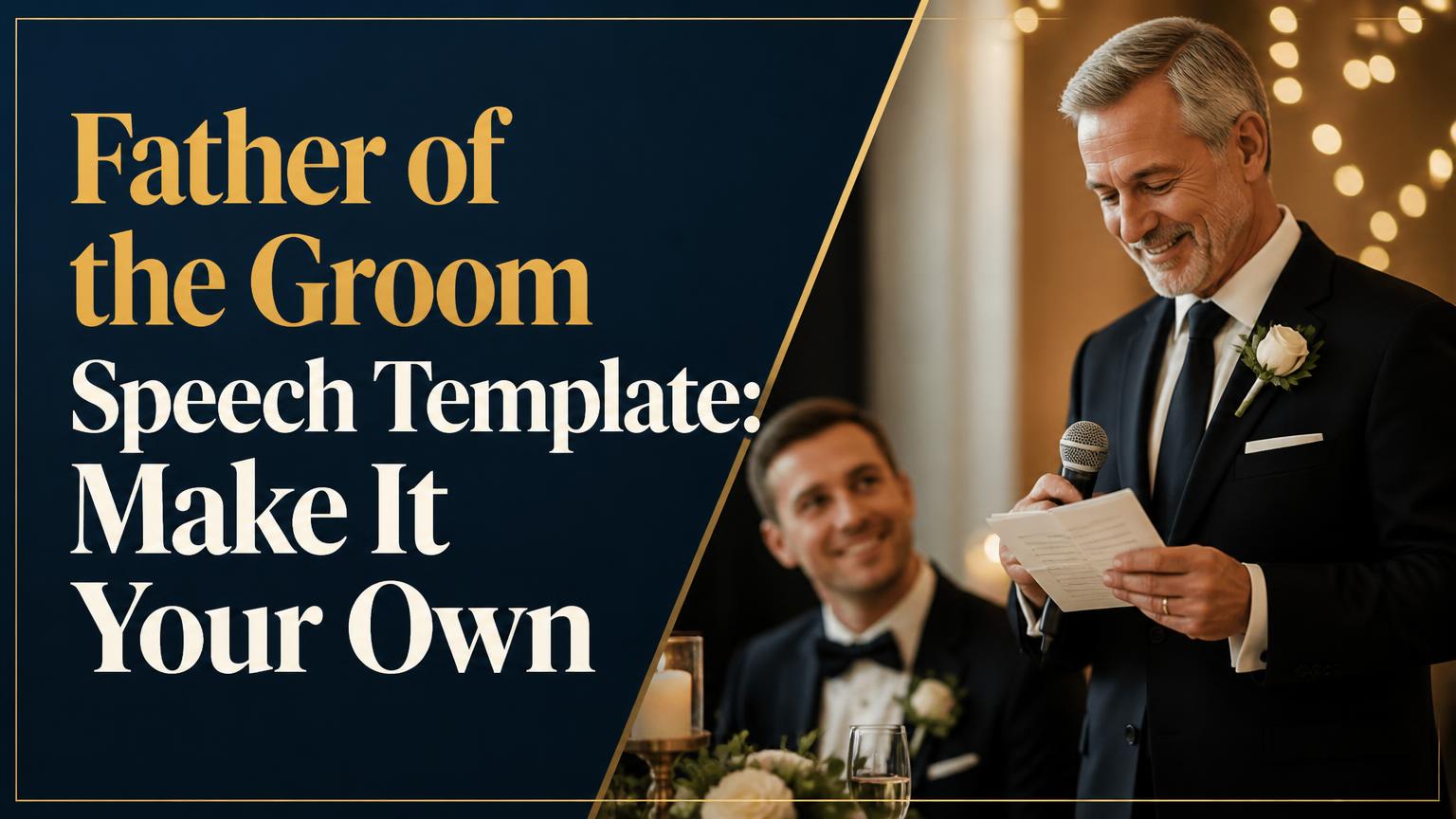
Writing a father of the groom speech can feel like a considerable responsibility. You want to welcome your son’s partner, honor both families, share something meaningful about your son, and celebrate the couple without making the speech too long or too personal. The most effective speech is warm, specific, and easy to deliver aloud. The template below gives you a dependable structure, while the guidance that follows will help you replace the placeholders with genuine memories, appropriate humor, and words that sound like you.
Father of the Groom Speech Template
A father of the groom speech usually combines welcome, gratitude, personal reflection, and a toast to the newly married couple. You do not need to tell your son’s entire life story or list every achievement. One or two carefully chosen memories will be more effective than a long biography.
The template below is designed to last approximately three to five minutes when spoken at a comfortable pace. Replace each bracketed section with details that are true, suitable for the audience, and meaningful to your family. If the wedding is between two grooms or does not follow traditional roles, simply adapt the language to reflect the couple and the celebration.
A Warm, Adaptable Speech Template
Good evening, everyone. For those I have not met, I’m [Your Name], [Groom’s Name]’s father. On behalf of our family, thank you all for being here to celebrate [Groom’s Name] and [Partner’s Name].
Weddings bring together people from different parts of our lives, and it is wonderful to see so many friends and family members gathered in one room. We are especially grateful to [Partner’s Family or Parents’ Names] for the love, support, and welcome they have given [Groom’s Name]. We are very happy to welcome [Partner’s Name] and everyone who has helped make this day possible.
When I think about [Groom’s Name] growing up, I remember [specific memory from childhood, school, family life, or a shared experience]. That memory says something about him that has remained true over the years: [quality, such as his loyalty, determination, kindness, curiosity, or sense of humor].
Of course, every parent watches their child grow and hopes they will find someone who appreciates them for who they are. When [Groom’s Name] met [Partner’s Name], it was clear that this relationship brought out something wonderful in him. He seemed [specific observation, such as more settled, more confident, more joyful, or eager to share his plans]. And as we have come to know [Partner’s Name], we have seen the qualities that make them such a good match: [two or three genuine qualities].
[Groom’s Name], I am proud of the man you have become. I am proud not only of what you have achieved, but also of the way you treat people, the values you carry with you, and the care you show to those you love. [Partner’s Name], thank you for loving him, supporting him, and building this life with him. We are delighted to have you in our family.
Marriage will bring many kinds of days. There will be exciting days, ordinary days, difficult days, and days that become treasured memories simply because you shared them. I hope you continue to give each other patience, honesty, laughter, and room to grow. Keep noticing the small things that first drew you together, and keep choosing one another in the everyday moments as well as the important ones.
Let us raise our glasses to [Groom’s Name] and [Partner’s Name]. May your life together be filled with trust, friendship, laughter, and a deep sense of home. May you continue to support each other’s hopes and celebrate the people you are becoming. To [Groom’s Name] and [Partner’s Name]—we love you, and we wish you every happiness. Cheers!
This template works because it gives the speech a clear emotional progression: welcome the guests, acknowledge the families, remember the groom, honor the partner, offer thoughtful marriage wishes, and finish with a toast. You can shorten it by removing one paragraph, or make it more personal by adding a brief story after the childhood memory.
How to Make the Template Your Own
The template should guide your thinking rather than replace your voice. A speech becomes memorable when the audience hears something only you could say: a small family detail, a revealing observation, or a story that shows the groom’s character. Personalization does not require dramatic revelations. Often, an ordinary moment becomes meaningful when you explain what it taught you about your son or his relationship.
Step 1. Decide What You Want the Speech to Say
Before filling in the blanks, write one sentence describing the main message of your speech. You might want to say, “My son has grown into a thoughtful and dependable man,” or, “His partner brings out his happiest and most generous qualities.” This central idea will help you choose material and avoid wandering into unrelated stories.
A father of the groom speech is not a complete family history, a list of accomplishments, or a second ceremony. Its purpose is to celebrate the couple and offer a personal perspective. If a story or detail does not support that purpose, leave it out or save it for a private conversation.
Step 2. Choose One or Two Revealing Memories
Select memories that show the groom’s character rather than simply proving that something happened. A story about him helping a younger sibling, persevering through a setback, welcoming someone who felt out of place, or taking responsibility may tell the audience more than a long list of achievements.
Keep each story focused. Explain where you were, what happened, and what the moment revealed. Avoid stories that require several minutes of background or include people who are not present and may feel uncomfortable being mentioned. If you use a humorous memory, make sure the groom would be happy to hear it repeated in front of both families.
Step 3. Welcome and Honor the Partner
The partner should have a meaningful place in the speech, not merely a brief mention near the toast. Speak directly to [Partner’s Name] if that feels natural, and identify qualities you have genuinely observed. You might mention their warmth toward relatives, their ability to make your son laugh, their patience, or the way they support his ambitions.
Avoid presenting the partner as someone who has “changed” or “improved” your son, as though he was incomplete before the relationship. A better approach is to describe what you have noticed in the couple together. Say that they encourage each other, make decisions as a team, or bring out qualities that are especially lovely to see.
Step 4. Use Humor With Care
Gentle humor can make a father of the groom speech sound relaxed, but the joke should never become the main event. Good wedding humor usually comes from a harmless family habit, a recognizable difference between childhood and adulthood, or the father’s own perspective on seeing his son grow up.
Avoid jokes about divorce, former partners, drinking, money, appearance, private arguments, or the couple’s future difficulties. Do not embarrass the groom or partner to get a laugh. If you are unsure whether a story is appropriate, remove the most revealing detail or choose a warmer memory instead. A smile from the couple matters more than a large laugh from the room.
Step 5. Include Both Families and the Wider Community
A wedding speech belongs to more than the speaker and the groom. Thank the guests for attending, acknowledge the partner’s family, and recognize the people who have supported the couple. Depending on the occasion, you may also mention relatives who could not attend or remember those who have died, provided the couple and their families would welcome that reference.
Do not turn this section into a long list of names. One sincere sentence is often enough. If there are formal thank-you speeches planned elsewhere, keep your remarks personal rather than repeating the entire wedding party’s acknowledgments.
Step 6. Write for the Ear, Not the Page
A sentence that looks elegant on paper may be difficult to say aloud. Read your draft slowly and listen for long clauses, repeated words, and phrases that do not sound like your normal speech. Replace formal expressions with language you would genuinely use when speaking to your son and his partner.
Aim for clear paragraphs and natural transitions. Mark places where you want to pause, especially before a meaningful memory or the final toast. A speech of roughly 400 to 600 words often fits comfortably into three to five minutes, but the right length depends on the wedding schedule, the number of speakers, and your speaking pace.
Step 7. End With a Real Toast
The final toast should be more than “Congratulations” repeated several times. Look ahead and offer a simple, sincere wish for the couple’s life together. You might wish them patience during difficult seasons, curiosity about one another, shared laughter, or a home where family and friends feel welcome.
Keep the last lines easy to remember. Name both partners, invite guests to raise their glasses, and finish with a clear phrase such as, “To [Groom’s Name] and [Partner’s Name].” A concise ending sounds confident and prevents the speech from fading into extra remarks after the emotional conclusion.
Father of the Groom Speech Etiquette and Delivery
There is no single universal format for a father of the groom speech. Wedding customs vary by family, culture, religion, venue, and the couple’s preferences. In some celebrations, the father of the groom is expected to speak; in others, several relatives give short remarks, or the couple chooses not to follow traditional speaking roles. Confirm the plan with the couple or the person coordinating the reception before preparing a speech.
Keep the audience in mind. Guests may include children, older relatives, colleagues, and people from different backgrounds. Avoid references that only a small group will understand unless you briefly provide context. It is also considerate to ask whether the couple wants particular topics avoided, especially family matters, finances, sensitive history, or mentions of absent relatives.
Rehearse out loud at least several times. You do not need to memorize every sentence, but you should know the order of your main points. Use large-print notes or cue cards with short prompts rather than a dense page of text. On the day, speak a little more slowly than feels natural, pause after important lines, and look up often. If emotion interrupts you, take a breath and continue when you are ready; a short pause is entirely acceptable.
Personalizing Common Parts of the Template
A few sections of the template often need more thought than others. The following approaches can help you replace general wording with details that feel genuine without making the speech too intimate.
Finding the Right Description of Your Son
Choose qualities you have seen in action. Instead of writing that your son is “amazing,” explain that he is the person who checks on relatives, keeps a promise when it is inconvenient, or makes time for friends who need him. Concrete descriptions sound more affectionate and credible than a string of broad compliments.
You can also acknowledge growth without suggesting that marriage has completed him. For example, you might describe how he has become more patient, more confident, or more willing to listen over the years. This gives the audience a thoughtful sense of his journey while keeping the focus on the man he is today.
Describing the Couple’s Relationship
Think about what you have observed when the couple is together. Do they listen carefully to each other? Do they make room for each other’s interests? Do they handle practical responsibilities as a team? Do they bring playfulness or calm into one another’s lives? These observations create a more personal picture than simply saying they are “perfect for each other.”
Do not claim to know every part of their relationship. A respectful speech recognizes that marriage belongs to the couple. Your role is to celebrate what you have seen and to offer good wishes, not to instruct them about every decision they should make.
Including a Family Memory
A family memory can connect the groom’s past with the person he is now. Consider a holiday, move, school event, hobby, challenge, or ordinary routine that still makes you smile. The memory does not need to be dramatic. A detail such as a familiar phrase, an old habit, or the way he reacted to an unexpected situation may help guests understand his personality.
Keep the story brief and make its relevance clear. After telling it, add a sentence explaining what it shows about him or why it remains meaningful to you. Without that reflection, the anecdote may feel disconnected from the wedding.
Closing Thoughts
A strong father of the groom speech does not depend on perfect wording or an elaborate story. It depends on sincerity, proportion, and a clear understanding of the occasion. Use the template as a framework, then replace general phrases with details that are true to your son, his partner, and your family. Keep the humor kind, the memories focused, and the ending directed toward the couple’s shared future. When the speech sounds like you, it will feel personal to everyone listening.