
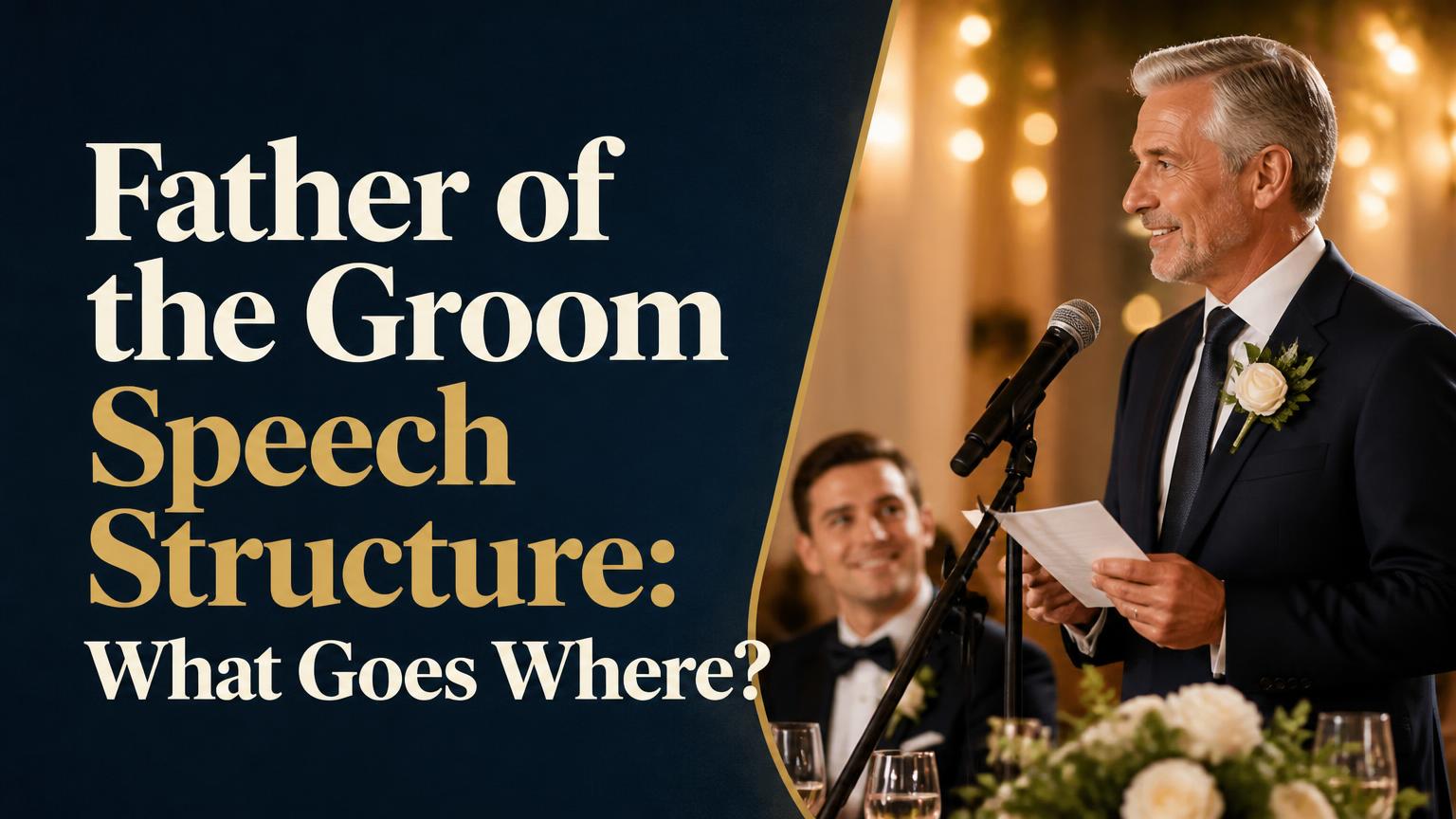
A father of the groom speech should feel welcoming, personal, and appropriately focused on the couple. The strongest structure gives you a clear beginning, a few meaningful moments from the groom’s life, a warm welcome to his partner, and a concise toast to their future. There is no single required wedding-speech formula, since traditions differ between families and cultures, but knowing what generally goes where makes the writing easier and the delivery more confident.
Father of the Groom Speech Structure
A practical father of the groom speech usually follows this order: welcome the guests, express gratitude, introduce the groom through a few defining qualities, share one focused story, welcome the bride or groom’s partner, offer a thoughtful reflection on marriage, and finish with a toast. You can adjust the order slightly to suit the wedding program, your relationship with the couple, and the tone the couple has requested.
The speech does not need to summarize the groom’s entire life or compete with the best man and maid of honor. Your role is to offer a father’s perspective while making the whole couple feel celebrated. The following structure gives each part a clear purpose.
Step 1. Open With a Warm Welcome
Begin by greeting the guests and acknowledging the significance of the day. A simple opening is usually more effective than a dramatic quotation or an elaborate joke. Introduce yourself briefly if some guests may not know you, and identify your relationship to the groom.
You might say, “Good evening, everyone. For those who have not met me, I’m [Name], [Groom’s Name]’s father, and it is a pleasure to welcome you to this wonderful celebration.” From there, mention how meaningful it is to see the couple surrounded by family and friends. Keep the opening friendly and easy to deliver.
Step 2. Thank the Hosts and Guests
After welcoming everyone, express appreciation to the people who helped make the wedding possible. Depending on the arrangements, this might include the hosts, family members, the wedding party, venue staff, or guests who traveled a long distance. Do not assume that one family formally hosted the wedding if that tradition does not apply.
Keep these thanks specific but brief. You could recognize the care that went into the day, thank guests for sharing the occasion, or acknowledge those who made a special effort to attend. If another speaker has already covered these acknowledgments, avoid repeating a long list and move naturally toward the groom and his partner.
Step 3. Introduce the Groom Through Character
This is the point where you give the audience a glimpse of the man the groom has become. Rather than listing every achievement, choose two or three qualities that genuinely describe him. Perhaps he is dependable, patient, curious, generous, quietly determined, or someone who makes people feel at ease.
Connect those qualities to your experience as his father. A brief observation about how he handled responsibility, supported a friend, pursued a goal, or changed over time will feel more personal than general praise. The goal is not to claim that he is perfect. It is to show the audience what you value in him and why those qualities matter in his marriage.
Step 4. Tell One Focused Story
A single well-chosen story often gives the speech its emotional center. Select a memory that reveals something about the groom rather than merely proving that something amusing happened. The story might involve a childhood moment, a family tradition, a difficult challenge, or an occasion when you saw his maturity or kindness clearly.
Keep the details relevant to the wedding and understandable to everyone in the room. Avoid private references that exclude most of the audience, embarrassing stories, and anecdotes that require a long explanation. A story should have a clear point: after telling it, explain in one or two sentences what it shows about the groom today.
Step 5. Welcome the Groom’s Partner
Make a deliberate transition from speaking about your son to honoring the person he is marrying. Use their name, speak directly about the qualities you appreciate, and explain what you have noticed about their relationship. This section should not sound like an examination or a formal test that the partner has passed.
You might describe the warmth they bring to the family, the way they encourage each other, or the ease and respect you see between them. If you have a meaningful memory of meeting the partner or observing the couple together, include it briefly. Make sure the focus remains on both people rather than suggesting that the partner’s main role is to improve or complete the groom.
Step 6. Reflect on the Couple’s Future
Once you have introduced both people, broaden the speech to consider their life together. Offer a sincere wish rather than a long lecture about marriage. You might speak about patience, humor, listening, shared effort, or making time for one another during busy seasons of life.
Advice works best when it is modest and personal. Instead of presenting yourself as an authority on every aspect of marriage, frame the thought as a hope or observation: “I hope you continue to give each other the same patience and good humor you have shown today.” This creates warmth without making the couple feel as though they are being instructed in front of their guests.
Step 7. End With a Clear Wedding Toast
The final section should gather the speech’s feeling into a simple, memorable conclusion. Express your love or affection for the groom, welcome the partner again if appropriate, and offer your good wishes for their life together. Do not introduce a new story or complicated idea at the end.
Then invite the guests to raise their glasses. A traditional ending might be, “Please raise your glasses to [Name] and [Name]. May your marriage be filled with trust, laughter, and many good years together. To the happy couple.” The wording can be formal, affectionate, or lightly humorous, but everyone should understand clearly that the speech has finished.
How Long Should a Father of the Groom Speech Be?
A father of the groom speech usually works well at about three to five minutes, depending on the number of speakers and the couple’s schedule. At a natural speaking pace of roughly 120 to 140 words per minute, that is approximately 360 to 700 words. A shorter speech is often preferable when several relatives and members of the wedding party are also speaking.
The couple or wedding coordinator may provide a specific time limit, and that request should take priority over general tradition. A five-minute speech should not feel rushed, while a two-minute speech can still be meaningful if it contains a clear memory and a sincere welcome. Read your draft aloud with a timer, allowing extra time for laughter, applause, pauses, or emotion. If the speech runs long, remove repeated compliments, secondary anecdotes, and detailed thank-you lists before cutting the most personal material.
How to Personalize the Speech Structure
A structure is useful because it prevents you from losing your place, but it should not make the speech sound like a form. Personalization comes from choosing details that only you could offer while keeping the couple and the occasion at the center.
Choose One Central Message
Before writing individual paragraphs, decide what you most want the couple and guests to understand. Your central message might be that the groom has grown into a thoughtful man, that the partner has become a treasured member of the family, or that the couple brings out steadiness and joy in each other.
This message acts as a filter. If a story, compliment, or piece of advice does not support it, you can shorten or remove that material. A central idea also creates a more coherent speech than a collection of unrelated memories. You do not need to state the message as a slogan; it should simply guide the choices you make.
Select Details Only You Can Provide
Think beyond obvious praise such as “kind,” “hardworking,” or “successful.” Ask yourself when you have actually seen those qualities in action. What small habit, family moment, conversation, or decision illustrates the groom’s character? What did you notice when he first introduced his partner to the family?
Specific details make a speech sound authentic, but they do not need to be private or elaborate. A brief description of the groom making time for someone, staying calm during difficulty, or showing care in an ordinary moment may reveal more than an impressive list of accomplishments. Replace bracketed prompts with memories you can describe truthfully.
Balance Emotion With Restraint
A wedding speech can be moving without becoming overwhelming. If you expect to feel emotional, write shorter sentences and leave space for pauses. You do not have to describe every feeling you have about your child’s marriage. One honest sentence can carry more weight than several paragraphs of intensified language.
It is also acceptable to acknowledge that the day feels significant or that watching your child marry brings mixed emotions. Avoid turning the speech into a personal farewell, however. The purpose is to celebrate a new chapter, not to suggest that the groom is leaving his family behind or that the partner is taking him away.
Keep the Couple at the Center
The groom is naturally important in a speech from his father, but the wedding celebrates a partnership. After sharing your perspective on your son, make a clear transition to the person he is marrying and to the relationship they have built. Use both names throughout the speech rather than speaking about the partner only once.
Review each paragraph and ask whether it serves the couple’s celebration. A long childhood history, professional biography, or family in-joke may be interesting to you but less appropriate for the room. The best personal material leads naturally toward the couple’s present relationship and future together.
Edit for Spoken Delivery
A speech that reads beautifully may still be difficult to say aloud. Read every paragraph at a conversational pace and listen for long sentences, repeated words, formal expressions, and transitions that feel artificial. Replace written phrases with the language you would naturally use when speaking to the guests.
Mark places to pause, especially before an important memory or the final toast. Print the speech in a large, readable format or transfer it to notes with clear paragraph breaks. Editing for speech does not mean removing all elegance; it means making sure the words can be understood when you are standing in a room, holding a microphone, and responding to real emotion.
Common Father of the Groom Speech Mistakes
Most problems in a wedding speech are not caused by a lack of affection. They come from losing sight of the audience, the time limit, or the couple’s comfort. A few careful choices can keep the speech generous, balanced, and easy to receive.
Making the Speech Entirely About the Groom
The groom should be a central subject, but the speech should not sound like a biography or a father’s private tribute. If every paragraph concerns his childhood, schooling, career, or achievements, the partner and the marriage can disappear from view.
Give the groom a meaningful introduction, then widen the focus. Include what you appreciate about the partner, what you notice in their relationship, and what you hope for them together. This balance is especially important when many guests know the partner better than they know the groom’s family history.
Using Embarrassing Stories or Private Jokes
A story that seems harmless within the family may feel uncomfortable in a wedding reception full of people who do not know the background. Avoid stories involving bodily mishaps, former relationships, intoxication, serious family conflict, or details the couple has not chosen to share publicly.
Private jokes can also weaken a speech because they leave the audience waiting for an explanation. Choose humor that includes the room rather than making the groom or partner the target. If you are uncertain whether a story is appropriate, ask the couple or another trusted person before including it.
Offering Too Much Marriage Advice
A few thoughtful wishes can be lovely; a long list of rules can sound patronizing. The couple may already have received advice from several speakers, relatives, and friends during the wedding events. Your role is to support them, not to present a lecture on how they must live.
Keep advice brief, optional, and grounded in your own experience. Phrases such as “I hope you continue to…” or “One thing I have learned is…” sound more generous than commands. Leave room for the couple to build a marriage that reflects their own values and circumstances.
Forgetting the Wedding Setting
A reception speech should suit the atmosphere of the event. A formal evening celebration may call for measured language, while a relaxed gathering may welcome a lighter and more conversational style. Neither setting requires you to imitate another speaker or follow a tradition that does not fit the couple.
Check practical details before writing the final version. Find out when you are speaking, whether a microphone will be used, how many other speeches are scheduled, and whether the couple has requested any subjects be avoided. Customs involving family acknowledgments, religious language, and toasts vary, so do not treat one format as universal.
Ending Without a Clear Conclusion
A speech can lose its impact if the speaker continues adding memories after the main point has been made. Once you have welcomed the partner, reflected on the couple, and expressed your wishes, move toward the toast instead of searching for another anecdote.
Write the final two or three sentences in advance. This gives you a reliable ending if you become emotional or lose your place. Raise your glass only after naming the couple and making the invitation clear. A concise ending often leaves a warmer impression than a speech that fades into repeated praise.
A Practical Writing Checklist
Before you deliver the speech, confirm that it contains a welcome, a brief acknowledgment of the guests or hosts, a personal view of the groom, one memorable story, a sincere welcome to the partner, and a clear toast. These elements do not need equal space. The story and personal reflections may take most of the speech, while the thanks and toast should remain concise.
Read the finished draft aloud at least twice. Check that the opening makes sense to guests who do not know you, that every anecdote has a clear point, and that the names are pronounced correctly. Remove anything that could embarrass the couple or require a lengthy explanation. Then print a readable copy, mark natural pauses, and practice looking up from the page at the moments that matter most.
Closing Thoughts
The best father of the groom speech structure gives you enough guidance to feel prepared while leaving room for your own voice. Start by welcoming the guests, move through a small number of meaningful and relevant observations, honor the groom’s partner, and finish with good wishes for the marriage. Keep the speech within the time limit, choose details that are genuinely yours, and remember that a sincere, well-focused toast will matter more than a perfectly polished performance.