
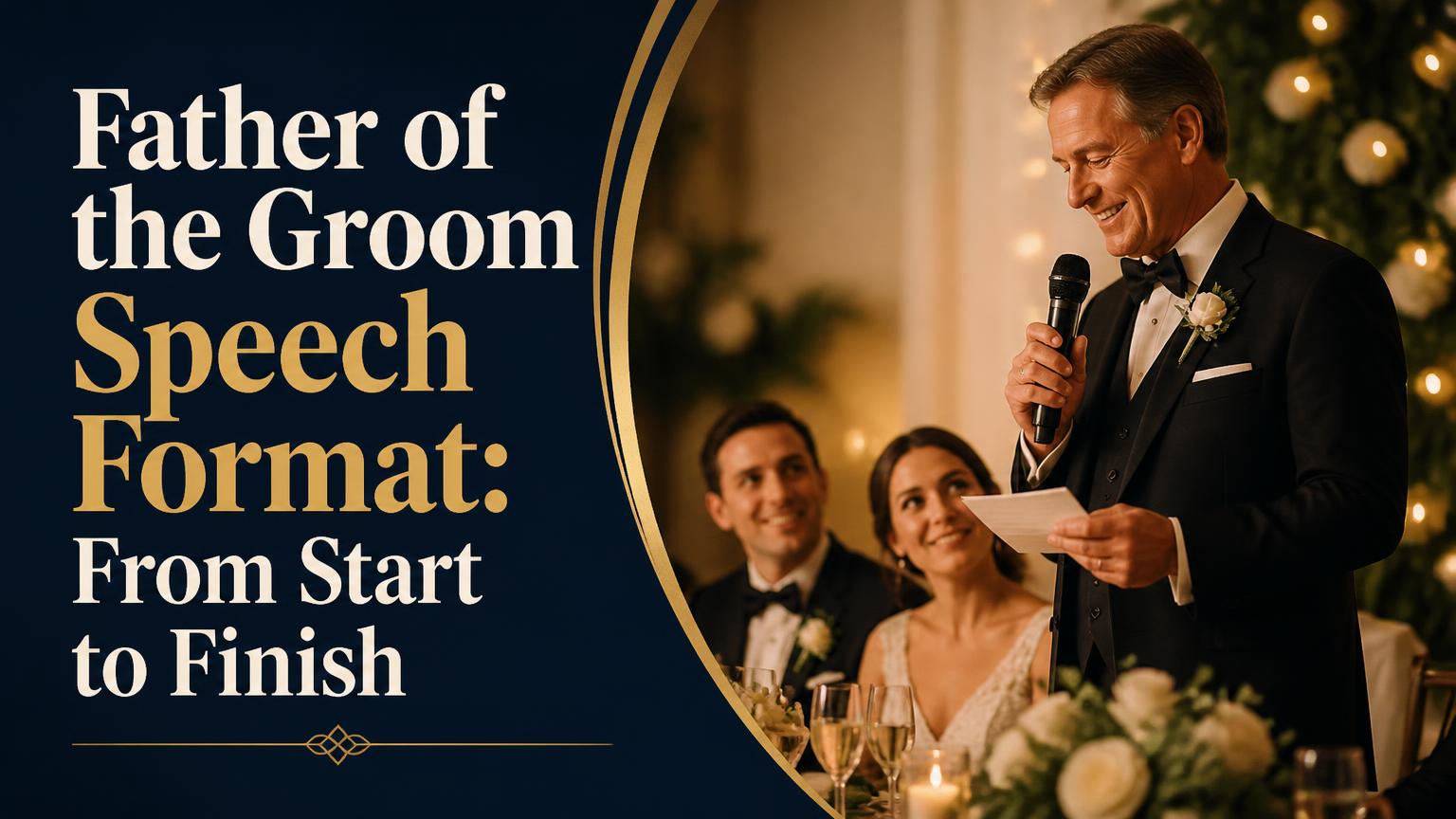
The father of the groom speech usually combines welcome, gratitude, personal reflection, and good wishes for the newly married couple. It should acknowledge the significance of the day without turning into a private family history or a second best man’s speech. The most effective format is warm, focused, and easy to follow: greet the guests, recognize both partners, share a meaningful story, offer a thoughtful reflection, and finish with a clear toast. The guide below takes you through each part from the first sentence to the final raised glass.
Father of the Groom Speech Format: A Start-to-Finish Guide
A strong father of the groom speech does not need to follow an inflexible tradition. Wedding customs differ among families, cultures, religions, and venues, and the couple may have specific preferences about who is thanked or what is mentioned. Still, a reliable structure helps you feel prepared and ensures that your speech gives attention to the people who matter most.
The basic format is: welcome the guests, thank them for attending, acknowledge the couple, share one or two suitable memories, describe what you admire about their relationship, offer wishes for their future, and propose a toast. The following steps develop that format into a speech that sounds personal rather than mechanical.
Step 1. Define the Speech's Purpose
Before writing, decide what you want guests to understand or feel when you finish. As the groom’s father, your purpose may be to welcome the bride or groom’s spouse into the family, express pride in your son, recognize the couple’s relationship, and thank the people who helped make the day possible. You do not need to cover every family achievement or tell your son’s entire life story.
Choose one central message to guide your choices. It might be that your son has found a true partner, that the couple brings out the best in each other, or that marriage is strengthened by patience and shared kindness. A clear purpose makes the speech easier to write and prevents unrelated stories from competing for attention.
Step 2. Welcome Guests and Thank Them for Coming
Begin with a direct greeting that suits the formality of the wedding. You might welcome family members, friends, and guests who have traveled to attend. If the couple has asked you to acknowledge particular people, such as relatives who helped organize the celebration, include them naturally rather than turning the opening into a long list of names.
Your opening should establish warmth and confidence within the first few sentences. You can mention the pleasure of seeing both families and friendship groups gathered together, but keep the focus on the couple. Avoid apologizing for your public speaking, announcing that you are nervous, or beginning with a joke that requires the audience to know private family history.
Step 3. Acknowledge Both Partners and Their Families
Although your relationship with the groom gives you a natural starting point, this is a speech about a marriage, not only about your son. Speak respectfully and specifically about his spouse. You might mention a quality you admire, the welcome they have extended to your family, or the way their presence has brought happiness and confidence to the groom.
If appropriate, acknowledge the other family and thank them for their support, friendship, or hospitality. Do not assume that one family has formally hosted the wedding or that a particular etiquette rule applies. A simple expression of gratitude is usually safer and more inclusive than making claims about who paid for, arranged, or hosted the celebration.
Step 4. Add One or Two Meaningful Stories
Choose a small number of stories that reveal character and connect naturally to the couple. A memory from your son’s childhood can work well if it illustrates a quality that remains visible today, such as persistence, generosity, curiosity, or loyalty. You can also tell a brief story about meeting his spouse or noticing how the relationship affected him.
Keep each story concise and understandable to guests who were not present. Give enough context for the audience to follow it, then explain why the moment matters. Avoid embarrassing incidents, references to former relationships, private arguments, sensitive family information, or jokes that could make either partner uncomfortable. One vivid, relevant memory is more effective than several rushed anecdotes.
Step 5. Connect the Story to the Couple's Future
After sharing a memory, explain what it shows about the groom or the couple. This transition is what turns an anecdote into a speech rather than a collection of unrelated stories. For example, a story about your son helping a neighbor may lead into a reflection on the care and steadiness he brings to his marriage.
Offer advice only if it sounds natural for your relationship and appropriate for the audience. A brief observation about listening, making room for laughter, or standing together during difficult seasons can be meaningful. Avoid presenting marriage as effortless or suggesting that you possess a universal formula for success. Your role is to offer sincere good wishes, not to lecture the couple.
Step 6. Thank the People Who Made the Day Possible
Near the end of the speech, include any essential thanks that have not already been covered. These may include relatives, friends, the wedding party, the venue team, or anyone who provided meaningful support. Ask the couple beforehand if there are people they especially want mentioned. Names should be pronounced correctly, and the list should remain short enough to preserve the speech’s emotional focus.
Thank the guests as well, particularly those who traveled a long distance or supported the couple through an important period. Be careful not to create a second formal acknowledgments section if another speaker is responsible for that role. Coordinate with the couple, wedding planner, or other speakers so that your remarks complement the program instead of repeating it.
Step 7. End With a Clear, Warm Toast
The conclusion should make it obvious that the speech is ending. Bring your main message back to the couple, express your affection or respect, and state your wishes for their life together. A direct ending is stronger than continuing until the material runs out. You might say that you are proud to welcome the spouse into the family or grateful to witness the beginning of this shared life.
Then invite the guests to raise their glasses. Name both partners, not only the groom, and make the toast easy to repeat or understand. A simple wish for happiness, friendship, courage, and many good years together is sufficient. Once the toast is complete, stop. Do not add another story, explanation, or apology after the glass is raised.
Final Checks Before You Speak
Writing the words is only part of preparing a father of the groom speech. A speech that looks polished on the page may be too long, too formal, or difficult to deliver aloud. Read it several times at a natural speaking pace, and listen for sentences that sound unlike the way you normally speak. Spoken language benefits from shorter paragraphs, clear transitions, and occasional pauses.
Also consider the practical setting. You may be speaking in a busy reception room, using a microphone, competing with background noise, or becoming emotional when you look at your son. Preparing a marked-up copy and practicing the opening and closing can give you stability without making the speech sound memorized. The following checks help you make the final version comfortable and appropriate.
Check the Timing and Focus
For many wedding receptions, a father of the groom speech of approximately three to five minutes is long enough to feel substantial without delaying the meal or other speakers. This is a common guideline, not a universal rule. Follow the couple’s instructions and the schedule of the event if they specify a different length.
Time the speech while reading it aloud rather than estimating by page count. Emotional pauses, laughter, applause, and microphone adjustments can make a speech take longer than it does in silent reading. If you need to shorten it, remove a secondary story, repeated compliment, or long list of thanks before cutting the central memory or final toast.
Read Every Sentence Aloud
Reading aloud reveals problems that are easy to miss on the page. You may discover that a sentence has too many clauses, a transition feels abrupt, or a particular phrase sounds overly formal. Mark places where you naturally pause, slow down, or want to emphasize a word. Those marks can become useful cues during the reception.
Listen especially for repeated openings such as “I want to say” or “I would like to.” Replace some of them with direct statements. Spoken delivery usually sounds more confident when you say, “What I admire most is…” rather than introducing every thought with an explanation that you are about to share it.
Keep Humor Safe and Inclusive
Gentle humor can make a wedding speech feel relaxed, but it should support affection rather than create discomfort. Choose amusing observations that do not depend on humiliating the groom, criticizing the spouse, or exposing a private family story. If a joke would be difficult to explain to the couple afterward, it probably does not belong in the speech.
Avoid humor about divorce, former partners, money, appearance, fertility, drinking, or conflicts between families. Do not assume that a story is suitable simply because relatives have laughed about it in private. Wedding audiences include different ages, relationships, and cultural expectations, so humor should be understandable and kind.
Prepare Notes You Can Actually Use
A full printed speech is acceptable, especially for an emotional occasion, but use a readable format. Choose a large enough font, leave generous spacing, and mark paragraph breaks clearly. Numbering the pages can help if they become separated. You can also prepare a shorter cue-card outline with the opening, story prompts, key thanks, and toast.
Do not reduce your notes to single words unless you have practiced extensively from that format. Under pressure, a vague prompt such as “childhood story” may not be enough to recover the details you want. Keep the complete version nearby even if you plan to use cards, and bring a backup copy on paper or on a device approved for the venue.
Plan for Emotion and Unexpected Interruptions
It is normal to feel emotional when speaking about your child’s marriage. Build pauses into the speech rather than trying to eliminate every feeling. Take a breath, look down at your notes, and continue when you are ready. You do not need to apologize repeatedly for becoming emotional; a brief pause is usually easier for the audience than a long explanation.
Reception conditions may also change. Someone may interrupt with applause, a microphone may fail, or another speaker may run over time. Know the essential shape of your speech so you can skip a paragraph without losing the ending. If public speaking feels overwhelming, discuss alternatives with the couple, such as sharing the speech privately or having another person read it.
Closing Thoughts
The best father of the groom speech format gives you enough structure to feel secure while leaving room for your own voice. Welcome the guests, recognize both partners, choose memories that reveal something meaningful, offer measured advice or good wishes, and finish with a toast that includes the couple together. Keep the speech respectful, personal, and appropriately brief. Most importantly, coordinate with the couple and adapt the words to your family, the wedding setting, and the relationship you genuinely share.