
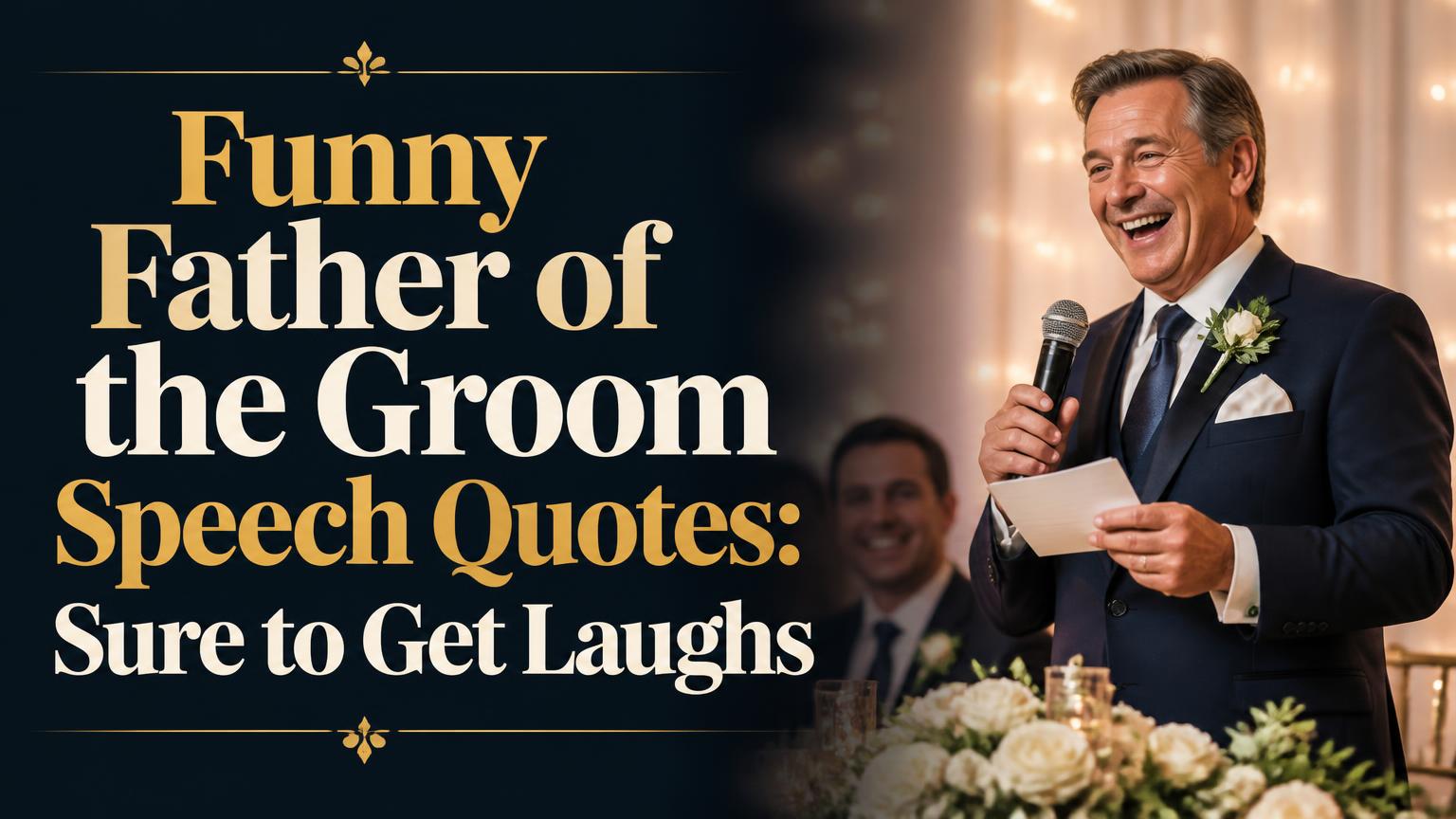
If you are the father of the groom, a few well-chosen funny lines can make your wedding speech warmer, more memorable, and easier to deliver. The best humor celebrates the groom, welcomes his partner, and allows guests to laugh without making anyone uncomfortable. Below, you’ll find original funny father of the groom speech quotes for openings, family stories, marriage advice, and the final toast. They are written to be adapted with names and genuine details from your family.
Father of the Groom Funny Speech Quotes
These funny lines are designed for a wedding audience rather than a comedy club. Use one or two as highlights within a sincere speech, then connect them to a real memory or meaningful observation. All the quotes below are original, so they are not attributed to public figures and can be personalized freely.
Opening Lines That Get the Room With You
A funny opening helps you settle your nerves and gives the audience an immediate sense of your tone. Keep it brief, friendly, and connected to the occasion. A joke about your own role is usually safer than one aimed at the couple, especially before the audience knows where your speech is going.
- “Good evening, everyone. As the father of the groom, I have been asked to say a few words. I have also been asked to keep those words appropriate, brief, and free of childhood stories. So this should be a very short speech.”
- “I’m delighted to be here tonight. I’ve spent years preparing [Groom] for marriage, although most of that preparation involved reminding him to put things back where he found them.”
- “When I was told I would be giving a speech, I was pleased. When I was told it would be at a wedding, I was touched. When I was told there would be a time limit, I knew someone in this family still had good judgment.”
- “Tonight, we celebrate love, family, and the remarkable fact that [Groom] managed to find someone who agrees to spend the rest of life explaining things to him.”
Follow an opening joke with a genuine welcome or a sincere sentence about the couple. That transition keeps the speech from sounding like a string of unrelated one-liners and makes the humor feel affectionate rather than performative.
Funny Quotes About Raising the Groom
Jokes about raising the groom work best when they reveal affection rather than embarrassment. Choose a harmless habit, a familiar family trait, or a broad observation that the groom will recognize. Avoid stories that could make him feel exposed, particularly if children, colleagues, or new relatives are in the room.
- “Raising [Groom] taught us patience, persistence, and the importance of labeling food in the refrigerator.”
- “We always knew [Groom] would grow into a fine man. We just didn’t know how long it would take him to grow into someone who could successfully organize a wedding suit.”
- “As his father, I have offered [Groom] advice for many years. He has listened carefully, nodded thoughtfully, and then done exactly what he had already planned.”
- “I’m proud of the man [Groom] has become. He is kind, dependable, and—after tonight—officially someone else’s responsibility at least half the time.”
- “Children grow up so quickly. One minute you’re teaching your son how to tie his shoes, and the next he is standing at the altar, pretending he knows how to tie a proper knot.”
After a line about childhood, add one true quality that explains why you are proud of him. The humor becomes more meaningful when it leads to something specific, such as his loyalty, generosity, patience, or ability to make people feel welcome.
Welcoming the Groom’s Partner With Humor
The groom’s partner should feel included and respected, not treated as the target of the father’s jokes. Use humor to celebrate what the couple brings out in each other or to welcome a new family member. Avoid jokes about controlling the groom, taking him away, or tolerating his faults.
- “[Partner], we are so happy to welcome you to the family. We promise to treat you with kindness, respect, and just enough unsolicited advice to make you feel completely at home.”
- “[Partner], thank you for loving [Groom] exactly as he is—and for encouraging him to become the version of himself who remembers birthdays and answers messages.”
- “We knew [Partner] was special when [Groom] started improving his appearance before leaving the house. We knew it was serious when he began asking for opinions before making plans.”
- “[Partner], you bring out the very best in [Groom]. We are grateful for that—and also grateful that you have accepted the fact that some of his habits may be beyond professional help.”
- “It is wonderful to welcome you into our family. We hope you feel loved, supported, and prepared for the occasional story that begins, ‘When [Groom] was younger…’”
Whenever possible, replace a general line with a true detail about the partner’s influence. You might mention a new confidence in the groom, a shared interest, or the way the couple supports one another. That makes the welcome feel personal rather than borrowed.
Lighthearted Marriage Advice Quotes
Marriage advice should sound generous, not superior. The father of the groom can offer a playful observation about communication, compromise, or everyday life, then follow it with a sincere wish for the couple. Avoid presenting one person as the permanent decision-maker or suggesting that marriage means surrendering independence.
- “The secret to a happy marriage is simple: listen carefully, apologize promptly, and never begin an important conversation when either of you is hungry.”
- “Marriage is built on love, trust, and compromise. For example, one person chooses the restaurant, and the other person agrees that it was their idea.”
- “Always remember that being right is not the same as being wise. A peaceful marriage contains many moments when wisdom is the better choice.”
- “A good marriage requires teamwork. Some days you will be carrying the heavy load, and other days you will be deciding what to have for dinner. Both responsibilities deserve respect.”
- “My advice is to keep talking, keep laughing, and remember that ‘I’m fine’ may occasionally require a thoughtful follow-up question.”
A funny piece of advice becomes more effective when it is followed by a serious sentence, such as, “In truth, the strongest marriages I know are built on patience, honesty, and the ability to enjoy ordinary days together.” The contrast gives the audience both a laugh and a reason to listen.
Self-Deprecating Quotes for the Father of the Groom
Self-deprecating humor can make a father sound relaxed and approachable, especially if he is nervous about public speaking. The key is to joke about your own speech, habits, or limited authority rather than criticizing yourself harshly. Keep the tone confident enough that guests do not mistake the joke for discomfort.
- “I have prepared carefully for this speech. I wrote down everything I wanted to say, removed the embarrassing stories, and was left with this paragraph.”
- “My role tonight is to offer wisdom. Fortunately, the couple has already shown excellent judgment, so they may not need much of it.”
- “I was told to speak from the heart. I was also told to stay on topic, so I’m going to try to keep my heart reasonably organized.”
- “I have been given a microphone, a time limit, and a room full of witnesses. This is more authority than I have had in years.”
- “I considered beginning with a long story about [Groom]. Then I remembered that the best man has photographs, and I decided cooperation was the wiser path.”
Use this category if you want to acknowledge your nerves without making them the subject of the entire speech. A short self-aware joke can loosen the room, but the main focus should quickly return to the couple and the significance of the day.
Funny Quotes for the Final Wedding Toast
A closing line should leave the audience with affection, not merely a final punchline. The best funny toasts combine a light observation with a sincere hope for the couple’s future. Keep glasses raised only if that fits the venue, family, and wedding customs; a toast can also be delivered with a simple invitation to applaud.
- “May your life together be filled with love, laughter, good health, and the ability to agree on what to watch before the evening is over.”
- “To [Groom] and [Partner]: may you always find reasons to laugh, reasons to stay kind, and at least one person willing to check whether the door was locked.”
- “May your marriage be long, your disagreements short, and your memories far more valuable than anything you put on a wedding registry.”
- “Here’s to a lifetime of shared adventures, private jokes, and the confidence to say, ‘You were right,’ before the discussion becomes a full evening event.”
- “Please raise a glass to [Groom] and [Partner]. May you love each other deeply, forgive each other quickly, and never underestimate the healing power of takeaway food.”
End with the couple’s names and a clear statement of good wishes. A closing such as “To a joyful life together” gives the audience an obvious moment to respond and prevents the speech from fading out after the last joke.
How to Make Funny Wedding Quotes Work in a Father of the Groom Speech
A funny line is most effective when it sounds as though it belongs to you and this particular couple. Rather than filling the speech with jokes, select two or three lines that support a central message: pride in your son, gratitude for his partner, or happiness about the family they are building.
Remember that wedding humor is shaped by the audience. Families, cultures, religions, and venues have different expectations about formality and teasing. A joke that works among close friends may not suit a mixed-age reception. When in doubt, choose warmth over shock and make the couple—not an embarrassing guest or sensitive subject—the center of the celebration.
Know Your Audience Before Choosing a Joke
Consider who will be listening, including the couple’s relatives, older family members, work colleagues, children, and guests you have never met. A father of the groom’s speech usually needs to welcome a broad audience, so humor about everyday family life is safer than profanity, drinking, sex, money, past relationships, or private disagreements.
Think about the couple’s preferred tone as well. Some weddings are relaxed and playful; others are formal or culturally traditional. If the couple has asked for a sincere and respectful celebration, use gentle humor as seasoning rather than turning the speech into a performance.
Keep the Couple at the Center
Even when the title of the speech identifies you as the father of the groom, the occasion belongs to the couple. A joke about raising your son can open a section, but it should lead to something relevant about the man he is today or the relationship he shares with his partner.
A useful balance is to spend some time on your pride in the groom, some time welcoming and appreciating his partner, and most of the speech celebrating their life together. If every joke is about childhood mischief, guests may learn more about the past than about the marriage being celebrated.
Avoid Humor That Creates a Target
Do not use the partner as the target of jokes about appearance, family, background, cooking, spending, or household roles. Also avoid humiliating the groom with stories about poor decisions, romantic history, physical habits, academic failures, or moments he has specifically asked you not to repeat.
Before including a personal anecdote, ask whether the couple would be comfortable hearing it repeated in front of everyone they invited. If the answer is uncertain, leave it out. A successful wedding joke creates shared amusement; it does not require one person to absorb the embarrassment on behalf of the room.
Personalize Each Quote With a True Detail
A ready-made line becomes much stronger when you connect it to a real observation. After a quote about the groom’s advice-taking, you might mention one area in which he has shown maturity. After welcoming his partner, you could refer to a genuine quality you admire or a moment when you saw the couple support each other.
Use names sparingly and replace general wording with details only you can provide. One authentic memory is usually more memorable than five polished jokes. Keep the detail concise, and make sure the audience can understand why it matters without needing a long explanation.
Build a Transition From Humor to Sincerity
A strong father of the groom speech does not jump randomly from joke to joke. After a humorous line, use a transition such as, “But beneath that, there is something I want everyone to know,” or, “That laughter aside, this is what makes me proud.” Then state the sincere thought clearly.
This pattern works because the joke gains purpose. It may begin with a laugh, but it ends by expressing love, gratitude, admiration, or hope. The audience is more likely to remember a funny line when it is attached to a meaningful point about the couple.
Rehearse the Timing and Delivery
Read the speech aloud several times, including every quote you plan to use. A line that looks clever on the page may be awkward when spoken, while a short pause before the final word may make the humor clearer. Mark places to breathe and avoid rushing simply because you feel nervous.
Do not wait too long for laughter. Deliver the line, pause naturally, smile if appropriate, and continue. Keep a printed copy or discreet notes with large type, and practice looking up at the couple and audience. If emotion interrupts you, pause, take a breath, and resume when ready; there is no need to apologize repeatedly.
Adapting These Quotes to Your Own Speech
The easiest way to personalize a funny father of the groom speech is to choose a small number of lines and surround them with genuine material. Begin with a welcome, include one or two observations about the groom, speak directly to his partner, and finish with a sincere toast. The quotes should support that structure rather than replace it.
You can also adjust the level of formality by changing individual words. “The groom” may become “[Name],” “his partner” may become the person’s name, and a general reference to marriage may become a detail that reflects the couple’s shared interests or daily life. Read the final version aloud to ensure every line sounds like something you would naturally say.
If a joke depends on a fact that is not true in your family, do not force it. Replace it with a comparable detail from your own experience. Authenticity matters more than using the exact wording, and a simple observation delivered warmly will usually land better than a clever line that feels borrowed.
Closing Thoughts
Funny father of the groom speech quotes work best when they create warmth as well as laughter. Choose lines that suit the audience, protect the dignity of both partners, and sound natural in your own voice. Add specific memories, sincere appreciation, and a clear toast so the humor has a meaningful place within the speech. A few well-timed jokes can help you relax, welcome the new family member, and celebrate the couple in a way guests will remember fondly.