
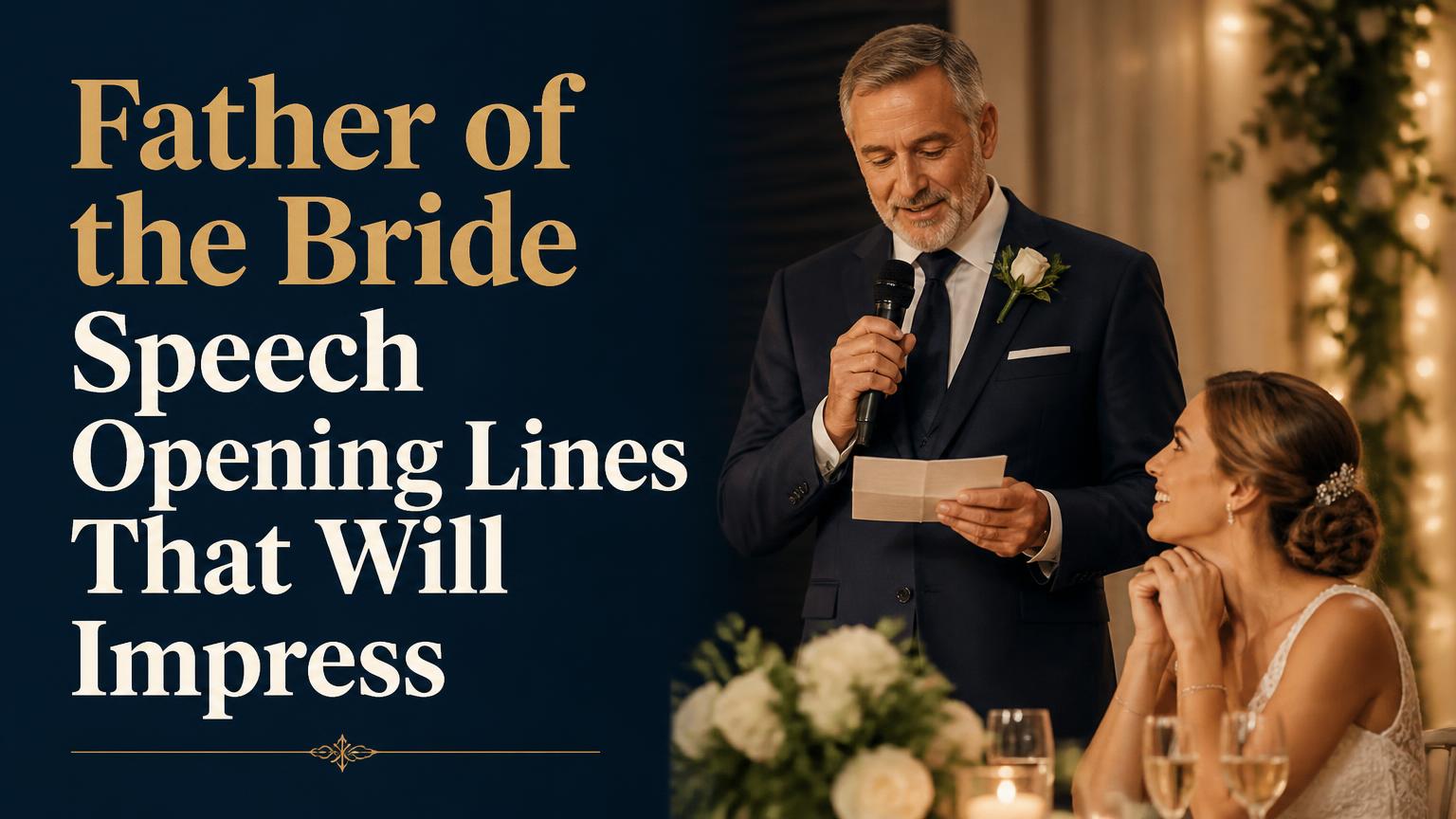
A father of the bride speech should begin with warmth, confidence, and a clear sense of occasion. The first few sentences establish whether the speech will feel heartfelt, amusing, formal, or deeply personal, so they deserve careful thought. The best opening lines welcome the guests, acknowledge both newlyweds, and reveal something genuine about your relationship with your daughter. Below are adaptable examples for different wedding styles, followed by practical guidance for choosing an opening that sounds natural in your own voice.
Father of the Bride Speech Opening Lines That Set the Right Tone
The strongest opening usually does three things quickly: greets the guests, recognizes the couple, and gives the audience a reason to listen. You do not need a dramatic quotation or an elaborate joke. A sincere sentence spoken calmly will often make a better impression than an ambitious opening that does not feel like you.
A Warm and Traditional Welcome
A traditional welcome is a reliable choice for a formal wedding or a large audience. It acknowledges everyone who has gathered without making the beginning sound stiff. You can mention family and friends, express your pleasure at seeing them, and then turn naturally toward the couple.
“Good evening, everyone. Thank you for joining us to celebrate [Daughter’s Name] and [Partner’s Name]. It means a great deal to see so many people who love and support them gathered here tonight.”
You could follow this with:
“As [Daughter’s Name]’s father, I am honored to say a few words about this wonderful day and the two people at its center.”
This opening is respectful, easy to deliver, and suitable for almost any venue or wedding style.
A Heartfelt Opening About Your Daughter
If you want the speech to feel personal from the first sentence, begin with the experience of watching your daughter grow. Keep the focus on one meaningful truth rather than listing every stage of her life. The audience will respond more strongly to a clear emotion than to a long childhood history.
“There are moments in a parent’s life that seem to arrive all at once. Looking at [Daughter’s Name] today, I can see the little girl I raised, the woman she has become, and the happiness she has found with [Partner’s Name].”
Another option is:
“I have watched [Daughter’s Name] grow through many chapters of life, but I have rarely seen her as happy and completely herself as she is with [Partner’s Name].”
These lines express pride without suggesting that the wedding is only about the bride.
An Opening That Welcomes Her Partner
A father of the bride speech should make the couple feel equally valued. Welcoming your daughter’s partner early is especially appropriate when families are meeting or celebrating together for the first time. Speak about the qualities you genuinely appreciate rather than making exaggerated claims.
“From the first time we met [Partner’s Name], we saw someone who brought warmth, steadiness, and happiness into [Daughter’s Name]’s life. Tonight, we are delighted to celebrate not only their marriage but also the family they are creating together.”
You might also say:
“Our family has gained something precious through [Partner’s Name]: not only a son-in-law, daughter-in-law, or spouse to [Daughter’s Name], but a person we are truly glad to call family.”
Adapt the wording to your relationship and the language your family naturally uses.
A Light Humorous Opening
A gentle joke can relax the room, but wedding humor should be affectionate rather than embarrassing. Avoid stories about former relationships, drunken behavior, private arguments, wedding expenses, or anything the couple has not approved. A small observation about your role as a father is usually safer.
“I was told to keep this speech short, meaningful, and free of anything embarrassing. So, naturally, I have prepared three different versions.”
Or try:
“When [Daughter’s Name] asked me to give this speech, I felt proud, honored, and briefly tempted to ask whether there was a maximum word count.”
Pause after the joke and move quickly into sincerity. Humor works best as an introduction to the warmth of the speech, not as the speech’s main subject.
A Memory-Led Opening
A specific memory can draw the audience into the relationship immediately. Choose a moment that reveals your daughter’s character or shows how the couple complements one another. The memory does not need to be dramatic; a small, accurate detail often feels more believable and touching.
“One of the things I have always admired about [Daughter’s Name] is the way she commits herself to the people she loves. I remember [brief, genuine memory], and I see that same generosity in the life she and [Partner’s Name] are building together.”
You could also begin with the first time you noticed the relationship mattered:
“I knew [Partner’s Name] was important to [Daughter’s Name] when [specific observation]. What stood out was not just what she said, but the calm happiness in the way she said it.”
Replace the bracketed detail with a real memory you can tell in two or three sentences.
A Proud but Unpossessive Opening
Parents sometimes unintentionally make a wedding speech sound like a farewell from one family to another. A better opening expresses pride in your daughter while recognizing that marriage is a partnership, not a transfer of ownership. Use language that celebrates her choices and the couple’s shared future.
“I am enormously proud of the woman [Daughter’s Name] has become, and I am equally grateful that she has found someone with whom she can be fully herself. Today is not about losing a daughter; it is about celebrating the life she and [Partner’s Name] are choosing together.”
A shorter version is:
“My greatest hope has always been that [Daughter’s Name] would find a life filled with respect, laughter, and love. Seeing her with [Partner’s Name], I know she has found those things and more.”
This approach is emotional without becoming possessive or overly solemn.
A Brief Formal Opening
Some fathers prefer to keep the first lines simple, particularly when another speaker will offer a longer welcome or when the wedding is highly formal. Brevity can sound polished when every sentence has a purpose.
“Good evening. On behalf of our family, thank you for being here to celebrate [Daughter’s Name] and [Partner’s Name]. We are proud of them, grateful for this gathering, and delighted to share this occasion with all of you.”
You can then transition directly into the main message:
“I would like to begin by saying a little about the daughter I have known all her life and the partner she has chosen for the future.”
A concise opening is not impersonal if it is delivered with eye contact and genuine feeling.
An Inclusive Opening for a Diverse Family
Wedding audiences may include separated parents, blended families, different faiths, cultures, nationalities, and guests who know only one side of the couple. An inclusive opening avoids assumptions and makes everyone feel recognized. Use the names, family terms, and traditions that are accurate for this wedding.
“Today brings together two people, two families, and many different circles of friends. However we arrived here and whatever traditions we bring with us, we are united in celebrating the love and commitment of [Daughter’s Name] and [Partner’s Name].”
Another option is:
“It is a privilege to see so many people from different parts of [Daughter’s Name] and [Partner’s Name]’s lives sharing one room and one joyful occasion.”
This kind of opening is particularly effective when the couple has planned a multicultural, interfaith, or nontraditional celebration.
How to Choose the Right Opening Lines
The most impressive opening is not necessarily the funniest or most poetic. It is the one that fits your relationship with your daughter, the couple’s personality, and the atmosphere of the wedding. Before choosing a line, consider what you genuinely want the audience to understand about the day.
Match the Wedding’s Formality
Listen to the tone established by the ceremony, venue, invitations, and other speakers. A formal hotel reception may call for a polished welcome, while a relaxed outdoor celebration may suit a conversational beginning. This does not mean copying the venue’s style exactly; it means avoiding a sharp mismatch.
Read your proposed opening aloud and ask whether you would actually say those words to the room. If the language feels too ceremonial, simplify it. If the wedding is formal, avoid sounding casual merely because you are nervous. A natural voice can still be respectful and well prepared.
Decide What You Want to Say First
Choose one central purpose for the opening: welcome the guests, express pride, introduce the partner, share a memory, or establish a gentle mood. Trying to do all five in the first thirty seconds can make the speech feel crowded.
Write down the one sentence you most want people to remember from the beginning. Then build two or three supporting sentences around it. For example, if your purpose is to welcome the partner, mention what you appreciate and how glad you are to celebrate the couple. A clear purpose makes the opening easier to deliver.
Mention Both People Early
Although you are speaking as the bride’s father, the occasion celebrates a marriage or partnership. Mention your daughter and her spouse or partner near the beginning so neither person seems like an afterthought. This is especially important if the rest of the speech includes several childhood memories.
You can name both people in the greeting, then refer to the partner again when describing the future they are creating. Avoid language that makes the partner sound like a guest being assessed or approved. The speech should communicate welcome, respect, and genuine happiness for them both.
Choose Humor You Can Defend
Before using a joke, ask whether the couple would be comfortable hearing it in front of every guest, including relatives, colleagues, and older family members. If the answer is uncertain, leave it out. A joke that depends on embarrassment may produce a laugh, but it can also become the detail people remember for the wrong reason.
The safest humor is self-aware, brief, and affectionate. Jokes about your nerves, your inability to keep the speech short, or the emotional difficulty of seeing your daughter grow up are usually easier to adapt. Never use humor to reveal private information or criticize the couple.
Keep the First Minute Focused
A strong opening generally takes less than a minute before moving into the main message. This is not a strict rule, but it helps you avoid spending too long on greetings, thank-yous, or background. At a typical speaking pace, 120 to 140 words takes about one minute, though pauses and emotion may make you slower.
Draft the opening, count the words, and read it aloud with the pauses you expect to use. If it takes more than a minute and a half before the speech reaches its subject, remove repeated welcomes and unnecessary explanations. The audience should understand the occasion quickly.
Make the Language Sound Like You
Do not choose a line simply because it appears polished on the page. A father who usually speaks plainly may sound uncomfortable delivering a highly poetic sentence. Likewise, someone who enjoys storytelling should not force the entire opening into a stiff formal formula.
Underline words you would not normally use and replace them with language you would say in conversation. Then rehearse the revised version aloud. The goal is not to sound casual at all costs; it is to sound sincere, prepared, and recognizable to the people who know you.
Leave Room for a Natural Transition
Your opening should lead somewhere. If you begin with a welcome, move into your relationship with your daughter or the significance of the couple. If you begin with a joke, follow it with a sincere observation. If you begin with a memory, explain what that memory reveals about her or the relationship.
A useful transition might be, “That has always been one of [Daughter’s Name]’s qualities,” or, “That is why seeing her with [Partner’s Name] means so much to me.” A clear bridge prevents the opening from feeling like a separate performance attached to the rest of the speech.
What to Say After the Opening Lines
Once you have welcomed the guests and established the tone, the next part of the speech should develop the idea you introduced. You do not need to follow a rigid formula, but a few dependable transitions can help the speech feel connected rather than like a series of unrelated remarks.
Move From Welcome to Appreciation
If your opening thanks the guests, explain why their presence matters. You might recognize family members who traveled, friends who have supported the couple, or everyone who helped make the celebration possible. Keep this section selective; you do not need to list every person involved in the wedding.
For example, you could say, “Many of you have known [Daughter’s Name] for years, while others have become important to her more recently. Seeing all of you here is a reminder of how many people have helped shape and support her life.” This creates a natural bridge to your personal reflections.
Introduce One Specific Memory
A single well-chosen memory is usually more effective than a catalogue of childhood stories. Select an incident that shows kindness, determination, humor, loyalty, or another quality you want the audience to understand. Give enough context for people who were not there, then explain why the memory still matters.
Keep the story focused and avoid private details that could embarrass your daughter. The point is not to prove how much you remember; it is to illuminate the person she is today. End the anecdote by connecting it to her relationship or character.
Turn Toward the Couple
After discussing your daughter, make a clear turn toward the two people being celebrated. Mention what you have observed in their relationship: perhaps they listen to each other, make room for one another’s ambitions, or bring out a relaxed and joyful side of each other.
A transition such as, “The qualities I have admired in [Daughter’s Name] have found a wonderful match in [Partner’s Name],” can work well if it is followed by a specific example. Avoid presenting yourself as the judge who has granted approval. Speak instead as someone grateful to witness their partnership.
Offer a Thought About Marriage
You do not need to deliver a grand lesson about marriage. A modest observation drawn from experience will sound more authentic. You might say that a lasting partnership involves attention, patience, humor, or the willingness to keep choosing one another through ordinary days as well as important ones.
Keep the advice appropriate to your relationship and avoid sounding as though you are instructing the couple. A sentence such as, “The happiest partnerships I have seen are built in the small, ordinary acts of consideration,” offers a useful thought without turning the speech into a lecture.
Lead Into the Toast
The ending should make it clear that the speech is moving toward a toast. Mention the couple by name, invite the guests to raise their glasses, and offer a wish that is warm but not overly predictable. You can wish them curiosity, patience, laughter, courage, or a home filled with welcome.
For example: “So please raise your glasses to [Daughter’s Name] and [Partner’s Name]. May the life ahead bring them many reasons to laugh, the strength to meet difficult days together, and the joy of continuing to choose one another.” Keep the final sentence easy to say and pause before drinking.
Opening Lines to Avoid
Avoid beginning with an apology such as “I’m not good at speeches” or “I have no idea what to say.” A brief acknowledgment of nerves can be endearing, but leading with self-criticism makes the audience focus on your discomfort rather than the couple. You also do not need to announce that the speech will be short, because that promise can make listeners watch the clock.
Clichés, exaggerated claims, and long lists of childhood achievements can make an opening feel impersonal. Be cautious with “I always knew this day would come,” “Where has the time gone?” and similar phrases unless you immediately follow them with a specific, truthful detail. Avoid inside jokes, references to wedding costs, comments about appearance, and stories involving former partners or private family disagreements. The first lines should make the room feel included, safe, and ready to celebrate.
Closing Thoughts
The best father of the bride speech opening lines do not try to impress through elaborate language. They create trust by sounding sincere, welcoming both people in the couple, and establishing a tone that suits the wedding. Choose one clear idea, add a genuine detail, and practice until the words feel comfortable aloud. Whether your opening is humorous, formal, emotional, or brief, it will be strongest when it reflects your real relationship with your daughter and your honest happiness for the life she and her partner are beginning together.