
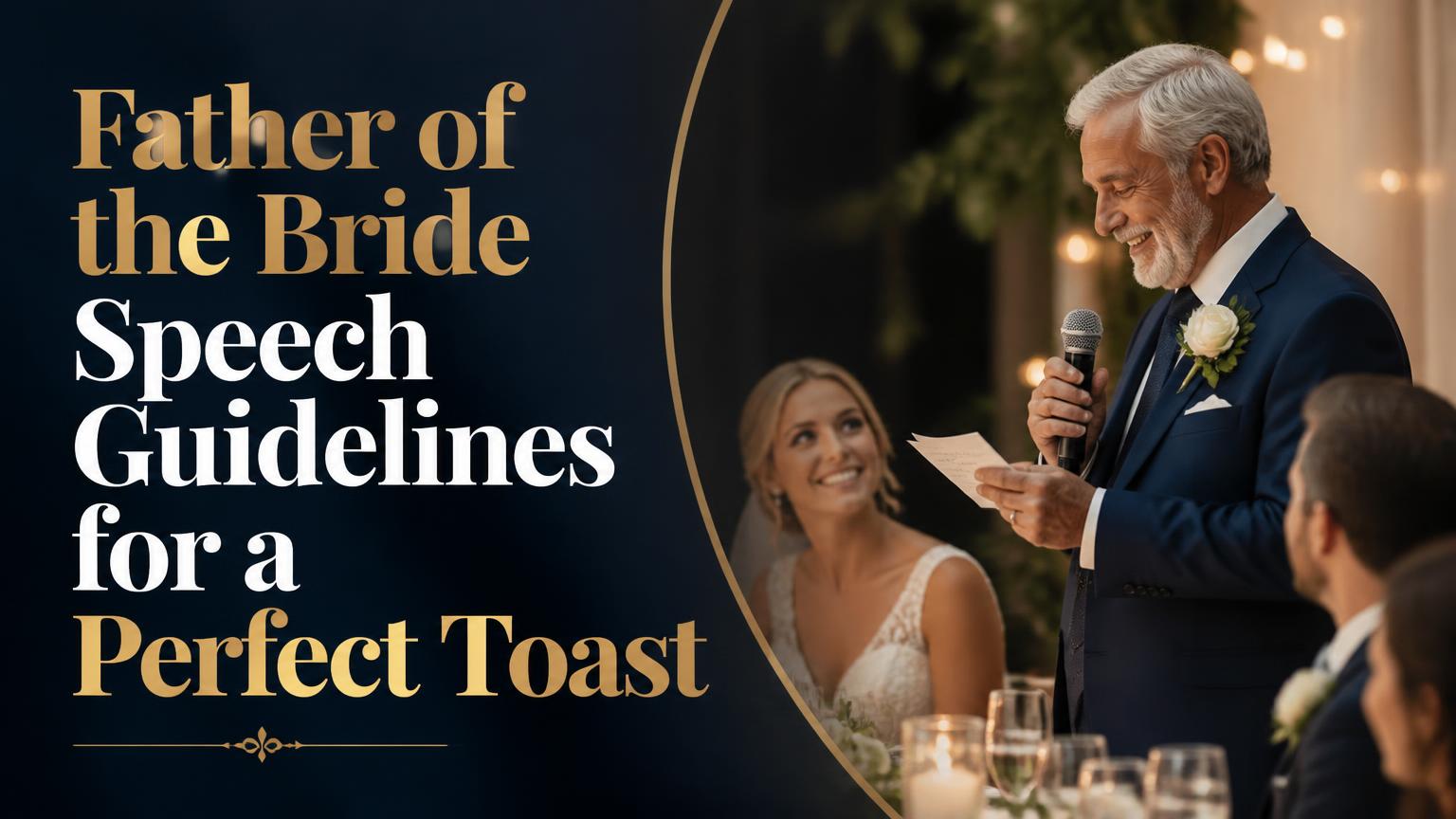
The father of the bride speech carries a distinctive responsibility: it should celebrate the bride, welcome her partner, acknowledge both families, and help set the emotional tone for the reception. Tradition may give the father a prominent role, but every couple has different expectations about length, humor, family references, and formality. These guidelines explain how to plan, write, personalize, rehearse, and deliver a warm wedding speech that sounds sincere rather than rehearsed.
Father of the Bride Speech Guidelines for a Meaningful Toast
A successful speech does not need elaborate language or a collection of perfect stories. It needs a clear purpose, a few genuine details, and an ending that brings the attention back to the couple. Use the following principles to shape a toast that fits the wedding and your relationship with the bride.
Understand Your Role in the Wedding
Traditionally, the father of the bride welcomes guests, expresses affection for his daughter, acknowledges the couple, and offers a toast. That pattern is common, not mandatory. The couple may want a short speech, a more informal family tribute, or remarks shared with another parent or loved one.
Ask the couple what they expect before you begin writing. Find out whether there are subjects to avoid, how long you have, who else will speak, and whether the reception will include a formal toast. Knowing your role prevents you from repeating another speaker’s material or taking the speech in a direction that does not suit the celebration.
Choose One Central Message
Give the speech a simple emotional center. Your message might be that your daughter has grown into a thoughtful adult, that her partner brings out her happiness, or that marriage joins two families and communities. A central idea helps you decide which memories belong and which interesting details should be left out.
Without a unifying message, a father of the bride speech can become a list of childhood stories, school achievements, family jokes, and compliments. Those details may all be true, but they will not necessarily create a satisfying speech. Once you know what you want guests to feel or remember, select every story and observation because it supports that purpose.
Plan a Clear, Manageable Structure
A dependable structure usually includes a welcome, a personal reflection about the bride, a transition to the couple, a few words about the future, and a toast. This gives the audience an easy path to follow while leaving room for your personality.
For many receptions, approximately three to five minutes is a practical target, although the couple or venue may set a different limit. At an ordinary speaking pace, that is roughly 360 to 700 words, with pauses and laughter affecting the total time. A shorter speech is often stronger than one that continues after its main point has been made.
Open With Warmth and Confidence
Begin by acknowledging the people who have gathered and thanking them for sharing the day. You may welcome guests who have traveled, recognize both families, or briefly express what the occasion means to you. A direct opening helps you settle into the speech and tells the audience why your remarks matter.
Avoid beginning with an apology, a warning that you are nervous, or a long explanation about how difficult the speech was to write. You do not have to announce that you are unprepared or uncomfortable. A simple sentence such as “Thank you all for being here to celebrate [Bride] and [Partner]” provides a natural beginning and immediately focuses attention where it belongs.
Select Stories That Reveal Character
The best stories do more than describe what happened; they show something about the bride. A small memory of her caring for someone, persevering through a difficult task, welcoming a new person, or finding humor in an ordinary moment may say more than a long account of her accomplishments.
Choose stories that the audience can understand quickly and that you can tell respectfully. Provide enough context, explain why the memory matters, and connect it to the person she is today. Avoid stories that embarrass her, expose private information, require several minutes of background, or make the partner and guests feel like outsiders.
Welcome the Bride’s Partner and Both Families
The speech should not become a tribute to the bride that treats her partner as an afterthought. Speak directly and generously about the qualities you appreciate in [Partner], especially qualities you have observed rather than vague claims you cannot support. You might mention kindness, patience, steadiness, humor, attentiveness, or the way the couple supports one another.
Acknowledge the partner’s family as well. A brief, sincere welcome can make the speech feel inclusive and gracious. If you do not know the family well, do not pretend otherwise. You can express genuine appreciation for the love and care that helped shape the person your daughter has chosen to marry.
Balance Emotion With Lightness
A wedding speech can include humor, but the safest humor is affectionate, brief, and understandable to everyone in the room. Light observations about family habits, your own lack of expertise, or the excitement of seeing your daughter as an adult are usually easier to receive than jokes at someone else’s expense.
Emotion is equally welcome when it is specific and controlled. You do not need to suppress tears, but you should give yourself a sentence or two that can be delivered even if your voice becomes unsteady. Avoid alternating between exaggerated jokes and overly dramatic declarations. A natural father of the bride speech can be tender, amused, proud, and thoughtful without forcing any one emotion.
End With a Toast to the Couple
The conclusion should clearly signal that the speech is ending. Bring your central message back to the bride and her partner, offer a hopeful but realistic wish for their life together, and invite the guests to raise their glasses if that suits the reception.
A strong toast does not need a famous quotation or an elaborate prediction about the future. It can focus on qualities the couple already demonstrates: respect, friendship, patience, curiosity, or the ability to enjoy ordinary days together. Keep the final words easy to hear and remember, such as, “Please raise your glasses to [Bride] and [Partner]. May your life together be filled with understanding, laughter, and many good days ahead.”
Writing and Personalizing the Father of the Bride Speech
Once you understand the speech’s purpose, personalization turns a familiar wedding format into something only you could say. The goal is not to include every important memory. It is to choose a few details that feel true, appropriate, and meaningful to the people listening.
Make a Short Memory List
Before drafting full paragraphs, write down several memories in brief phrases. Include moments from different stages of the bride’s life, observations about her character, and examples of how the couple relates to one another. Do not judge the ideas too quickly; first create a useful collection of possibilities.
Then mark the memories that are specific, concise, and relevant to the wedding. A story works well when it gives the audience a clear image and leads naturally to a reflection. For instance, a memory of the bride making room for someone who felt left out might support a point about her generosity today. One well-developed memory is more effective than five rushed anecdotes.
Replace General Praise With Evidence
Words such as “wonderful,” “amazing,” and “beautiful” may express genuine feelings, but they become more powerful when supported by an example. Instead of saying that your daughter is compassionate, describe a moment when she noticed someone needed help. Instead of calling the couple perfect together, explain what you have seen in the way they listen, cooperate, or recover from difficulties.
Specificity also makes the speech sound authentic. The detail does not need to be dramatic. A familiar phrase, a small family ritual, a practical kindness, or an everyday habit can give the audience a clearer sense of the people being celebrated. Choose details that the bride will recognize and appreciate rather than details included only because they are entertaining.
Include the Partner as a Person
Take time to write down what you genuinely value about the bride’s partner. Consider how [Partner] treats your daughter, how they participate in family life, and what you have learned from spending time together. If the relationship is new or you have had limited contact, keep your remarks honest and focus on what you have directly observed.
You can also describe the couple as a team without suggesting that marriage completes either person. Mention the way they encourage one another, make decisions, share responsibilities, or bring different strengths to the relationship. This approach honors both individuals while celebrating the partnership they are beginning or continuing.
Protect Private and Sensitive Information
A speech is delivered in a public setting, often in front of relatives, colleagues, children, and guests from different parts of the couple’s lives. Before using a story, consider whether everyone involved would be comfortable hearing it aloud. A detail that seems harmless in a family conversation may feel embarrassing or intrusive during a formal celebration.
Avoid references to former relationships, family conflict, serious private difficulties, financial matters, embarrassing childhood incidents, or jokes that depend on alcohol. If you are uncertain about a story, ask the bride or couple before using it. Their wedding day is not the right setting to reveal a secret, settle an old disagreement, or test whether a controversial joke will work.
Use Notes That Support Natural Delivery
A full manuscript can help during drafting, but many speakers find that a condensed outline is easier to deliver. Write the opening sentence, the main points, the key details of each story, and the final toast on cards or printed pages. Use large type and generous spacing so you can find your place without losing contact with the audience.
Do not reduce the notes to single words if you are likely to forget the sequence. At the same time, avoid putting every sentence in tiny type. The best format depends on your comfort and the formality of the event. Whether you use a complete script or an outline, bring the written version with you as a safety net.
Edit for the Ear, Not the Page
Read the speech aloud several times. Spoken language usually needs shorter sentences, clearer transitions, and fewer formal phrases than written prose. If you run out of breath, stumble over a sentence, or cannot remember why one paragraph follows another, revise it rather than blaming yourself for poor delivery.
Listen for repeated words, long introductions, and sentences that contain too many ideas. Mark places where you want a pause after a laugh, a meaningful statement, or an emotional memory. Reading aloud also exposes jokes that do not sound natural and compliments that feel exaggerated when spoken.
Delivering the Speech With Confidence
Good delivery is less about appearing polished than about helping guests hear and feel the message. Preparation matters, but so does accepting that a wedding speech may include a few pauses, a laugh in an unexpected place, or a moment when emotion becomes visible.
Rehearse for Timing and Flow
Practice the speech aloud at least several times, including once while standing. Time the complete delivery rather than estimating from the word count, because pauses, laughter, and emotion can add length. If the speech is too long, remove a story or repeated point instead of rushing through every sentence.
Rehearse the transitions as carefully as the memorable lines. Moving from a childhood memory to the present, or from the bride to her partner, should feel deliberate. Ask a trusted person to listen and tell you where the speech becomes unclear, overly detailed, or less engaging. Their response can help you edit without changing your voice.
Practice Speaking Through Emotion
If you expect to become emotional, identify the sentences most likely to affect you and practice them slowly. Look at the audience, take a breath, and continue when you are ready. It is acceptable to pause and say, “I need a moment,” but you do not need to apologize repeatedly for caring about the occasion.
Keep a glass of water nearby and mark a natural place in the notes where you can pause. Some speakers find it helpful to memorize only the opening and closing, because knowing those sections provides security even when the middle is delivered from notes. If public speaking feels overwhelming, discuss alternatives with the couple; recording a message or sharing the role may be more suitable.
Use the Microphone and Room Well
If a microphone is provided, hold or position it close enough to your mouth for the sound system to pick up your voice without forcing you to shout. Ask the venue or a coordinator how it works before the reception begins. Avoid tapping the microphone, turning away from it for long periods, or lowering your voice while looking down at the page.
Stand where guests can see you, keep both feet stable, and look up at the couple and the room regularly. You do not have to make eye contact with every person. Aim your attention toward a few friendly faces, then return your gaze to the couple during the most personal parts of the speech.
Control Pace, Volume, and Pauses
Nervous speakers often speak faster than they realize. Slow down enough for guests at the back of the room to follow, particularly after a laugh or before an important sentence. Vary your pace naturally: a short line can create warmth or humor, while a reflective memory may need more space.
Pauses are useful rather than empty. Stop briefly after introducing the couple, before delivering a punch line, or after a meaningful observation. If the audience does not respond immediately to a joke, do not explain it or repeat it. Simply continue with the next sentence and keep the focus on the celebration.
Coordinate With the Couple and Other Speakers
Find out when you will speak and whether the schedule includes other toasts, readings, dances, or meal service. This practical information helps you avoid an overlong speech and prevents you from referring to an event that has not yet happened. It also allows you to coordinate names and pronunciations with the couple.
Ask whether there are topics that should remain private and whether the couple prefers a traditional toast or a less formal tribute. Wedding customs differ across families, cultures, religions, and venues, so a practice that feels expected in one celebration may not belong in another. The couple’s preferences should guide your final choices.
Recover Gracefully From Interruptions
A wedding reception may include background noise, late arrivals, laughter, applause, or an unexpected interruption. Stop if you cannot be heard, wait for the room to settle, and resume from the last clear point. Keeping your notes marked with short sections makes it easier to find your place.
If you lose a sentence, skip it and continue. Guests usually remember the warmth of the speech, not the exact wording. If a joke fails, do not draw further attention to it. A calm transition such as “What matters most is this” can bring the speech back to its central message without making the moment uncomfortable.
Common Father of the Bride Speech Mistakes to Avoid
One common mistake is making the speech entirely about the bride’s childhood. Those memories can be valuable, but the wedding celebrates a partnership, so the speech should eventually include [Partner], both families, and the couple’s life ahead. Another mistake is turning the speech into a catalogue of accomplishments. Achievements may be worth mentioning, but character, relationships, and meaningful observations usually create a warmer connection with the audience.
Avoid using humor as a substitute for preparation. A joke about the couple’s spending, private habits, past relationships, appearance, or family history can damage the tone of the entire reception. Do not drink enough to affect your judgment before speaking, and do not rely on an untested quotation or a story that requires extensive explanation. Finally, do not treat the toast as a competition with other speakers. Your role is to offer a sincere contribution, not the longest, funniest, or most dramatic speech of the evening.
A Simple Final Checklist Before the Wedding
Read the speech once more with the couple’s comfort in mind. Confirm that every name is correct and pronounced properly, that the stories are suitable for the full audience, and that your remarks welcome rather than divide the families. Check that the speech includes the partner and ends with a clear toast.
Print or write your notes in a readable format, bring a backup copy, and practice the opening and closing until they feel secure. On the day, arrive early enough to locate the microphone and ask where you should stand. Take a breath before beginning, speak more slowly than your nerves suggest, and remember that sincerity matters more than flawless performance.
Closing Thoughts
The strongest father of the bride speech is personal without being private, emotional without becoming overwhelming, and humorous without making anyone uncomfortable. Start with the couple’s wishes, choose a small number of meaningful details, and shape them around one clear message. Rehearse enough to feel prepared, but leave room for a natural voice and genuine feeling. A thoughtful welcome, an honest reflection on your daughter, generous words for her partner, and a warm final toast will give the wedding a memorable contribution from you.