
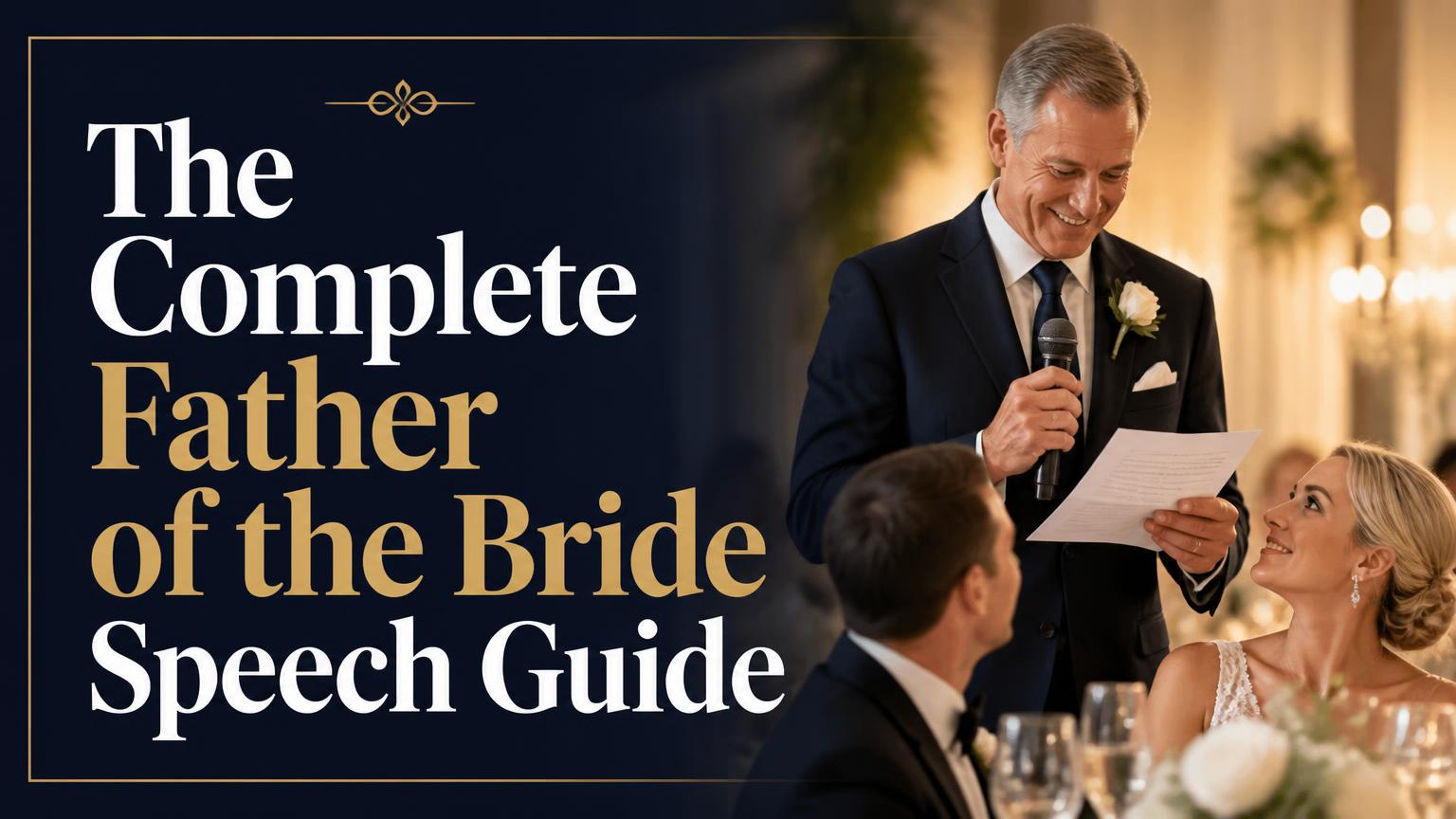
Writing a father of the bride speech can feel like a significant responsibility, especially when you want to honor your daughter without making the occasion entirely about your emotions. The strongest speeches are personal, concise, and generous toward both partners. They welcome the guests, share a few carefully chosen memories, acknowledge the marriage, and end with a sincere toast. This guide explains how to plan, write, edit, and deliver a speech that sounds natural and suits the couple, the venue, and the atmosphere of the wedding.
Father of the Bride Speech Guide: How to Write and Deliver It
A successful father of the bride speech usually lasts about three to five minutes, although the couple or wedding planner may have specific preferences. Its purpose is not to tell your daughter’s entire life story. Instead, it should offer a warm perspective on who she is, recognize the person she has chosen, thank the people who helped make the day possible, and express hope for the couple’s future.
Use the following steps to create a speech with a clear message and a natural speaking rhythm.
Step 1. Clarify the Purpose and Audience
Before writing, consider what the guests should understand or feel by the end of your speech. You may want to express pride in your daughter, welcome her partner into the family, thank relatives and friends, or reflect on the meaning of marriage. You can include several of these purposes, but one should guide the speech.
Remember that the audience includes both families, friends, colleagues, and often guests who do not know you well. A private message meant only for your daughter belongs in a card or quiet conversation. During the speech, share enough personal feeling to make the moment meaningful while keeping the whole room included.
Step 2. Choose One Central Message
A central message gives the speech direction. It might be, “My daughter has always cared deeply for the people around her,” or, “Today is a joyful beginning built on the love and trust this couple share.” Every story, observation, and compliment should support that idea.
Choosing one message also prevents the speech from becoming a long list of unrelated memories. If you have many stories, select the one or two that reveal something important about your daughter or the couple. A focused speech is usually more memorable than one that attempts to mention every stage of her life.
Step 3. Build a Simple and Welcoming Opening
Begin by acknowledging the occasion and welcoming the guests. You might thank everyone for being present, recognize those who traveled, or briefly express how meaningful it is to see two families and communities gathered together. Introduce yourself if some guests may not know who you are.
The opening should establish a warm tone rather than create suspense or pressure. Avoid starting with an embarrassing childhood story, a joke about marriage, or a lengthy apology about public speaking. A simple beginning such as, “Thank you all for being here to celebrate [Daughter’s Name] and [Partner’s Name],” is clear, gracious, and easy to deliver.
Step 4. Select Specific and Appropriate Memories
Choose memories that reveal character rather than merely describe events. A story about your daughter helping someone, showing determination, welcoming a friend, or finding her own path will tell the audience more than a general statement that she has always been wonderful.
Keep each story brief and provide enough context for people who were not there. Avoid private information, stories that could embarrass your daughter, or memories involving former partners. If a humorous story is appropriate, make sure the humor is affectionate and that your daughter would be comfortable hearing it repeated in front of both families.
Step 5. Speak About the Couple, Not Only Your Daughter
The speech should honor your daughter while also recognizing the marriage she is entering. Speak directly and respectfully about her partner. Mention a quality you appreciate, a way the couple supports each other, or an observation about how they seem together.
You do not need to pretend that you know every detail of their relationship. A sincere, measured comment is better than an exaggerated declaration. You might say that you have enjoyed seeing your daughter become more confident and happy, or that you admire the patience, kindness, humor, or steadiness the couple bring to one another.
Step 6. Organize the Body With Clear Transitions
A useful structure is to move from welcome, to personal reflection, to the couple, and finally to the future. Short transitions help the audience follow that movement. For example, after a childhood memory, you might say, “As she grew older, that same thoughtfulness became one of the qualities I admire most in her.”
You can also organize the speech around a single theme, such as kindness, resilience, friendship, or home. Whatever structure you choose, read the speech aloud and listen for abrupt changes. If one paragraph discusses childhood and the next suddenly thanks the caterer, add a sentence that explains the connection or remove the unrelated material.
Step 7. Write a Warm and Forward-Looking Closing
The ending should feel intentional rather than appearing when you run out of material. Offer a brief wish for the couple’s marriage, express your love and support, and invite the guests to raise their glasses if that fits the wedding’s customs.
A good closing does not need a famous quotation or an elaborate metaphor. A direct sentence can be more powerful: “May your marriage be filled with patience, laughter, and the confidence that you never have to face life alone.” Then raise your glass and toast the couple by name. Keep the final words easy to remember and deliver.
Father of the Bride Speech Length, Structure, and Content
The ideal speech is long enough to feel substantial but short enough to preserve the energy of the reception. Three to five minutes is a common range, which usually means approximately 360 to 700 words depending on your pace and the pauses you take. The couple’s preferences and the overall schedule matter more than any universal rule, so ask whether there is a specific time limit.
A practical structure might include a brief welcome, a thank-you to guests and hosts, one or two personal reflections, a generous acknowledgment of the partner, a few thoughts about marriage, and a final toast. You do not need to include every element. The most important test is whether each part contributes to the speech’s central message.
Keep the Opening Brief
The first section should settle you and the audience into the moment. Welcome the guests, identify the couple, and explain your relationship to the bride if necessary. If you are also expected to thank particular people, do so in a concise way rather than turning the opening into a roll call.
Avoid spending the first minute describing how nervous you are. A small acknowledgment may be acceptable, but repeated apologies can make the audience uncomfortable and distract from the couple. Speak slowly, look up, and allow the opening sentences to establish your confidence.
Balance Personal Reflection With the Wedding
Personal memories give the speech its individual character, but they should lead back to the wedding. After describing something from your daughter’s childhood or adult life, explain what it shows about her today. This connection helps guests understand why the memory belongs in the speech.
For example, a story about her organizing neighborhood games as a child could lead into a reflection on her ability to bring people together. The point is not the event itself but the quality it reveals. Keep the balance generous: the audience has come to celebrate a marriage, not attend a complete biography.
Include Thanks Without Creating a Roll Call
Many father of the bride speeches include thanks to guests, family members, the wedding party, or people who helped with the celebration. These acknowledgments are appropriate when they are specific and proportionate. Thank people for traveling, offering support, helping with preparations, or contributing to the day.
Try not to list every person who had a role. Long lists are difficult for guests to follow and can make the speech feel administrative. Group people naturally when possible, and give special attention only to those the couple or family has asked you to recognize.
Address Marriage Realistically and Kindly
A wedding speech can offer a thoughtful observation about marriage without becoming a lecture. You might mention the value of listening, making room for change, keeping humor alive, or choosing one another through ordinary days as well as celebrations.
Avoid presenting yourself as the authority on the couple’s future. Advice should sound like a supportive wish rather than a set of instructions. If you refer to challenges, keep the tone hopeful and respectful. The wedding is an occasion for encouragement, not a time to predict difficulties or recount personal grievances.
Make the Toast Distinct From the Main Speech
The toast is the final expression of goodwill, not merely another paragraph. Signal the transition with a phrase such as, “So, if you would all join me,” or “Please raise your glasses.” Then offer a concise wish for the couple’s happiness, health, friendship, and shared future.
Keep the toast easy to hear and pronounce. Say both names clearly, pause so guests can respond, and avoid ending with a complicated quotation that may be lost in a noisy room. The closing should leave the audience with the couple at the center of the moment.
Father of the Bride Speech Delivery and Etiquette
Good writing helps, but delivery determines how the speech feels in the room. You do not need to perform like a professional speaker. You do need to prepare enough that you can make eye contact, pause when emotion arises, and recover if you lose your place. Read the speech aloud several times before the wedding, preferably in the same format you will use at the reception.
Wedding customs vary by family, culture, religion, venue, and personal preference. There may be a traditional speaking order, or the couple may choose something less formal. Treat common practices as suggestions rather than strict rules, and confirm details with the couple or coordinator.
Confirm the Speaking Order and Time Limit
Ask who will speak before and after you, whether a microphone will be provided, and how long the couple would like each speech to last. A wedding reception may include several speakers, so a speech that seems brief in isolation can become tiring when added to a long program.
The speaking order may differ from traditional expectations, particularly at modern, multicultural, or nontraditional weddings. Follow the couple’s plan rather than assuming the father of the bride must speak first or last. Knowing the schedule also helps you create an ending that hands attention smoothly to the next part of the celebration.
Use Humor Without Making Anyone the Target
Humor can make a speech lively, but wedding humor should be generous. Choose stories in which you or a harmless situation provides the joke, rather than placing the bride, her partner, former relationships, family tensions, or guests under scrutiny.
Test every joke by asking whether it will still feel kind if repeated the next day. Avoid references to divorce, infidelity, drinking, money, embarrassing photographs, or private arguments. If a joke requires a long explanation, an inside connection, or a person’s discomfort to work, leave it out.
Prepare Notes That Support You
Use a printed speech, large-font notes, or cue cards with clear spacing. Mark pauses, names, emphasis, and the final toast. Number pages so that a dropped sheet does not create unnecessary panic. Some speakers prefer a complete manuscript; others use an outline with key phrases.
Do not reduce the font so much that you must stare down to read it. Your notes are there to protect your preparation, not prevent eye contact. If you become emotional, it is perfectly acceptable to pause, take a breath, find your place, and continue. The audience will usually respond with patience.
Rehearse for Sound, Not Just Accuracy
Reading silently can hide awkward sentences, repeated words, and phrases that are difficult to say aloud. Practice standing up and speaking at a comfortable volume. Time yourself, but also listen for whether the speech sounds like something you would genuinely say.
Rehearse the names of the couple, family members, and anyone else you mention. Practice the opening and closing especially well, since confidence at those points helps settle nerves. If possible, deliver the speech once to a trusted person who can tell you whether the stories are clear and whether the tone feels appropriate.
Manage Emotion With Practical Preparation
It is normal to feel emotional when speaking about your daughter and her marriage. You do not have to eliminate that feeling; you only need enough preparation to keep it from making the speech impossible to follow. Mark natural pauses in the manuscript and keep water nearby.
If you become overwhelmed, stop briefly rather than rushing. Look at the couple, breathe slowly, and continue with the next sentence or glance at your notes. You may also decide in advance which paragraph can be shortened if necessary. Asking someone else to speak, sharing the speech, or choosing not to speak at all is also a valid option if the couple supports that decision.
Handle the Microphone and Room With Awareness
If you are using a handheld microphone, hold it a few inches from your mouth and keep it at a consistent height. Do not turn your head sharply away while speaking, and avoid tapping or blowing into the microphone. If a lectern microphone is provided, stand close enough for your voice to remain clear.
Look at the couple and the wider audience rather than reading continuously toward the page. In a large or noisy room, speak slightly more slowly than you would in conversation. Pause after an important sentence, especially before the toast, so guests have time to hear and absorb your words.
Common Father of the Bride Speech Mistakes to Avoid
The most common problems are usually matters of focus rather than grammar. A speech can be heartfelt and still lose the audience if it is too long, too private, too dependent on inside jokes, or too focused on the speaker’s own experiences. Editing is not a sign that your feelings are inadequate; it is a way of making those feelings easier for everyone to receive.
Read the finished speech with the couple in mind. Would they feel respected? Would both families feel included? Would a guest who has never met you understand the story and why it matters? These questions will help you remove material that may be amusing or meaningful only in a private setting.
Avoid these specific problems:
- Do not tell embarrassing stories simply because they get a reaction.
- Do not criticize wedding choices, family traditions, or the couple’s plans.
- Do not compare the partner with a former boyfriend or girlfriend.
- Do not make the speech primarily about the expense or difficulty of raising a child.
- Do not rely on alcohol to manage nerves.
- Do not read so quickly that laughter, emotion, or important names disappear.
- Do not continue past your planned ending because the audience responds warmly.
Personalizing a Father of the Bride Speech
The easiest way to personalize the speech is to replace general praise with observable details. Instead of saying your daughter is kind, describe the way she notices when someone is left out, stays in touch with distant relatives, or makes people feel welcome. Instead of saying the couple is happy, mention a quality you have seen in the way they handle life together.
Choose details that are true, comfortable to share, and relevant to the audience. You might refer to a family tradition, a moment when you recognized your daughter’s independence, a quality you appreciate in her partner, or a simple scene that captures the couple’s connection. One honest detail is more effective than a series of sweeping compliments.
If your relationship with your daughter is complicated, you do not need to pretend otherwise in private, but the public speech should remain respectful and constructive. Focus on the present occasion and the support you can sincerely offer. A father of the bride speech does not have to sound perfect or sentimental; it has to sound genuine, considerate, and appropriate for the people gathered to celebrate.
Closing Thoughts
The best father of the bride speech is not the longest or most polished one. It is the speech that sounds like you, gives the audience a clear sense of your daughter and her partner, and respects the importance of the wedding day. Choose a small number of meaningful details, keep the focus on the couple, rehearse aloud, and leave room for genuine emotion. With thoughtful preparation, your words can become a lasting part of the celebration without competing with it.