
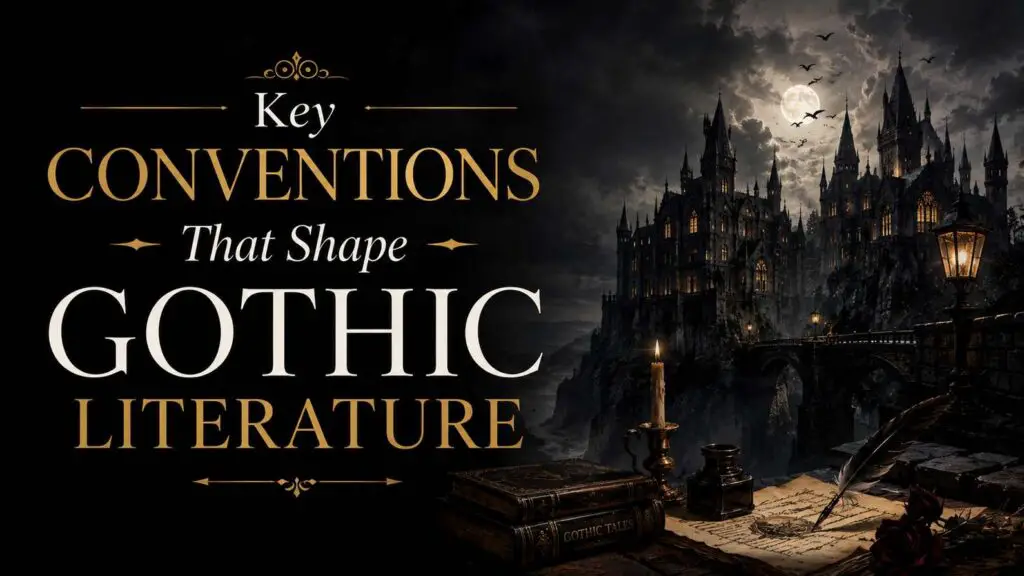
Gothic literature has always fascinated readers with its ability to create fear, mystery, and emotional intensity. It invites readers into worlds filled with dark secrets, haunted landscapes, troubled characters, and unsettling events. While many literary genres seek to entertain or inform, Gothic literature often aims to disturb, intrigue, and provoke reflection.
What makes Gothic literature especially powerful is its focus on the darker aspects of human experience. Fear, guilt, obsession, isolation, madness, and death are recurring themes that appear throughout Gothic works. These themes are brought to life through a collection of conventions that have become closely associated with the genre.
Understanding these conventions is essential not only for appreciating Gothic literature but also for writing effective Gothic fiction. When used skillfully, they can transform an ordinary story into one filled with suspense, atmosphere, and psychological depth.
An Introduction to Gothic Literature
Gothic literature emerged in the late eighteenth century and quickly established itself as one of the most distinctive literary traditions. Beginning with works such as The Castle of Otranto by Horace Walpole, the genre developed through the writings of authors like Ann Radcliffe, Mary Shelley, Edgar Allan Poe, and Bram Stoker.
The genre combines elements of horror, mystery, romance, and psychological drama. Gothic stories often feature gloomy settings, supernatural events, hidden secrets, family curses, and characters struggling against forces they do not fully understand. However, Gothic literature is much more than a collection of spooky images and frightening events.
At its core, Gothic literature explores what happens when people encounter the unknown. It examines the tension between reason and fear, civilization and chaos, the present and the past. Through this exploration, Gothic writers create stories that are both entertaining and thought-provoking.
Many of the genre’s most memorable works rely on a shared set of literary conventions. These conventions help establish the atmosphere, themes, and emotional impact that define Gothic fiction.
Key Conventions That Shape Gothic Literature
The conventions of Gothic literature are more than simple storytelling devices. They are tools that writers use to create tension, deepen characterization, and immerse readers in unsettling worlds. Understanding how these conventions work can help writers craft more effective Gothic novels and stories.
The following conventions are among the most important elements that shape Gothic literature.
#1. Dark and Mysterious Settings
Setting is often the foundation of a Gothic story. A Gothic setting should do more than provide a backdrop for the action. It should contribute directly to the mood and emotional atmosphere of the narrative.
Writers frequently choose locations such as abandoned castles, decaying mansions, isolated monasteries, ruined estates, graveyards, forests, or remote villages. These settings naturally create feelings of uncertainty and isolation. A character walking through a brightly lit city street rarely evokes the same tension as a character wandering through a deserted manor during a thunderstorm.
When writing Gothic fiction, consider how the environment can reflect the emotional state of the characters. A crumbling mansion with water stains creeping down the walls might mirror a family’s slow moral decay. A castle hidden in fog-covered mountains may symbolize secrets that have remained concealed for generations.
Details matter. The creaking of floorboards, flickering candlelight, damp stone corridors, and distant echoes all contribute to the atmosphere. In Dracula, the Count’s castle is not merely a location. It functions as a prison, a mystery, and a source of fear. Similarly, a modern Gothic writer might place a protagonist in an abandoned psychiatric hospital where every corridor seems to hold forgotten memories and hidden dangers.
The most effective Gothic settings feel almost like characters themselves, influencing the events and emotions of the story.
#2. An Atmosphere of Fear and Suspense
Fear in Gothic literature rarely comes from constant action. Instead, it grows gradually through anticipation and uncertainty. Readers become frightened because they sense that something terrible may happen, even when they do not know exactly what it is.
When writing Gothic fiction, focus on creating questions before providing answers. Why does a strange sound echo through the house every night at midnight? Why does the portrait in the hallway appear different each morning? Why do the villagers refuse to discuss the abandoned chapel on the hill?
Suspense thrives on delayed revelation. A writer may spend several chapters building tension around a locked room before finally revealing what lies inside. The imagination often creates more fear than immediate explanations.
Consider a scene where a character hears footsteps above their bedroom every night despite living alone. The footsteps stop whenever the character investigates. Nothing overtly frightening occurs, yet readers become increasingly anxious because the mystery remains unresolved.
By allowing fear to develop slowly, writers create a lingering sense of dread that keeps readers engaged throughout the story.
#3. The Supernatural and the Unexplained
Supernatural elements are among the most recognizable features of Gothic literature. Ghosts, curses, apparitions, vampires, prophetic dreams, and mysterious forces frequently appear throughout the genre.
However, effective Gothic fiction often treats the supernatural with ambiguity. Readers should not always know whether an event is truly supernatural or whether another explanation exists.
For example, a young woman may repeatedly see a pale figure standing beside a lake at dusk. Is it the ghost of a drowned ancestor, or is grief causing her to imagine what is not there? A family may believe they are cursed because each generation experiences a tragic death, but the true cause could be hidden crimes committed long ago.
This uncertainty creates tension because readers are forced to question reality alongside the characters. The unexplained becomes more unsettling when no clear answer is available.
Writers should resist the temptation to explain every mystery immediately. Sometimes the most powerful Gothic stories leave readers wondering whether the supernatural events were ever fully understood.
#4. Haunted Characters
Some of the most memorable Gothic characters are haunted not by ghosts but by their own pasts. Guilt, trauma, shame, obsession, and regret often drive the emotional conflict within Gothic fiction.
When creating Gothic characters, think about what emotional burden they carry. A nobleman may be haunted by a crime committed years earlier. A widow may be unable to escape memories of a deceased spouse. A scientist may become obsessed with correcting a mistake that destroyed lives.
These internal struggles often shape the character’s actions more than external threats. A protagonist who fears exposure of a terrible secret may interpret ordinary events as signs of judgment or punishment.
Edgar Allan Poe frequently used this convention. In stories such as The Tell-Tale Heart, the character’s guilt becomes more terrifying than any supernatural force. A modern Gothic writer might create a protagonist who inherits an ancestral home and gradually discovers that their family was responsible for a long-forgotten tragedy.
The deeper the emotional wounds, the stronger the Gothic atmosphere becomes.
#5. Secrets, Mysteries, and Hidden Truths
Few conventions are more important to Gothic literature than secrets. Nearly every Gothic story contains information that has been deliberately concealed.
When writing Gothic fiction, give your story a central mystery. Perhaps a family member disappeared decades earlier. Perhaps a locked wing of a mansion remains permanently sealed. Perhaps an old journal contains missing pages that reveal a disturbing truth.
The secret should influence the present story. Readers should feel that the hidden truth matters and that uncovering it will change everything.
Imagine a protagonist who discovers a collection of letters hidden behind a fireplace. As they read them, they slowly realize that their respected grandfather was responsible for a series of unsolved deaths. The mystery creates suspense while also adding emotional complexity.
Strong Gothic secrets are rarely trivial. They often involve betrayal, violence, forbidden relationships, hidden identities, or moral corruption. The revelation of the truth should feel both shocking and inevitable.
#6. Villains, Tyrants, and Dangerous Power
Gothic villains are often more complex than traditional antagonists. They represent power used in destructive or corrupt ways.
When developing a Gothic villain, think beyond physical danger. The most effective villains control people psychologically, socially, financially, or emotionally. Their power creates an environment of fear and helplessness.
A wealthy aristocrat who controls an isolated village may be more frightening than a monster. A respected doctor who secretly conducts unethical experiments can create a greater sense of unease than a supernatural creature.
In Dracula, the Count possesses both supernatural abilities and psychological influence over his victims. Similarly, a modern Gothic story might feature a charismatic cult leader whose followers obey him unquestioningly despite mounting evidence of his cruelty.
The best Gothic villains embody a threat that extends beyond a single character and affects the entire world of the story.
#7. Vulnerable or Isolated Protagonists
Isolation is a powerful source of fear. Gothic protagonists often find themselves separated from the people and systems that could protect them.
When writing a Gothic novel, place your protagonist in circumstances where help is difficult to obtain. They may be stranded in a remote location, trapped within a controlling family, or surrounded by people they cannot trust.
A young scholar researching an ancient manuscript in a secluded monastery may have no one to turn to when strange events begin occurring. A woman living in an isolated estate may suspect danger but find that everyone dismisses her concerns.
Vulnerability does not mean weakness. In fact, Gothic protagonists often become compelling because they continue moving forward despite fear. Their courage becomes meaningful precisely because they face overwhelming uncertainty.
Readers connect with these characters because they share their confusion, anxiety, and determination to uncover the truth.
#8. Madness and Psychological Breakdown
Gothic literature frequently explores the fragile boundary between sanity and madness. Characters may experience hallucinations, paranoia, obsessions, or emotional collapse.
For writers, this convention offers an opportunity to create uncertainty. Readers should question whether events are happening objectively or are being filtered through an unreliable perspective.
A character who has not slept for days may begin seeing figures in mirrors. Another may become convinced that someone is watching them from the shadows. These experiences may be genuine supernatural encounters or symptoms of psychological deterioration.
The convention becomes especially powerful when external and internal threats overlap. A character investigating a haunted house may gradually lose confidence in their own perceptions. Each new discovery raises the question of whether the house is truly haunted or whether fear itself is destroying their sanity.
This uncertainty creates some of the most memorable moments in Gothic fiction.
#9. The Return of the Past
In Gothic literature, the past never remains buried for long. Forgotten crimes, family scandals, old grudges, and ancestral sins often return to shape the present.
When writing Gothic fiction, consider what unresolved event from the past continues to influence the story. Perhaps a murder was covered up decades earlier. Perhaps an entire family benefited from a terrible injustice. Perhaps a curse began with an act of betrayal generations ago.
The past should leave visible traces. An abandoned wing of a house, a faded portrait, a damaged gravestone, or a forgotten diary can all serve as reminders that history is still present.
Imagine a protagonist renovating an inherited estate and discovering a hidden room containing evidence of a crime committed by an ancestor. The discovery forces them to confront both family history and their own identity.
This convention creates depth because it connects personal struggles to larger historical forces.
#10. Death, Decay, and Ruin
Death and decay are essential aspects of the Gothic imagination. They remind readers that all things eventually deteriorate, whether they are buildings, families, institutions, or individuals.
When writing Gothic fiction, use physical decay symbolically. A mansion with collapsing walls may reflect a family on the verge of collapse. A neglected cemetery may suggest forgotten obligations and unresolved grief.
Descriptions of deterioration can strengthen the atmosphere significantly. Peeling wallpaper, rusted gates, crumbling stone, dying gardens, and dust-covered rooms all contribute to a sense of decline.
In many Gothic stories, characters are surrounded by reminders of mortality. A protagonist may pass a row of weathered graves each day or live in a house where funeral portraits line the walls. These details create an environment where death feels constantly present.
The goal is not simply to emphasize destruction but to explore what remains after loss and what hidden truths emerge when things begin to fall apart.
Closing Thoughts
Gothic literature continues to captivate readers because it transforms fear into compelling storytelling. Its conventions provide writers with powerful tools for creating atmosphere, suspense, mystery, and emotional depth.
Dark settings, hidden secrets, haunted characters, psychological instability, and the lingering influence of the past are not merely decorative features of the genre. They work together to explore some of humanity’s deepest fears and most persistent questions.
For writers, understanding these conventions offers a practical framework for crafting Gothic fiction. By combining these elements thoughtfully, it becomes possible to create stories that are unsettling, memorable, and emotionally resonant. Whether the tale involves ghosts, family curses, psychological torment, or ancient mysteries, the conventions of Gothic literature remain as effective today as they were centuries ago.