
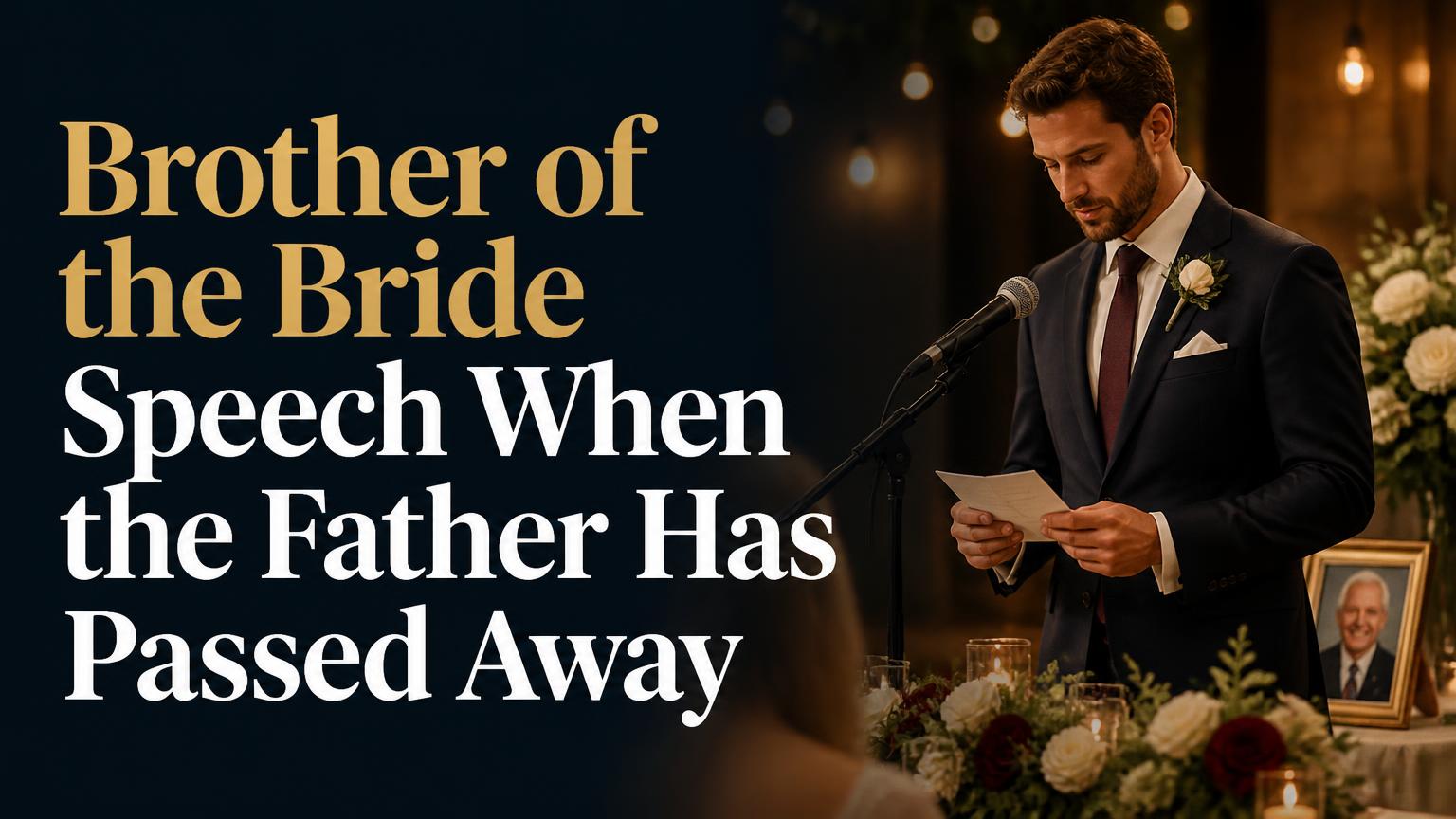
When a bride’s father has died, a brother may feel that his wedding speech has to carry both the joy of the occasion and the weight of someone missing from it. It does not. Your role is not to replace your father or turn the reception into a memorial service. A thoughtful speech can acknowledge his absence, reflect your sister’s wishes, welcome her partner, and keep the focus on the marriage being celebrated. The guidance and adaptable sample below will help you do that with honesty and care.
Brother of the Bride Speech When Father Has Died
A brother’s speech can recognize the father’s absence in a few sincere sentences before returning to the bride and her partner. The most important consideration is what your sister wants. She may appreciate a direct tribute, a brief mention, or no reference at all. Discuss the subject with her privately before writing, especially if the loss is recent or the family relationship was complicated.
A practical wedding speech usually lasts about three to five minutes unless the couple or venue has requested a different length. Keep one clear message at its center: your love for your sister, your welcome to her partner, and your hopes for their life together. The following steps can help you create a speech that is personal without becoming overwhelming.
Step 1. Clarify What Your Sister Wants Included
Begin with a private conversation rather than making assumptions. Ask whether she would like you to mention your father by name, share a particular memory, or acknowledge the difficulty of celebrating without him. She may have words she wants included or subjects she would prefer you to avoid. This conversation also gives her control over how her loss is represented in a public setting.
Consider the audience as well. A small family gathering may allow for more personal detail than a large reception. If the wedding includes different cultural or religious traditions, ask whether any customary language feels appropriate. Your speech should support your sister, not surprise her with an emotional reference she has not agreed to hear in front of everyone.
Step 2. Choose One Honest Message
A speech becomes easier to write when you decide what you want people to remember. Your central message might be, “Our father’s absence is deeply felt, but his love remains part of our family story,” or, “Today is about the strength and happiness my sister has found with her partner.” Choose only a message that genuinely reflects your family.
Avoid trying to summarize your father’s entire life, your sister’s childhood, and the couple’s relationship in a few minutes. One honest idea will have more impact than a long list of qualities. Write the message at the top of your notes, then make sure every story and sentence supports it.
Step 3. Acknowledge Your Father Without Making the Wedding a Funeral
If your sister wants him mentioned, be direct and restrained. You might say, “There is someone we wish could be here today—our father, [Name]. His absence is felt, and I know he remains an important part of [Bride’s Name]’s story.” This acknowledges reality without asking the audience to enter a different ceremony.
You do not need to explain how your father died, describe the final days, or speak at length about grief unless your sister has specifically requested it. A short acknowledgment can be followed by a meaningful connection to the bride, such as a quality he encouraged or a memory that shows who she is. Then return naturally to the couple and the celebration.
Step 4. Select a Memory That Serves the Couple
Choose one specific, true memory rather than several unrelated anecdotes. A story about your sister’s kindness, determination, humor, or loyalty can help guests see her clearly. If the memory includes your father, make sure it illuminates the bride rather than turning into a separate eulogy.
Avoid embarrassing childhood stories, private family conflicts, or anything that could make the bride or her partner uncomfortable. A useful test is to ask whether the memory explains something about the woman she is today. If it does not, leave it out. You can use a placeholder while drafting, such as “[brief memory showing her generosity],” and replace it with a detail only your family would recognize.
Step 5. Welcome and Honor the Partner
The speech should not become solely about your sister and your father. Her partner is also being welcomed into the family, and the marriage is the reason everyone has gathered. Mention a quality you genuinely appreciate, a moment when you saw their care for each other, or your gratitude for the life they are building together.
Do not claim that the partner has “replaced” your father or that they now carry responsibility for protecting the family. Those ideas can create unnecessary pressure and reduce the partner to a role. Instead, speak about mutual respect, companionship, patience, laughter, or the particular way they support one another.
Step 6. Build a Spoken Structure and Meaningful Ending
A simple structure will keep the speech focused: introduce yourself, welcome the guests, acknowledge your father if appropriate, share one relevant memory, speak directly to the couple, and finish with a toast. Each section only needs a few sentences. Clear transitions will help the speech sound natural rather than like separate notes placed together.
Write for the ear. Shorter sentences are easier to deliver when you are emotional, and a pause can be more powerful than another explanation. End by addressing both newlyweds. A wish such as “May your marriage be filled with patience, laughter, and the kind of loyalty that carries you through every season” provides a warm conclusion without making promises about their future.
Step 7. Prepare for Emotion and Deliver Calmly
Read the speech aloud several times, preferably in the room or setting where you will give it. Mark places where you want to pause, and print the final version in large type or on cards with generous spacing. Do not memorize every word if doing so will make you more anxious; familiarity with the order and main points is usually enough.
Tell the maid of honor, best man, wedding coordinator, or another trusted person that the speech may be emotional. Keep water nearby, breathe before beginning, and pause if your voice catches. If you decide you cannot give the speech, asking someone else to read it is not a failure. The purpose is to honor your sister and the couple, not to prove that you can speak through overwhelming grief.
A Sample Brother of the Bride Speech
The following speech is written to be adapted rather than copied without thought. Replace the bracketed sections with details that are true for your family, and remove the reference to your father if your sister would prefer not to include it.
#1. A Warm, Direct Wedding Speech
Good evening, everyone. For those who do not know me, I’m [Brother’s Name], [Bride’s Name]’s brother. Thank you all for being here to celebrate [Bride’s Name] and [Partner’s Name]. Looking around this room, it is clear how many people care about them and how many different parts of their lives have come together today.
Before I say anything else, I want to acknowledge someone whose absence is felt very deeply: our father, [Father’s Name]. We wish he could have been here to see this day. His absence does not make this celebration less joyful, but it does mean that joy and sadness are sharing the same room. He remains an important part of our family and of the story that brought [Bride’s Name] to this moment.
When I think about my sister, I think about [insert a brief, true memory that shows her character]. That memory captures something I have always admired in her: [quality such as kindness, determination, loyalty, or humor]. She has grown into someone who gives a great deal of herself to the people she loves, and I feel fortunate to have had her as my sister through every stage of our lives.
[Partner’s Name], thank you for loving her, respecting her, and building this life with her. I appreciate the way you [insert a genuine observation about how Partner supports or understands Bride]. You do not have to be perfect for each other. You only have to keep choosing one another with honesty, patience, and care.
[Bride’s Name], I am proud of you, and I am grateful to stand beside you today. You do not have to choose between remembering Dad and being happy. Both can have a place in your life, and I hope this marriage brings you many years of comfort, laughter, and shared strength.
To [Bride’s Name] and [Partner’s Name]: may your home be a place of warmth, your partnership a source of courage, and your life together full of moments worth remembering. Please raise your glasses to the happy couple.
When the Family’s Situation Is Complicated
Not every relationship with a deceased father is simple. There may have been distance, estrangement, divorce, unresolved hurt, or a long period without contact. In that situation, do not assume that a wedding speech must present the relationship as completely loving or uncomplicated. Ask your sister what feels honest and respectful. She may want a brief acknowledgment, a neutral sentence, or no mention at all.
The same care applies if a stepfather, grandfather, uncle, or another father figure played a central role in the bride’s life. Do not create a competition between relationships or suggest that one person replaces another. If your sister wants to honor someone who supported her, speak about that person in the terms she chooses. You also do not need to describe the cause of your father’s death or use religious language about an afterlife unless those words genuinely suit the family and the ceremony.
Phrases to Avoid in a Wedding Speech About Loss
Some familiar phrases can sound comforting but may not fit the family or the bride’s beliefs. Avoid saying, “He is watching over you,” or, “He would be so proud,” as though you can state those ideas as facts. You could instead say, “I know how much his absence is felt today,” or, “The lessons and memories he left with us remain important.” These alternatives acknowledge emotion without imposing a religious belief or claiming certainty about what the deceased would think.
Avoid turning the bride’s marriage into a response to loss. Phrases such as “You are the man of the family now,” “You must protect her,” or “At least she has found someone to take Dad’s place” place an unfair burden on the partner and can make the bride feel defined by bereavement. Do not use the death as the basis for a joke, reveal private medical details, or tell the audience that the family should be grateful because someone is no longer suffering. A wedding speech should make room for sadness while still allowing the couple’s happiness to lead.
Closing Thoughts
A brother of the bride speech after the death of a father does not need to find perfect words or resolve the family’s grief. It needs to be truthful, considerate, and appropriate for the couple. Speak with your sister before writing, mention your father only in a way she welcomes, and give the newlyweds the final emotional focus. A brief, sincere acknowledgment followed by a loving toast can honor what is missing without overshadowing the life and marriage being celebrated.