
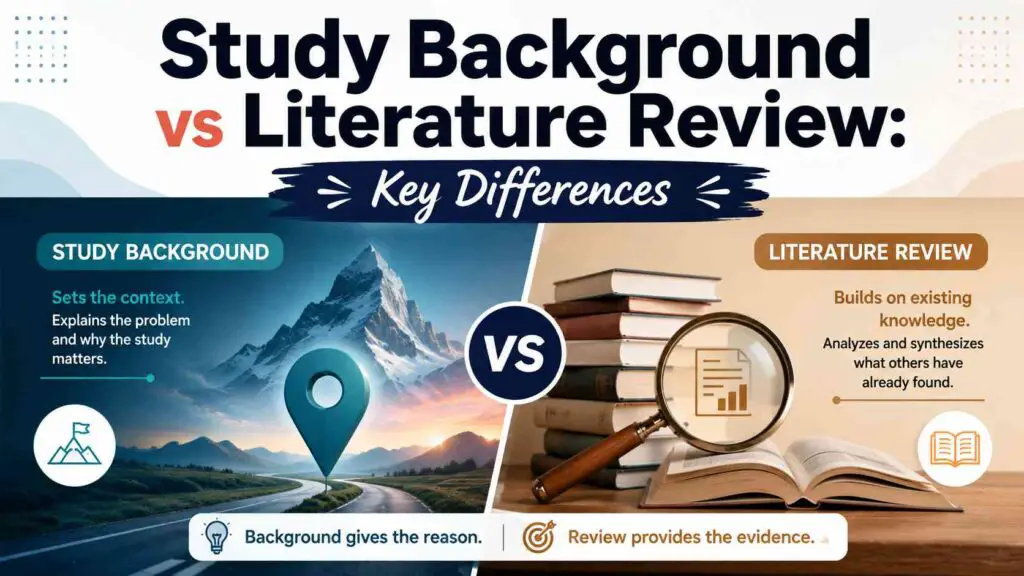
Research writing often uses terms that sound similar but serve different purposes. Two of the most commonly confused parts are the study background and the literature review.
Both sections help readers understand the research topic. Both connect the study to existing knowledge. Both explain why the research matters. But they do not do the same job.
The study background introduces the issue, problem, or context that led to the research. The literature review examines existing studies, theories, and scholarly discussions related to the topic.
Understanding the difference helps students, researchers, and academic writers organize their work clearly. It also prevents repetition and makes the research paper easier to follow.
Definitions
Study Background
The study background explains the context of the research. It shows what the topic is about, why it matters, and what problem the study is trying to address.
This section usually gives readers the basic information they need before they can understand the research problem. It may include the general situation, historical context, practical issue, social concern, or academic gap that inspired the study.
The study background answers questions such as:
What is the issue?
Why is it important?
What situation led to this study?
What problem needs attention?
Its main purpose is to prepare the reader for the research problem, objectives, and questions.
Literature Review
The literature review examines existing scholarly work on the research topic. It discusses what other researchers have already studied, what they found, where they agree or disagree, and what gaps remain.
This section is more analytical than the study background. It does not simply introduce the topic. It reviews academic sources and shows how the current study fits into the wider body of research.
The literature review answers questions such as:
What has already been studied?
What theories or concepts are relevant?
What methods have other researchers used?
What gaps exist in the existing research?
Its main purpose is to position the current study within existing scholarship.
Study Background vs Literature Review: Key Differences
The study background and literature review are closely connected, but they differ in purpose, content, scope, and depth. The study background sets the scene for the research, while the literature review evaluates what scholars have already written about the topic.
To understand the distinction clearly, it helps to compare them using specific criteria.
#1. Main Purpose
Study Background
The main purpose of the study background is to introduce the research context. It explains the situation or problem that makes the study necessary.
This section provides readers with the foundational information needed to understand the topic. It often begins with a broad overview of the issue and gradually narrows down to the specific concern being investigated.
It helps readers understand why the topic deserves attention before they encounter the research questions or objectives. By establishing relevance and context, it creates a logical pathway to the study’s purpose.
Literature Review
The main purpose of the literature review is to examine existing academic knowledge. It shows what has already been studied and how the current research relates to previous work.
Rather than introducing the topic in general terms, it evaluates scholarly contributions and identifies patterns, trends, and areas of disagreement among researchers.
It helps establish the scholarly foundation of the study. It also demonstrates how the current research builds upon, challenges, or extends existing knowledge.
#2. Focus
Study Background
The study background focuses on the broader issue behind the research. It may discuss real-world problems, social trends, institutional concerns, historical developments, or general academic context.
Its focus is on explaining the problem clearly. The emphasis is on helping readers understand the circumstances that led to the study and why the issue deserves investigation.
The discussion is often practical and contextual, highlighting factors that make the research timely or significant.
Literature Review
The literature review focuses on existing studies, theories, models, debates, and findings. It is centered on scholarly sources rather than general background information.
Its focus is on analyzing previous research. Instead of discussing the problem itself, it examines how researchers have approached and interpreted the problem.
This section seeks to identify what is already known, what remains uncertain, and where opportunities for further research exist.
#3. Type of Information Included
Study Background
The study background may include general information, context, statistics, historical details, problem statements, and practical observations.
It gives enough information to help readers understand the research issue. Information presented here is often descriptive and intended to establish the significance of the topic.
The section may also include current trends, policy concerns, industry challenges, or societal issues that provide context for the study.
Literature Review
The literature review includes academic sources such as journal articles, books, theses, reports, and theoretical works.
It summarizes, compares, critiques, and synthesizes scholarly evidence. The information presented is drawn primarily from published research rather than general observations.
In addition to findings, it may discuss research methods, theoretical frameworks, and differing viewpoints within the field.
#4. Level of Detail
Study Background
The study background is usually brief and direct. It gives only the necessary context needed to understand the study.
It should not become a long discussion of every previous study on the topic. Instead, it provides a concise overview that prepares readers for the research problem.
The goal is to inform readers without overwhelming them with extensive academic analysis.
Literature Review
The literature review is usually more detailed. It examines several sources and explains how they relate to one another.
It often includes themes, debates, research gaps, and theoretical perspectives. Researchers are expected to engage critically with the literature rather than simply summarize it.
As a result, this section is often one of the longest and most comprehensive parts of a research paper or thesis.
#5. Use of Sources
Study Background
The study background may use sources, but it does not depend entirely on reviewing academic studies.
Sources are used mainly to support the context or show the seriousness of the problem. For example, statistics, reports, or policy documents may be cited to demonstrate the scale of an issue.
The emphasis remains on explaining the research context rather than evaluating scholarly work.
Literature Review
The literature review depends heavily on sources. Its entire purpose is to discuss and evaluate existing literature.
Without scholarly sources, a literature review cannot perform its function. Every argument, observation, or conclusion in this section is typically supported by academic evidence.
The quality and relevance of the sources used significantly influence the strength of the literature review.
#6. Position in the Research Paper
Study Background
The study background usually appears near the beginning of a research paper, thesis, or proposal. It is often part of the introduction chapter or introductory section.
It comes before the research problem, objectives, or questions. This placement allows readers to understand the context before encountering the specific aims of the study.
Its early position helps establish a clear foundation for everything that follows.
Literature Review
The literature review usually appears after the introduction or as a separate chapter in longer academic works.
It comes after the reader already understands the general research context. At this stage, the focus shifts from introducing the issue to examining scholarly discussions about it.
Its placement reflects its role in providing academic support for the study’s rationale and framework.
#7. Connection to the Research Problem
Study Background
The study background leads directly to the research problem. It explains the circumstances that make the problem important.
It helps readers see why the study is needed. By outlining the context and significance of the issue, it creates a logical basis for the problem statement.
The section often concludes by narrowing attention to the specific challenge that the research intends to address.
Literature Review
The literature review supports the research problem by showing gaps in existing knowledge. It proves that the study is not just interesting but academically necessary.
It helps justify the study within the field. Through analysis of previous research, it identifies unanswered questions, inconsistencies, or limitations that warrant further investigation.
This connection strengthens the argument that the study can make a meaningful contribution to existing knowledge.
#8. Writing Style
Study Background
The study background is usually explanatory. It introduces, describes, and clarifies the context.
The tone is informative and accessible. Writers aim to present information in a way that readers from different backgrounds can easily understand.
The emphasis is on clarity and logical progression rather than critical evaluation.
Literature Review
The literature review is usually analytical and critical. It does not only describe sources. It compares them, evaluates them, and connects them to the current study.
The tone is more scholarly and evaluative. Researchers are expected to assess the strengths, weaknesses, and relevance of existing studies.
This analytical approach helps demonstrate a deep understanding of the research field.
#9. Scope
Study Background
The scope of the study background is broader. It may begin with a general issue and gradually narrow down to the specific research problem.
It gives readers the big picture. The discussion often covers contextual factors that influence the topic, even if they are not examined directly in the study.
This broad perspective helps readers understand where the research fits within a larger setting.
Literature Review
The scope of the literature review is more focused on academic work related to the research topic.
It narrows attention to what has already been studied and what still needs investigation. Sources are selected based on their relevance to the research objectives and questions.
As a result, the discussion becomes increasingly specific and closely aligned with the study’s focus.
#10. Role in Justifying the Study
Study Background
The study background justifies the study by showing that the problem is important, relevant, and worth exploring.
It creates practical or contextual justification. Readers learn why the issue matters in a real-world, organizational, social, or academic setting.
This justification helps establish the significance of conducting the research.
Literature Review
The literature review justifies the study by showing that there is a gap, weakness, inconsistency, or unanswered question in existing research.
It creates academic justification. By demonstrating limitations in previous studies, it shows why additional investigation is necessary.
This evidence-based justification strengthens the credibility and originality of the proposed research.
Closing Thoughts
The study background and literature review are both important parts of academic research, but they should not be treated as the same section.
The study background explains the context of the research. It tells readers what the issue is, why it matters, and what situation led to the study.
The literature review examines existing scholarship. It shows what researchers have already discovered, what debates exist, and where the current study can contribute.
A strong study background helps readers understand the problem. A strong literature review helps readers understand the academic conversation surrounding that problem.
When both sections are written clearly, the research becomes easier to follow, more persuasive, and more academically sound.