
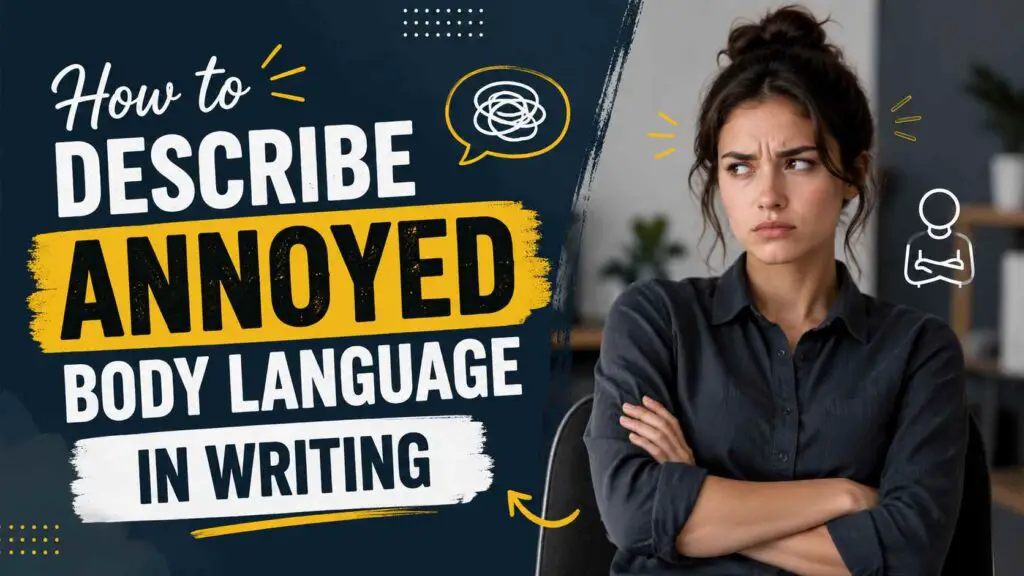
Annoyance is one of the most useful emotions to show in fiction because it often appears long before a character expresses their feelings out loud. Unlike rage or excitement, annoyance is usually subtle. A character may still be trying to remain polite, avoid conflict, or maintain self-control, but their body often reveals the truth. Readers naturally notice these small physical cues, making body language an effective way to communicate irritation without relying on dialogue or internal thoughts.
Showing annoyance through body language also makes scenes feel more realistic. In everyday life, people rarely announce that they are annoyed. Instead, they sigh, cross their arms, tap their fingers, tighten their jaws, or make their movements shorter and sharper. These reactions happen almost instinctively, and incorporating them into your writing helps readers recognize the emotion immediately.
The key is to avoid relying on the same gestures repeatedly. While crossed arms or eye-rolling can certainly communicate annoyance, combining different physical signals creates more believable and unique characters. Consider the situation, the character’s personality, and how much they are trying to hide their frustration. Someone with excellent self-control may show only a clenched jaw, while someone with less patience might slam a door or interrupt another person.
By focusing on facial expressions, posture, gestures, movement, and small unconscious habits, you can show a character’s irritation in ways that feel natural and engaging. The following techniques will help you describe annoyed body language in your writing with greater depth and variety.
How to Describe Annoyed Body Language in Writing
Annoyed body language is often restrained. It usually falls somewhere between calm and outright anger, making it one of the more nuanced emotions to portray. Instead of explosive reactions, annoyance is typically expressed through subtle physical changes that gradually build as the situation continues. A reader may notice a character becoming increasingly tense before the character even realizes how frustrated they have become.
The most effective descriptions focus on observable behavior rather than naming the emotion directly. Rather than telling readers that a character is annoyed, show them through facial expressions, posture, gestures, breathing, and movement. These details allow readers to infer the emotion on their own, creating stronger emotional engagement with the story.
Here are effective ways to describe annoyed body language in writing.
#1. Tight Facial Expressions
The face is often the first place where annoyance becomes visible. Even when someone is trying to remain polite, the muscles around the mouth, eyes, and jaw may tighten. Pressed lips, narrowed eyes, a clenched jaw, or a raised eyebrow can all suggest growing irritation without requiring any dialogue. These expressions are especially effective because they can be brief and subtle, allowing readers to sense the character’s emotional state without making it overly obvious.
Examples:
Mara pressed her lips into a thin line and stared at the clock again.
His jaw tightened, but he said nothing.
She narrowed her eyes just enough to make him stop talking.
#2. Sharp or Sudden Movements
Annoyance often changes the way people move. Actions that are normally smooth become quick, abrupt, or unnecessarily forceful. A character may place an object down harder than intended, close a drawer with extra force, or make short, impatient gestures while speaking. These physical changes communicate mounting frustration and can reveal emotions even when the character is trying to stay composed.
Examples:
He snapped the folder shut and slid it across the table.
Lena grabbed her coat from the chair with a quick, irritated tug.
She turned the page so sharply it nearly tore.
#3. Crossed Arms
Crossing the arms is a classic sign of emotional withdrawal, defensiveness, or impatience. Although it should not be used alone to indicate annoyance, pairing it with facial expressions, posture, or tone makes the emotion much clearer. Crossed arms can suggest that a character is mentally closing themselves off from the conversation or resisting what they are hearing.
Examples:
He folded his arms and leaned back, waiting for the excuse to end.
Nina crossed her arms, her fingers tapping against her sleeve.
She stood in the doorway with her arms locked across her chest.
#4. Restless Hands
Hands often reveal emotions that a character is trying to hide. When someone becomes annoyed, nervous energy can appear through repetitive hand movements such as tapping fingers, clicking a pen, rubbing their palms together, or fidgeting with nearby objects. These unconscious habits communicate impatience and growing frustration while keeping the emotional display relatively subtle.
Examples:
His fingers tapped against the table in a steady, impatient rhythm.
She clicked the pen again and again, each snap louder than the last.
Marcus rubbed his thumb over the edge of his phone, eyes fixed on the door.
#5. Avoiding Eye Contact
Although eye contact often increases during confrontations, annoyance can also cause a character to deliberately look away. They may avoid meeting another person’s gaze to prevent saying something they will regret or simply because they no longer wish to engage. Looking elsewhere can communicate emotional distance, restraint, disappointment, or impatience, depending on the context of the scene.
Examples:
She looked past him, focusing on the wall instead of his face.
He stared out the window, his silence sharper than an answer.
Cara dropped her gaze to the papers, pretending to read.
#6. Forced Smiles
A forced smile is an excellent way to show concealed annoyance. The character may maintain outward politeness while their facial muscles betray the effort required to do so. Smiles that fail to reach the eyes or appear stiff and unnatural suggest that the character is suppressing irritation for social, professional, or personal reasons.
Examples:
She gave him a smile that never reached her eyes.
His mouth curved politely, but his fingers tightened around the glass.
Amanda smiled as if the expression had been pulled into place.
#7. Heavy Sighs
Sighing is one of the most recognizable signs of annoyance because it often reflects emotional exhaustion or impatience. A sigh may occur after repeated interruptions, unnecessary explanations, or ongoing frustration. Depending on how it is described, it can communicate mild irritation, resignation, or the feeling that someone’s patience is beginning to wear thin.
Examples:
He let out a long breath and pinched the bridge of his nose.
She sighed through her nose, slow and controlled.
Another sigh escaped him before he could stop it.
#8. Stiff Posture
As annoyance grows, the body often becomes noticeably tense. Shoulders may lift, muscles tighten, and movements become more controlled. A rigid posture suggests that a character is consciously holding back stronger emotions. This restrained physical tension can be especially effective in scenes where the character must remain professional or polite despite feeling irritated.
Examples:
She sat perfectly straight, shoulders tight beneath her jacket.
His back went stiff the moment her name was mentioned.
Daniel stood motionless, but every line of him looked tense.
#9. Clipped Actions
Annoyed people frequently perform ordinary tasks with noticeably less patience. Their actions become shorter, quicker, and more forceful than usual. Whether typing on a keyboard, washing dishes, organizing papers, or packing a bag, these clipped movements suggest that frustration is influencing even routine behavior.
Examples:
She stacked the plates with short, hard movements.
He typed the reply with more force than necessary.
Mina pushed the chair in with a sharp scrape against the floor.
#10. Personal Space Changes
Changes in personal space often reveal how a character feels toward another person. Someone who is annoyed may instinctively step back, lean away, or increase the distance between themselves and the source of their irritation. In other situations, particularly when frustration is becoming confrontation, the character may instead move closer, invading another person’s space to emphasize their displeasure. Paying attention to these shifts can make interactions feel more dynamic and emotionally authentic.
Examples:
He took one step back, as if her words had become something unpleasant.
She shifted away from him on the bench.
James leaned forward, his patience clearly running out.
Closing Thoughts
Annoyed body language works best when it is specific, subtle, and connected to the scene. Instead of writing that a character “looked annoyed,” show the tension in their jaw, the sharpness of their movements, the silence after a sigh, or the way they avoid someone’s eyes.
Small gestures can carry a great deal of emotional weight, especially when they build gradually throughout a scene. Rather than relying on a single repeated cue, vary the physical signals based on the character, the relationship, and the circumstances. A restrained professional, an impatient child, and a frustrated parent will all express annoyance differently.
When you describe annoyance through believable physical behavior instead of simply naming the emotion, readers become more immersed in the story. They interpret the character’s feelings for themselves, making the emotional experience feel more authentic and memorable.