
An abandoned house is a story that stopped mid-sentence — someone chose the wallpaper, someone left the chair facing the window, and then, for reasons the walls won’t volunteer, everyone stopped coming home. That’s the form’s real subject: not decay but interruption. The peeling paint is scenery; the calendar stopped on a month, the coat still on its hook — those are the questions the visitor and the reader can’t put down. Below are abandoned house descriptions for creative writing, organized as techniques, each with examples you can study and adapt.
Abandoned House Descriptions for Creative Writing
#1. Stage the Approach — the House Seen Before It’s Entered
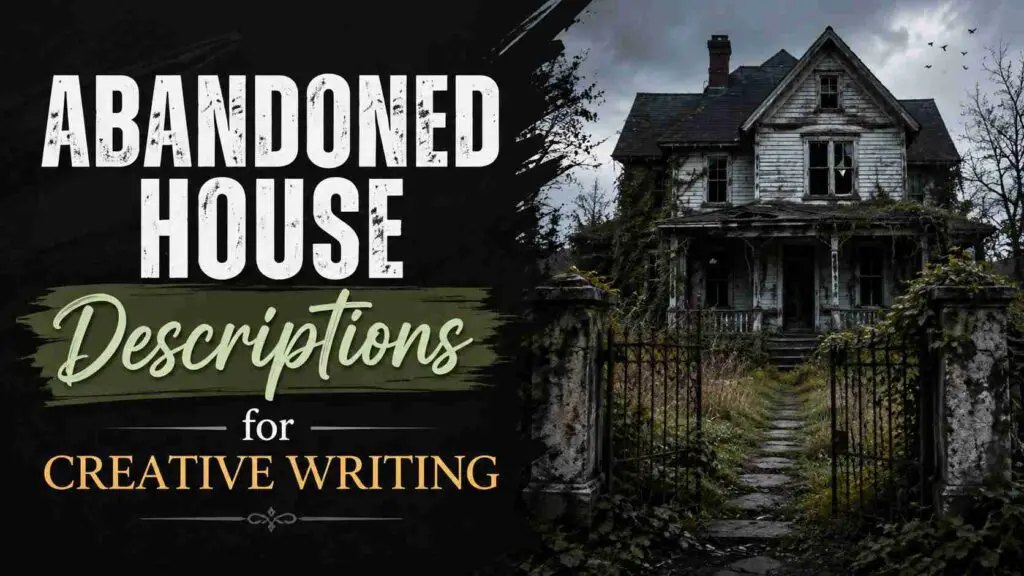
The abandoned house is a scene before the door — the drive grown over, windows boarded or blindly dark, the garden gone feral around a still-standing gate — and the approach builds the reader’s dread or curiosity at walking pace. What the yard has done with its freedom announces how long the house has been alone.
The drive was two ruts of memory under waist-high grass, and the mailbox at its mouth still wore the family’s name, lichen slowly redacting it letter by letter.
The roses had gone feral across the porch, beautiful and lawless, a garden that had stopped taking instructions sometime in the last decade.
Every window on the road side was boarded except one upstairs, which stared out unblinking over the plywood like the house keeping one eye open.
#2. Write the Threshold — Crossing Into Held Air
Entering is the form’s ritual moment — the door’s resistance, the smell of damp and dust and stopped time, the temperature drop, the instinctive hush visitors adopt — and the air itself deserves description: houses closed for years hold an atmosphere as distinct as a cellar’s. Trespassers whisper; write why.
The door gave at the second shove and the house exhaled — damp plaster, old smoke, and underneath, faint as a signature, whatever the family had cooked for thirty years.
Inside, the air stood still in a way outdoor air never does — furniture-thick, waiting — and both boys dropped their voices without agreeing to.
Her flashlight crossed the hall and the dust moved through the beam in slow galaxies, disturbed for the first time since whoever closed the door last.
#3. Find the Interruption Evidence — the Stopped Clock Details
The genre’s most powerful details prove sudden stopping — the calendar on its final month, dishes in the rack, a coat on the hook, glasses folded on a newspaper — because they convert ruin into mystery. Decay says time passed; interruption asks what happened, and the question is the story.
The kitchen calendar said October 1987, a dentist appointment circled on the 14th, and whether anyone had kept it was suddenly the most important question in her week.
Two cups stood in the drying rack, washed and waiting, done properly by someone who then never needed cups again.
A man’s reading glasses lay folded on a folded newspaper beside the chair — the house’s whole story in one small still life: he meant to come back to both.
#4. Let Nature File Its Claim
Abandonment is a handover — ivy through the window casement, a birch in the gutter, swallows in the parlor, the floor’s soft spots where rain got in — and nature’s reoccupation gives the house a second, greener life to describe. The wild moving indoors is both beautiful and unnerving; write it as both.
Ivy had come in through the broken casement and crossed the parlor wall like slow green handwriting, three sentences deep by now, still composing.
Swallows owned the upstairs — mud nests in the cornices, the air busy with them — and the master bedroom had become, without objection, an aviary.
A birch sapling stood knee-high in the hall’s rotted carpet, growing patiently toward the hole in the roof that had made it possible — the house now merely weather with walls.
#5. Sound the Silence — and What Breaks It
The abandoned house’s quiet is textured — dripping somewhere, wind in a flue, a shutter’s knock, floorboards answering footsteps two rooms over — and every sound in the stillness lands amplified and possibly attributable. The visitor’s own noise is the loudest thing there, which is its own kind of exposure.
Somewhere upstairs a drip counted the silence, patient as a metronome, and the house’s quiet arranged itself around that one small clock.
His own footsteps came back at him off the empty rooms, doubled and strange, and he found himself walking softly to keep the house from hearing him.
A shutter knocked once in the wind, and both of them stood very still and let it be the wind.
#6. Reconstruct the Lives — the Visitor as Archaeologist
The abandoned house invites detective work — heights penciled on a doorframe, the good wallpaper in one room only, letters in a drawer, children’s shoes by size — and a character reconstructing the family from evidence performs the reader’s own curiosity. Every room is testimony; let someone read it aloud.
The doorframe held penciled heights — MARY, then MARY again two inches up, then a last one, higher, dated June — and the measurements simply stopped, the way they do when children do the next of their growing somewhere else.
One bedroom had been papered in roses, carefully, the seams matched by an amateur taking pains — someone’s project, someone’s pride — and it was for that room she found herself hoping things had gone gently.
He read the house room by room like a deposition: money in the front parlor, none in the kitchen, piety on one wall, a locked box under a floorboard that argued with the piety.
#7. Give the House a Village Reputation
Abandoned houses accrue folklore — the dare at Halloween, the story that empties it (debt, scandal, the night nobody discusses), the neighbor who still mows the front strip out of respect — and the community’s relationship with the ruin is half the setting. What the town says, and won’t say, frames every visit.
Every child in the village knew the dare — touch the porch, count to ten — and every adult had done it once and would not discuss the house past a certain sentence, which was always the same sentence.
Old Mr. Prentiss mowed the dead house’s front strip every week in season, unasked, unpaid — the town’s one ongoing act of memory, performed at push-mower pace.
The house had three explanations depending on which bar you asked in, and the bank’s version, which was the true one, was the only one nobody enjoyed telling.
#8. Resist the Haunted-House Kit — Interruption Beats Cobwebs
Creaking doors, drifting cobwebs, and a conveniently flapping crow are the rented props — atmosphere by checklist, spooky and empty. The stronger register is the human one: the drying rack, the penciled heights, the mowed strip. An abandoned house doesn’t need ghosts; it needs evidence that people were interrupted, which is more haunting than haunting.
The draft had cobwebs and a creaking door; the revision had the dentist appointment circled for October 14th, 1987, and readers wrote in asking what happened to the family, which was the point.
Nothing supernatural ever happened in the house, the note said — and don’t let it. The two washed cups are doing something no ghost can.
Skip the crow, keep the coat on the hook — horror is optional in this genre; grief is structural.
Closing Thoughts
The abandoned house is the one setting where description and plot are the same activity: every detail is either decay (time’s work) or interruption (the story’s), and the interruption details are the ones readers carry out with them. Build the approach, hold the threshold breath, then plant your stopped clocks — the calendar, the cups, the glasses on the newspaper — and let a visitor read the rooms like testimony. Give the town its version and the ivy its handwriting, and leave the cobwebs to lesser houses. Done right, the reader leaves the way every real explorer of these places leaves: quietly, and wondering about the people, all the way home.