
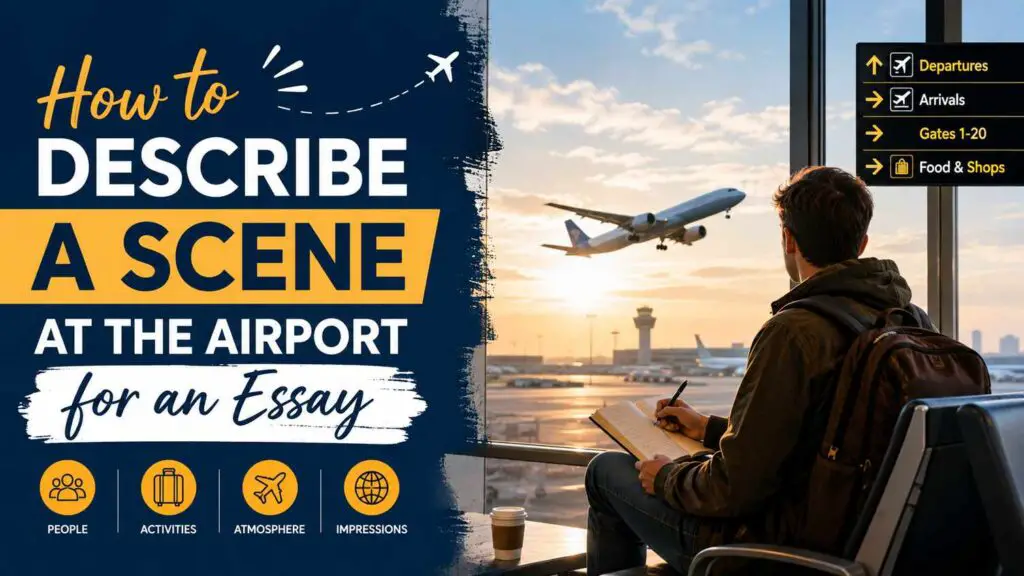
An airport is the best free theater on Earth — a building where thousands of strangers publicly perform the biggest emotions of their year: reunion, farewell, panic, boredom, hope with a boarding pass. That’s why it’s such a reliable essay subject, and why so many airport essays fail the same way, reaching for “hustle and bustle” and describing a crowd instead of a single visible human being. The strong airport scene works like all strong observation: one vantage point, a few chosen people, the senses in order, and the writer honest about what the place is doing to them too.
Here’s how to build the essay, step by step — with each step shown as a full written scene.
How to Describe a Scene at the Airport for an Essay
#1. Choose One Vantage Point and Hold It
An airport is too big to describe from everywhere, so anchor yourself — one seat at a gate, one table above arrivals — and let the scene flow past your fixed position. A held vantage gives the essay coherence and makes you a witness rather than a tour guide.
I claimed the end seat at gate B12 at six a.m. and did not move for two hours, and the airport obliged by performing around my chair. To my left, the red-eye arrivals shuffled past in yesterday’s clothes; to my right, the dawn departures clutched their coffees like small hot anchors. Directly opposite, a man slept across four seats with his boarding pass tucked in his shoe, and I watched three separate strangers notice it, smile, and decide to guard his flight for him. Nobody appointed us. By boarding time he had a volunteer committee, and when the agent called his zone, four people woke him at once.
The café above the arrivals hall sells the best seat in the building for the price of one coffee, and I made mine last ninety minutes. From up there the doors are a stage that opens every forty seconds, and the waiting crowd below is the audience that never sits down. I stopped watching the travelers after a while and watched the waiters instead: the woman who checked the flight board and her lipstick in the same glance, the driver whose misspelled sign drooped a little lower each half hour, the boy on his father’s shoulders commanding the whole room to find one particular grandmother. When she finally came through, last of her flight, small behind a huge trolley, the boy’s shriek carried to the mezzanine — and every stranger at every table around me looked up and briefly, helplessly, smiled.
#2. Cast Three People, Not a Crowd
Crowds are invisible; individuals are essays. Pick two or three passengers and follow them in prose — your chosen cast becomes the scene’s plot, and the crowd becomes their background.
Three people owned my hour at gate 9. The first was a grandmother guarding a hand-lettered WELCOME HOME sign, smoothing its corner over and over, as if the reunion’s success depended on its flatness. The second was a man in an excellent suit eating a terrible sandwich with the resignation of the two-hundredth time, his laptop open to a spreadsheet he never once touched. The third was a girl with a brand-new backpack who checked her gate number against her boarding pass four times in ten minutes — first solo flight, I decided — and I spent the rest of the wait quietly rooting for her from behind my coffee. When her zone was called she stood too early, and the businessman, without looking up from his sandwich, said, “You’re fine, kid, they’ll call it twice.” The grandmother nodded. The gate had become a family.
At the security exit I picked my cast badly on purpose: the least dramatic person in view, a middle-aged man with one small bag, waiting for no one I could identify. For twenty minutes he did nothing essayworthy — checked his watch, moved out of a family’s way, read the departure board’s far column. Then a woman in a cleaner’s uniform came off shift through the staff door, and his whole face reorganized, and I understood I had been watching a husband time his arrival to the minute for the pleasure of carrying a tote bag that weighed almost nothing. They walked out talking about, as far as I could hear, nothing at all — groceries, a cousin’s phone call. The lesson took me years to learn and one airport bench to confirm: the drama is optional; the devotion is everywhere.
#3. Score the Soundtrack
Airports have a signature audio layer — the chime before announcements, strangers’ names paged into the air, ten thousand wheels on polished floor. Cataloguing the sounds in their actual texture beats any general statement of noise.
I closed my eyes at gate 40 and tried to write the airport by ear alone. The floor came first: a river of small wheels, constant as rain, pierced every few seconds by the squeak of one bad caster that its owner had stopped hearing years ago. Then the ceiling: two soft chimes, and a voice paging “passenger Onwudiwe, passenger Kessler” — names launched into the air like paper planes, some never claimed. Under it all ran the espresso machine’s periodic scream and the flat, amiable murmur of a hundred phone calls all promising to text when they landed. When I opened my eyes, a plane was rising past the window in complete silence, all that violence sealed behind glass, like watching a shout through a window.
The 5 a.m. terminal has a soundtrack nobody writes about because nobody chooses to hear it. The cleaning machines still owned the concourse when I arrived, waltzing slowly between the first bleary passengers, humming their one low note. A shutter rattled up at the coffee kiosk and the espresso grinder cleared its throat for the day’s first order — mine. Somewhere far down the hall, a floor polisher and a rolling suitcase crossed paths in a brief duet. By six the announcements began, and the building put on its public voice, and the early sounds went wherever they go — but for one hour I had heard the airport talking to itself, and it sounded, of all things, peaceful.
#4. Arrivals and Departures Are Different Essays
The two halls run opposite emotional economies — departures is clenched hugs and last looks back; arrivals is the door opening on relief every forty seconds. Decide which energy your essay needs, or use the contrast itself.
I spent one hour in each hall, same morning, same coffee, and came away with two different essays. Arrivals was the happiest room in the city: strangers holding flowers, drivers with misspelled names, the doors opening again and again on somebody’s finished journey, and applause — actual applause — when a whole extended family met a baby it had only known by phone. Departures, one floor up, ran on a different currency. The hugs there had a grammar of their own: longer, tighter, ending in the little back-pats that mean go on now, before I change my mind. At arrivals people looked past each other, hunting one face. At departures they looked at each other, memorizing one. One escalator separated the two halls, and riding it back down felt like traveling between the beginning of every story and the end.
The family at the departures rope had brought too many people for the goodbye — parents, a sister, an uncle filming, a grandmother in her best coat at seven in the morning. The boy leaving for his first contract abroad hugged them in careful order, youngest to oldest, and the grandmother took his face in both hands and said something that made him laugh and cry in the same second. Then he was through the barrier, and the family did what departure families do: stood exactly where he’d left them, waving at his back, holding the wave long after he’d stopped turning around. The uncle filmed it all. Someday, I thought, that footage will be the most valuable thing that family owns, and none of them knows it yet.
#5. Write the Suspended Time
Airport time is nobody’s time — early mornings indistinguishable from midnight, breakfast beer unjudged, a whole population between obligations. Essays that name this limbo honestly gain a philosophical layer without straining for one.
It was 6 a.m. and also no time at all. At the bar beside my gate, a man in a wedding suit drank a pint next to a woman eating dinner salad, and no clock in the building found either of them strange. My phone said Tuesday; my body said nothing; the departure board said only its own kind of time — BERLIN 40 MIN, DOHA 3 HRS — hours measured not from midnight but from escape. I had been awake since three and the airport absorbed that fact without comment, the way it absorbs everyone’s. Nobody in an airport is where they mean to be, I wrote in my notebook, and a man walking past with a neck pillow nodded at me as if I’d said it aloud.
The delay rolled from forty minutes to two hours, and gate 22 settled into its strange village life. The outlets became communal property, administered by an unspoken rota. The man in the good suit surrendered his tie and taught a bored seven-year-old to fold boarding passes into planes; a woman shared her charger and received half a sandwich in return, the village economy finding its feet. Each non-announcement drew the same collective exhale, half groan, half laugh — the sound of a town developing a sense of humor about its weather. When the flight finally boarded at 9:40, we filed on almost reluctantly, nodding at each other like neighbors moving away — citizens of a town that had existed for four hours and would never exist again.
#6. The Rituals of Passage
Security is the airport’s ceremony — shoes off, belts coiled, arms raised in the scanner’s little chapel — and everyone submits identically. Describing the choreography and its small recoveries gives your essay its most universally recognized scene.
At the belt we all became the same person. The executive ahead of me surrendered his watch and his authority in the same tray; the teenager behind me held up her jeans with one hand, beltless, dignity in the other. The scanner required its pose — feet on the yellow prints, hands overhead, a two-second surrender — and I watched a bishop perform it, then a toddler, delighted, twice. On the far side stood the recovery benches, where strangers rebuilt themselves: rethreading belts, relacing shoes, restoring watches to wrists and selves to bodies. A man beside me hopped on one foot, wrestling his shoe, and said to no one, “Every time, I pack the slip-ons, and every time I forget.” Everyone within earshot nodded. It is the only sacrament we all still take together.
The woman ahead of me in the security line was flying for the first time in thirty years — she announced it to the officer like a confession, apologizing in advance. The line behind her did not sigh. The officer walked her through it step by step — liquids here, shoes there, nothing to worry about, ma’am — and the executive behind me quietly moved her second bin for her, and the teenager passed her forgotten phone down the rollers like a bucket brigade. She came through the scanner with her arms still raised, triumphant, and a small ripple of applause broke out — three people, maybe four — and she took a bow no larger than a nod. For one minute, the most impersonal machine in the building had run entirely on kindness.
#7. Scale Against Intimacy
The airport’s power is contrast: cathedral architecture and jet-scale machinery framing tiny human moments. Alternate the wide shot and the close-up deliberately; the small moments read larger against all that steel and glass.
The window at gate 51 framed three hundred tons of aircraft being fed by trucks and men in vests, a machine the size of a church lying on the tarmac while the fuel line ran into its wing. And reflected in the same glass, a toddler pressed one starfish hand against all of it, claiming the plane the way children claim the moon. Her mother stood behind her, half-watching, half-reading her phone, unaware she was part of the composition. When the jet finally pushed back, the girl waved with her whole arm, and — I will swear this in any court — the man in the high-vis vest walking the wingtip waved back. The building processed forty thousand strangers that day. The essay was those two.
Under a departure board listing half the planet — Nairobi, Osaka, Reykjavik, Lima — a man knelt on the polished floor to retie his daughter’s shoe. He took his time with it, double-knotting, saying something that made her laugh, while above his bent head the whole world scrolled and blinked and called its boarding groups. Around them the concourse poured its thousands toward their gates. Nobody stopped, and nobody needed to; the picture composed itself for anyone willing to stand still — the enormous and the tiny, the everywhere and the right-here, a shoelace holding its own against the entire planet. When they walked on, hand in hand, the board had already changed, and somewhere new was boarding.
#8. Put Yourself in the Scene Honestly
An essay needs its narrator — why you’re there, what you’re carrying, what the place is doing to you as you watch. The observing “I” gives the description stakes and turns scenery into testimony.
I should admit why I was watching all these reunions: I was flying away from one. My mother had insisted on coming in, though I’d said curbside was fine, and we stood in the line’s last shared stretch performing calm for each other, our conversation shrunk to logistics — passport, gate, text me when. At the rope, the goodbye we’d both been rationing arrived all at once and lasted four seconds, her hand on my sleeve, the back-pats that mean go on now. I looked back twice. The first time she waved. The second time she was still there, smaller, not waving, holding her elbows — and that is the picture of her I carried through the scanner, across the ocean, and into every essay I have written about home since.
I had two hours to kill and an acceptance letter in my bag, and the airport knew neither of these things, which was exactly why I loved it that morning. I bought the expensive orange juice. I watched a delayed crowd groan in unison and felt, unfairly, wonderful. At the window a 747 lifted off for somewhere with a name like a spell, and I stood there with my whole future folded in an envelope, thinking: every person in this building is mid-sentence. The woman running for gate 12 — mid-sentence. The pilot wheeling his little case — mid-sentence. Me, juice in hand, admitted somewhere at last — mid-sentence, and for once in my life, enjoying not knowing how the sentence would end.
#9. Ban the Hustle and Bustle
“The airport was a hive of activity, full of hustle and bustle” is the essay’s autopilot opening — a sentence that has boarded a million school assignments and describes none of them. Open instead on one specific, timed, sensory fact that could only belong to this airport on this day.
My first draft began “The terminal was a hive of activity,” and my teacher circled it and wrote: “Which bee?” So I went back and found the bee. At 7:15, at gate 6, the flight to Lagos began boarding to a drumbeat of applause — an entire extended family clapping a grandmother down the jet bridge on her first trip home in nineteen years. Two gates over, the Frankfurt flight boarded in silence broken only by roller wheels. Same morning, same airline, same gray carpet — two completely different countries of feeling, forty meters apart. The terminal wasn’t a hive of anything. It was two hundred specific mornings happening at once, and my essay only had to catch one.
Forget the bustle; here is what was actually happening at 8:40. On the up escalator, a single lost glove rode the rail alone, and half the passing travelers touched it lightly, as if for luck. At the base of the down escalator a cleaner leaned on his cart and watched the glove complete another lap, making no move to retrieve it — later he told me it had been riding since seven, and that he was leaving it: “Somebody’s coming back for it. They always come back.” I waited twenty more minutes on the strength of that. At nine a breathless woman in one glove came up the concourse at a half-run, and the cleaner pointed, and she laughed, and the whole morning paid off like a bet.
Closing Thoughts
The assignment hiding in this article: go to an airport early on purpose — or use your next delay — and sit at arrivals for thirty minutes with a notebook and no phone. Log what actually happens: the doors, the signs, the taxi drivers’ boredom, the one reunion that makes a stranger near you pretend something is in their eye. You’ll leave with more essay than you can use, because the airport does the emotional work for free; your job is only accurate witness. Every scene above was built that way: arrive early, sit still, watch one door.