
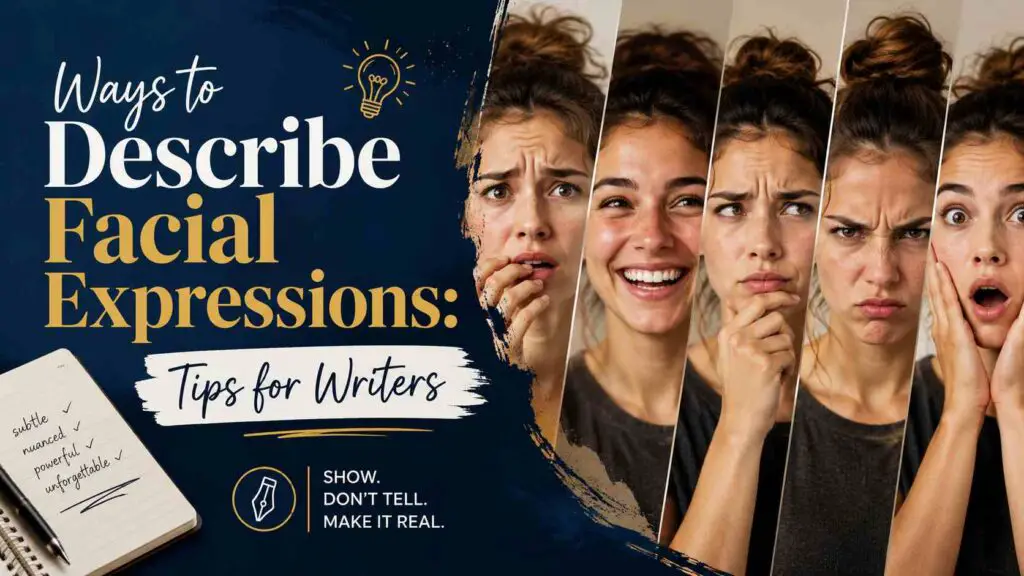
Facial expressions are dialogue’s second channel — the face broadcasting agreement, doubt, and injury while the mouth says something politer — and most manuscripts transcribe only the words. The craft problem is that expression writing defaults to a tiny stock kit (eyes widen, jaws drop, brows raise) that reads like emoji, while real faces work in timing, halves, suppression, and leakage. Writing expressions well means writing them as events: they arrive, they fight the face’s intentions, they decay at different speeds, and other characters read them — sometimes correctly, which is drama, and sometimes wrongly, which is more drama.
Here’s the working method.
Ways to Describe Facial Expressions: Tips for Writers
#1. Write the Onset — Expressions Arrive
An expression is a motion, not a state: delight breaks, dismay spreads, recognition dawns in stages. Describing the arrival — what moves first, how fast — turns a face-label into an event the reader watches happen.
The smile started before she’d finished the sentence — at the eyes, spreading downward — so that her mouth was merely confirming what her face had already published.
You could watch the bad news travel across his face like weather crossing a field — the forehead first, then the eyes, the mouth holding out longest.
Recognition arrived in installments: a frown, a squint, and then the whole face opening at once — “MARISOL?” — twenty years paid off in half a second.
#2. Write the Decay — They Also Leave
How an expression exits is often the tell — the smile that collapses the instant the door shuts, the laugh that drains slowly, delight that fades into something complicated. The decay curve reveals what the expression was covering.
She held the smile until the taillights turned the corner, and then it left her face all at once, like staff going off shift.
His laughter subsided by degrees into something quieter and less certain, the amusement draining out the bottom of it until only the shape was left.
The delight lasted exactly as long as she believed him — you could see the moment doubt arrived, because the smile stayed and stopped being one.
#3. The Suppressed Expression
Faces fight themselves — the twitch of a grin at a funeral, tears blinked down in a meeting, fury ironed flat mid-sentence. The struggle between feeling and control is more expressive than either side winning; write the wrestling match.
Something tried to happen at the corner of his mouth during the eulogy — his brother’s favorite, terrible joke arriving unbidden — and he bore down on it like a man holding a door.
Her face made one attempt at crumpling, was overruled, and reassembled — the whole coup and its suppression taking under a second, visible only to her sister.
He kept his expression neutral the way you keep a lid on a pot — actively, with attention, and everyone could hear the simmer anyway.
#4. The Leak
Suppression is never total — the real feeling escapes through one small aperture: a jaw muscle, a too-long blink, nostrils, a swallowed swallow. Give each character a signature leak and observant characters (and readers) can read them past their performances.
His face took the insult without moving; only the small muscle at the jaw’s hinge stood up, once, like a knuckle rapped under the table.
“Fine by me,” she said, expression level — and blinked one blink that lasted a half-second too long, a shutter closing on something being moved out of view.
The tell was never his eyes, which lied beautifully; it was the nostrils, which had no training at all.
#5. Halves and Mixtures
Real faces are rarely one thing — amusement over hurt, warmth with warning, the smile that never reaches the top half. Describing the mixture, or the mismatch between a face’s halves, captures emotional complexity no single label holds.
She was amused and wounded in the same face — the mouth taking the joke, the eyes filing the injury — and he apologized to the eyes.
The smile occupied the lower floors only; upstairs, the eyes remained on business, cool and counting.
Pride and grief shared his face at the passing-out parade without negotiating — his son’s uniform, his brother’s uniform, the same uniform — two expressions standing at attention side by side.
#6. Let Another Face Read It
Expressions exist to be read, so write the reading — accurately, or crucially wrong. A misread face (boredom taken for contempt, shyness for coldness) launches whole plots, and the reader who knows the truth watches the error with delicious helplessness.
She read his stillness as indifference and left the party early; it was, in fact, the stillness of a man rehearsing a sentence he’d waited a year to risk.
The interviewer’s small frown meant concentration; Dev, who could not know that, spent the next ten minutes dismantling his own best answer.
Only her mother read the expression correctly across the reception — happy, and lonely inside the happiness — and began, quietly, moving toward her through the crowd.
#7. Context Recolors the Same Face
An identical expression means different things in different frames — the grin at a wedding versus the same grin in a courtroom. You can reuse one described expression across scenes and let situation change its meaning; the repetition itself becomes characterization.
It was the same crooked half-smile from the wedding photos, and in the deposition room it stopped being charming and started being a statement.
Her thinking-face — lips pressed, gaze up-left — meant dinner plans at home and meant a man’s sentence in chambers, and she wore it identically for both.
He had one expression for pain and one for joy, and they were the same expression, which made him a terrible patient and a wonderful poker partner.
#8. Ration the Face
Expression inflation is real — faces that widen, narrow, darken, and brighten every paragraph exhaust the reader and cheapen the currency. Cut expression beats to the moments that change something, and let dialogue run clean between them; a face used sparingly is a face that lands.
For three pages of argument her face did nothing at all — which is why, when her chin finally crumpled on the word “stay,” it broke the reader with it.
The editor’s margin note said it best: “His eyebrows have done more work this chapter than the plot.”
One expression per scene, the old writer said — choose it like a knife from the drawer, and put the rest back.
#9. Retire the Emoji Kit
“Her eyes widened. His jaw dropped. She raised an eyebrow. His face darkened.” — the stock kit renders every cast member’s face identically, like a font of emoji. The repair is ownership: give the moment a movement particular to this character’s face — the specific asymmetry, the signature leak — or give it to their hands, posture, or silence instead. Faces aren’t the only actors.
Kit version: her eyes widened in shock. Owned version: her face did the thing it did at bad news — went very smooth, very polite, a counter being wiped before the real reaction was served.
Not “his jaw dropped”: he set down the coffee with exaggerated care, as if the mug had become responsible for the news, and looked at the wall for a while.
Nothing on her face moved at all — and the letter in her hand acquired one slow, deliberate crease, which was the expression.
Closing Thoughts
Do one pass through your manuscript for faces alone: highlight every widened eye, dropped jaw, raised brow, and darkened face, and count how many characters share the identical repertoire. Then rebuild the beats that matter using this list — an onset, a decay, a suppression, a leak, a misreading — and delete the rest outright, trusting dialogue and gesture to carry the scene between. The goal isn’t more facial description; it’s fewer, better-timed expressions, each owned by one particular face. A reader should be able to identify your characters by their expressions alone, with the names removed. That’s the standard — and it’s reachable in one afternoon’s revision.