Jewelry is the smallest cargo a character can carry and the heaviest — a ring holds a marriage, a bracelet holds a grandmother, a watch chain holds a century — and yet on most pages it gets one dead adjective: “sparkling.” Real jewelry description works the way jewelers do, in light, metal, weight, and provenance, and works the way novelists do, in what the piece means, costs, and betrays about its wearer. A diamond described well should glitter; a locket described well should ache. Below are ways to describe jewelry that sparkles on the page, each with examples you can study and adapt.
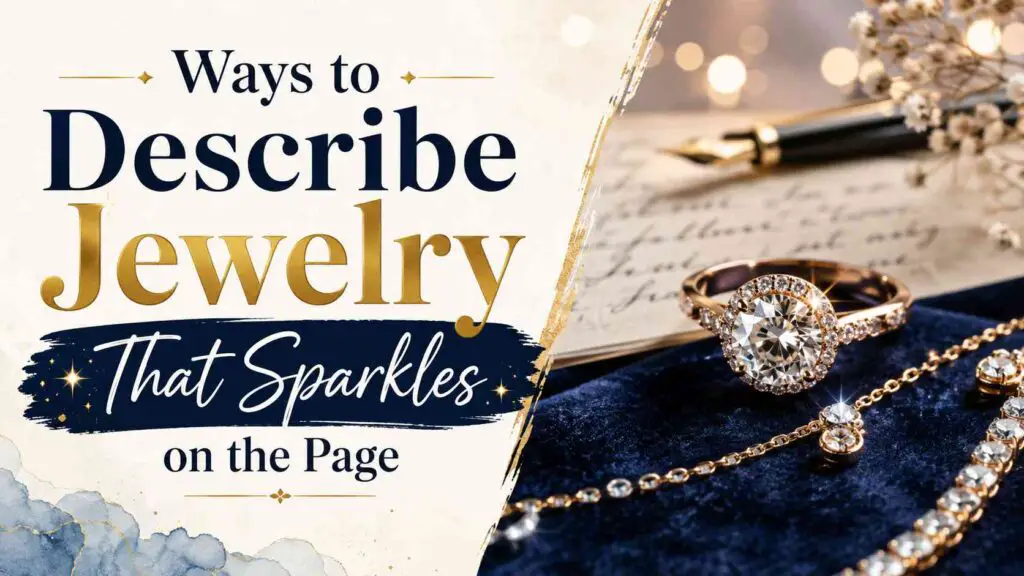
Ways to Describe Jewelry That Sparkles on the Page
#1. Write the Light as Behavior, Not “Sparkle”
Stones and metals each treat light differently — diamonds throw white fire, gold holds a warm steady glow, pearls keep a soft interior sheen, opals shift like weather — and describing the specific light-behavior replaces the generic glitter. The verbs matter: gold gleams, silver flashes, pearls simply hold.
The diamond didn’t sparkle so much as transmit — every candle on the table filed a small white report from her finger when she moved.
The pearls made no flash at all; they glowed from somewhere under their own surface, moonlight banked at low interest.
Old gold has a temperature — the bangle lay on the dresser holding its warm butter light, while the new ring beside it merely shone.
#2. Give It Weight, Warmth, and Sound
Jewelry is felt and heard as much as seen — a heavy ring turned by a thumb, bangles announcing arrival down a corridor, earrings’ cold at first touch warming to the skin, a charm bracelet’s small percussion — and the physical senses make ornaments into bodily companions rather than props.
You heard Auntie before you saw her — a soft brass conversation of bangles that had announced her down forty years of hallways.
The signet ring had real weight, a small dumbbell of ancestors, and he turned it with his thumb in meetings the way other men clicked pens.
The earrings went in cold and warmed within the minute, taking her temperature the way they had taken her mother’s.
#3. Read the Wearer Through the Piece
Jewelry is autobiography in metal — the single good watch of a careful man, the armor of rings on a woman who came from nothing, the wedding band still worn or newly absent, the small cross under the collar — and what’s worn, where, and how often characterizes without a word. The absence of jewelry is a statement too.
She wore rings on eight fingers, stacked and mismatched, a portable vault — a woman who had been poor once and had decided her wealth would ride where she could see it.
The pale stripe on his ring finger was three months old and he still turned the ring that wasn’t there.
Her only jewelry was a thin chain kept under the blouse, private as a pulse — ornament for an audience of one.
#4. Carry the Heirloom’s Freight
Inherited jewelry is ancestry you can wear — the ring resized down three generations of hands, the brooch that survived the crossing sewn into a coat hem, the pieces divided after funerals with more care than the money — and provenance gives small objects novelistic weight. Who gets the ring is a will’s loudest clause.
The ring had been sized down twice, from great-grandmother’s hand to grandmother’s to hers, the gold thinning at each descent like a story losing no truth but some detail.
The brooch had crossed the ocean sewn into a coat hem in 1923, and the family still spoke of it in the tone reserved for surviving relatives.
The estate divided smoothly except for the cameo, which all three sisters claimed, and which their mother had promised — quietly, separately, and in writing to none of them — to each.
#5. Stage the Transaction — Gifts, Proposals, and Pawnshops
Jewelry moves at life’s hinges — the ring box’s terrifying smallness, the anniversary gold that apologizes or celebrates, the pawnshop counter where love’s tokens meet arithmetic — and every transfer scene carries stakes beyond price. Jewelry given, refused, returned, or sold is plot wearing a clasp.
The box was absurdly small for what it was about to do to both their lives, and his hand around it had been sweating since the appetizers.
The pawnbroker weighed her mother’s bracelet with terrible neutrality, and the number he said was correct about the gold and wrong about everything else.
She mailed the ring back in its original box, packed in cotton wool, registered post — the entire ending conducted with more care than the middle had ever received.
#6. Distinguish Fine From Costume — and Honor Both
The fine/costume line is social information — the real pearls among the paste, the heiress in flea-market plastic, the counterfeit that fools everyone but the jeweler — but sentiment doesn’t follow price: a dead child’s plastic ring outranks diamonds. Value in jewelry description is always two ledgers, and the second one runs the scene.
The appraiser went down the tray — paste, paste, good, paste — and then stopped at the plain glass ring from a carnival machine, which was the only piece the old woman had asked to be buried in.
Her diamonds were excellent fakes and her confidence was real, and in that room the second thing outshone the first.
The bent tin ring from the boardwalk machine had cost a quarter in 1969, and he had seen her hand it out of reach of two burglaries and one house fire.
#7. Put It in Motion — Jewelry Worn, Fidgeted, and Caught
Jewelry lives in gesture — the necklace chain run along a lip in thought, the earring removed for the phone, the ring twisted in a lie, the bracelet caught on a sweater at the worst moment — and motion integrates ornament into scene instead of leaving it posed in a display case. Fidgeted jewelry is a tell with a hallmark.
She twisted the ring through the whole negotiation, around and around, and the man across the table read the carat weight of her doubt precisely.
He removed one cufflink at the door the way other men loosen ties — the day being taken off, link by link.
Her bracelet snagged the bride’s veil at the exact quietest moment of the ceremony, and four pews conducted the untangling with their breath held.
#8. Let Jewelry Keep Secrets
Jewelry conceals as professionally as it displays — the locket’s hidden face, the inscription inside a band, the ring worn on a chain instead of a finger, the second earring never explained — and the hidden compartment is narrative architecture. What a piece keeps private is usually the story.
Inside the wedding band, where only the jeweler and one other person had ever read it, ran a date that was not the wedding’s.
He wore a ring on a chain under his shirt, and the men he worked with had three theories, and all three were gentler than the truth.
The locket was soldered shut — her grandmother had paid the jeweler extra for that — and the family had honored the closure for sixty years, which told you what they suspected was in it.
#9. Retire “Dripping in Diamonds” and the Glitter Kit
“Dripping in diamonds,” “sparkling jewels,” “glittering gold” — the glitter kit describes a jewelry-store window, not a piece someone owns. The repair is singularity: one piece, with light behavior, weight, provenance, and a habit of being touched. A single ring fully described outshines a treasury generally praised.
The draft had her dripping in diamonds; the revision gave her one ring, worn over an arthritic knuckle it could no longer cross, and the reader learned the marriage’s whole length from the fit.
Not “glittering gold” — say the chain had worn a faint groove at the back of her neck, fifty years of being there doing what fifty years does.
One piece per character, the note said — described like evidence, worn like biography — and melt the rest of the treasure chest down.
Closing Thoughts
Open any real jewelry box and notice what’s actually in it: not sparkle — stories with clasps. The resized ring, the soldered locket, the carnival glass that outranks the diamonds, the bangles that announce an aunt. That inventory is the whole method. Write light as behavior, weight as fact, provenance as freight, and gesture as tell; keep one secret per box and one piece per character. “Sparkling” is what jewelry does in shop windows, for strangers. On the page, in a life, jewelry glows, weighs, remembers, and occasionally lies — and that is the shine worth writing.