
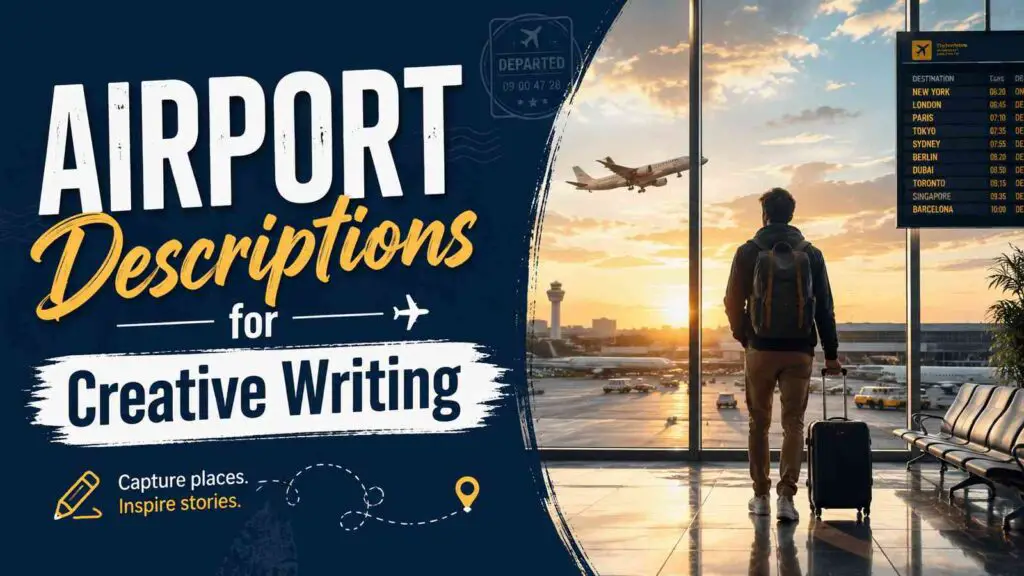
An airport is a city with no residents — thousands of people, none of whom live there, all mid-transformation between one life and another. It runs on the strangest emotional economy of any public building: the arrivals hall hosts the best moments of people’s years while departures hosts the worst, fifty meters apart, all day. For writers it’s a gift of built-in stakes, forced waiting, strangers in proximity, and farewells with boarding times. Below are airport descriptions for creative writing, organized as techniques, each with examples you can study and adapt.
Airport Descriptions for Creative Writing
#1. Work the Two Halls — Arrivals and Departures as Opposite Weathers
The airport’s emotional geography is split — arrivals is reunion, flowers, and names on cardboard; departures is the long hug and the walk through security that can’t be unwalked — and staging a scene means choosing your hall. The same building holds both weathers simultaneously, which is itself worth writing.
Arrivals ran on joy in bursts — a shriek, a run, a lifted child — while one floor up, departures processed the same families in reverse, and the building held both without comment.
She watched the arrivals doors deal out reunions like a slow card game — businessman, students, grandmother — while holding her own cardboard sign steady.
The rule of departures: whoever stays watches until the security line turns the corner, and whoever goes looks back exactly once, and both parties time it wrong.
#2. Describe the Terminal’s Placeless Placeness
Terminals are engineered anywhere — the same glass, wayfinding font, and coffee franchises on every continent — and that placelessness is describable as a quality: a building that could be nowhere in particular, lit like an operating room, timeless as a casino. Characters feel unmoored in terminals precisely because the terminal is.
The terminal could have been any terminal on earth — same glass, same font, same coffee — and jet-lagged, she had to read her own boarding pass to remember which country was outside.
The light was the same at 3 p.m. and 3 a.m., a shadowless institutional noon, and time in the terminal became something you took on faith from the screens.
Only two things located the airport at all: the language of the announcements, and the mountains standing in the window’s far edge like a rumor of an actual place.
#3. Run the Soundtrack — Announcements, Wheels, and the Gate’s Quiet
The airport’s audio is layered and specific — the bing-bong preceding announcements, final calls with names in them, roller bags’ plastic thunder, the hush of a delayed gate at 1 a.m. — and the soundtrack sets tempo. A name paged over the speakers is a whole plot device in one sentence of sound.
The bing-bong preceded every announcement like a tiny doorbell to nowhere, and the terminal’s ten thousand people flinched attentive and relaxed in one shared reflex.
“Final call for passenger Okafor” went out over four concourses, twice, with that edge announcers get — and somewhere in the building a man began to run.
By 1 a.m. the delayed gate had gone library-quiet — phones at ten percent, a baby surrendered to sleep, roller bags parked like patient dogs.
#4. Use Security as the Story’s Turnstile
Security is the airport’s ritual threshold — shoes off, belongings tray-ed and x-rayed, the body scanned, the small indignities absorbed — and narratively it’s a one-way valve: past it, the goodbye is final and the journey real. The line’s choreography and the re-dressing bench afterward are rich, underwritten territory.
She surrendered her belt, her watch, her water, and her composure to the gray trays, and reassembled all four at the bench on the far side, a citizen rebuilt from parts.
The goodbye happened at the rope because it had to — past that point the airport belonged to ticketed persons only — and the rope, waist-high and velvet, might as well have been a border wall.
He watched his son’s socks cross the scanner threshold, and the officer waved the boy through into the rest of his life.
#5. Fill the Waiting — Airport Time as Its Own Substance
Airports manufacture waiting — the too-early arrival, the delay’s creeping updates, the layover’s dead hours — and waiting characters reveal themselves: pacers, sleepers, bar philosophers, the woman who befriends the gate agent. Airport time is thick and strange; write what your character does with three unwanted hours.
The delay went from twenty minutes to forty to “see agent,” and the gate settled into siege mentality — alliances formed, outlets shared, a man in a suit sat on the floor.
She had a five-hour layover and spent it watching the board flip through cities like a jukebox of other lives — Nairobi, Reykjavik, Lima — any of them one gate change away.
Airport beers at 9 a.m. obey no earthly rules, and the two strangers at the bar toasted to that, both of them between things they didn’t discuss.
#6. Watch the Crowd — a Census of In-Between People
The terminal crowd is all transitions — soldiers coming home, students leaving, the funeral-fare traveler in black, honeymooners, the deportee with his escort — and people-watching scenes inventory lives at their hinges. Every passenger is mid-sentence; a character reading the crowd reads a hundred stories in progress.
Gate 14 held a soldier asleep on his duffel, a bride with the dress bagged and carried flat like a casualty, and an old man reading the same letter twice — the departures board of lives, not flights.
You could sort the terminal by luggage: the carry-on professionals, the families moving countries in taped boxes, the girl whose single backpack was either freedom or everything left.
The man in black flying on a Tuesday with no bag and red eyes needed no explaining to anyone who looked, and the crew, who had seen the fare code, moved him forward without being asked.
#7. Give the Windows Their Due — Planes, Weather, and the Edge of the World
The terminal’s one honest wall is glass — planes heaving up impossibly, the ballet of fuel trucks and baggage trains, weather arriving across the tarmac, tails lit at dusk — and the window seats are where characters think. The child at the glass watching takeoffs is the airport’s resident philosopher.
The boy stood at the glass calling weights and verdicts — “that one’s too heavy, that one’s fine” — while behind him the adults checked screens for permission to feel the same wonder.
Rain crossed the tarmac in gray sheets while the ground crew worked on in it, glowing vests bent under wings, the airport’s honest labor visible for anyone who looked past the duty-free.
At dusk the tails lit up down the stands like a row of nations’ candles, and her own — the one with the wrong flag, the one going home without her — pushed back at 8:40 exactly.
#8. Scale It Honestly — Hub, Regional, and the One-Gate Airfield
Airports come in sizes with different souls — the mega-hub’s city-state sprawl, the regional’s six gates and one café, the island strip where the pilot loads the bags — and the small airport’s intimacy (everyone on the flight known by name) is a different genre from the hub’s anonymity. Choose the scale; it sets the whole scene’s physics.
The island airport was a shed with a windsock, and the pilot took her bag himself, weighed it on a bathroom scale, and asked after her mother by name.
The hub was a city with a cathedral’s ceilings and a stadium’s crowds, and she crossed it for forty minutes on moving walkways, a pilgrim between concourses B and F.
The regional terminal’s single café closed at seven, and the last flight’s passengers waited in a quiet that was almost domestic, eleven of them, like a bus stop with a tower.
#9. Skip the Generic Bustle — Give the Airport One Human Machine
“The bustling airport teemed with travelers” is the stock line — motion without a single person in it. The repair is choosing one human machine and following it: one reunion, one final call answered at a run, one gate agent absorbing a hundred delays with vending-machine calm. The bustle is background; the airport is the individual mid-transit.
The draft had the airport bustling; the revision followed one running man — laptop bag swinging, gate 44 to 12 — and the whole terminal assembled itself around his sprint.
Not “teeming with travelers” — say the gate agent rebooked her ninety-first passenger of the storm with the same courtesy as the first, and her coffee had been cold since noon.
One arrival, fully written — the doors, the scan, the shriek, the run — beats a thousand teeming extras, the note said; airports are made of individuals who all think they’re the main character, because today, arriving, they are.
Closing Thoughts
Next layover, put the phone away for twenty minutes and take the census: the soldier on the duffel, the flat-carried wedding dress, the agent’s cold coffee, the boy judging planes at the glass. Everything an airport scene needs is on display hourly, free, because the building concentrates human hinge-moments like no other roof on earth. Choose your hall and your scale, run the bing-bong soundtrack, respect security’s one-way valve, and follow one person through rather than gesturing at the teeming many. The airport is never the story — it’s the machine that presses stories together for a few hours and then, gate by gate, lets them go.