
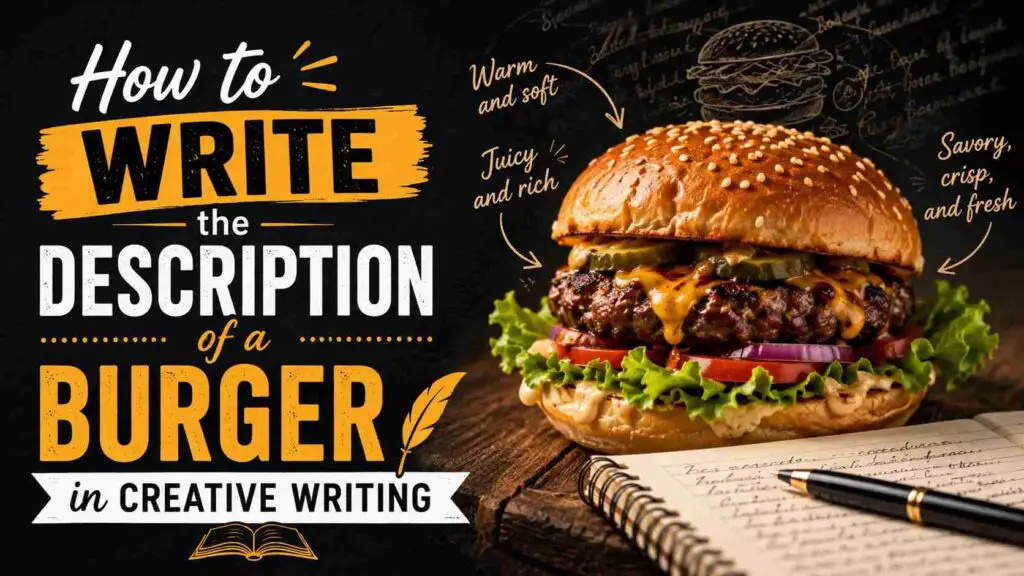
Food writing has one law: make the reader hungry or don’t bother — and the burger is where writers most often bother without the hunger. “Juicy” and “mouthwatering” are menu words, worn frictionless by advertising; they inform the reader that food occurred. A burger that works on the page is built from mechanics and circumstance: the architecture of its layers, the physics of the first bite, the sizzle it arrived from, and — above all — who is eating it, after what kind of day, because a burger is never just lunch. It’s reward, ritual, comfort, or surrender.
Here’s how to write one worth the napkins.
How to Write the Description of a Burger in Creative Writing
#1. Build the Architecture
A burger is a structure — foundation bun, patty, the melt-layer of cheese, the produce storey, the crown — and describing the stack from bottom to top gives the reader a blueprint their appetite can inhabit. Note the engineering: what’s load-bearing, what’s sliding, what the toothpick is holding together.
It arrived as a tower with a lean — bun, beef, a cheese layer done melting and now merely holding on, tomato at the slip angle, the whole structure pinned by one heroic toothpick.
The patty overhung the bun all the way around, a policy statement, and the onions had been laid like roof tiles by somebody who took the trade seriously.
He lifted the crown to audit the interior — pickles, two; sauce, adequate; lettuce, ceremonial — and rebuilt it with the care of a man closing a watch case.
#2. The First Bite Is the Event
Slow the opening bite into its stages — the jaw’s stretch, crust giving way to give, the temperature, the first full arrival of flavor. This is the scene’s payoff; spend a paragraph’s patience on two seconds, and the reader’s mouth does the rest.
The first bite required commitment — a jaw opened past politeness — and then the crust gave, the beef gave, everything gave at once, and conversation at the table lost him for a while.
Heat first, then salt, then the char’s bitterness shaking hands with the sauce’s sweetness — the whole argument of the thing landing in the first mouthful, as it must.
She closed her eyes on the first bite — involuntary, brief, the body pulling the blinds to be alone with it.
#3. Honor the Mess
A burger’s juices run, sauce escapes at the far side, the napkin stack exists for a reason — and the mess is the meal’s honesty. Writing the drip down the wrist and the two-handed defensive lean makes the food real; a tidy burger is a stock photo.
By the third bite the juices had found his wrist and were making for the elbow, and he assumed the position — hunched, elbows out, guarding the perimeter like a man eating in a wind.
The sauce departed at the rear, as sauce does, and landed on the plate with a small diplomatic slap, and nobody at the table judged, because their own rears were leaking too.
She finished with four napkins down and one to go, fingers glazed, chin shining — wrecked, victorious, a woman who had eaten the burger rather than negotiated with it.
#4. Backstage: Sizzle and Griddle
The burger’s origin story is audible and visible — the hiss as patty meets steel, the smash, the flip’s chrome flash, onions going translucent on the griddle’s edge. Writing the cooking builds appetite before arrival, and the cook’s economy of motion is a character sketch for free.
The patty hit the griddle with a sound like applause starting, and the cook pressed it once — one firm, ringed hiss — and left it alone, which is the entire secret, and he knew it.
Behind the counter the man ran four burgers like a card dealer — flip, press, cheese, lid — never hurrying, never late, the spatula scraping little bright commas off the steel.
You smelled the onions before the diner’s door — that sweet griddle-edge smell that has sold more burgers than every billboard ever printed.
#5. Where You Eat It Is What It Means
The same burger changes meaning by venue — 2 a.m. at a highway diner, one-handed in a parked car, off a backyard grill in July, the first meal after the hospital. Context is the burger’s seasoning; establish where and after-what, and the food carries the scene’s emotion.
At 2 a.m., after the shift from hell, the diner burger wasn’t food; it was restitution — the night paying her back in char and salt, one bite at a time.
They ate in the parked car with the rain coming down, passing the fries across the handbrake, and the burger tasted of every road trip his father had ever apologized with.
Six weeks of hospital trays, and the first thing he asked for on the outside was a cheeseburger — and he ate it slowly, gratefully, like a man rejoining a religion.
#6. The Eater’s Appetite Is Half the Description
Hunger is the lens: the famished construction crew, the heartbroken friend talked into eating, the kid earning the adult-menu burger. Describe the appetite — its size, its history, its reluctance or ferocity — and the burger’s qualities matter because someone needs them to.
He hadn’t eaten since the funeral breakfast, and the burger met a hunger that had been waiting behind the grief — and for six minutes, mercifully, took its place.
The crew came off the roof at one and ate like weather — four burgers gone before the fries arrived — men refueling rather than dining, beautiful to watch.
Her appetite had been gone so long that the first real bite startled her — want, actual want — and she sat with it a moment, this small returning animal, before taking another.
#7. The Bad Burger Deserves Prose Too
Fiction needs the gray patty, the fridge-cold tomato, the bun with the structural integrity of a wet napkin — disappointment is comedy and characterization. How your character handles a bad burger (sends it back, eats it loyally, reviews it aloud) is worth a page of their biography.
The patty had the gray commitment of a Monday, the tomato was refrigerator-cold and structural, and the bun surrendered on contact — and Ray ate all of it, uncomplaining, because his daughter had made it, beaming, herself.
It was a bad burger in an honest way — thin, salty, fast — and at 3 a.m., at that window, honesty was the entire menu and exactly enough.
“How is it?” the waitress asked, and he looked down at the beige situation on his plate and said “present,” which was fair, and she docked nothing for it.
#8. Send Back the Juicy Mouthwatering Kit
“A juicy, mouthwatering burger piled high with fresh toppings” is menu copy — approval without a single reproducible sensation. The repair is the physical test: every adjective must be replaced by something the body could verify — a temperature, a texture, a sound, a drip, a jaw’s stretch. If the phrase could sell the burger, it can’t describe it.
Menu version: juicy and mouthwatering. Body version: hot enough to steam when opened, loud at the crust, and running at the wrist by bite three — evidence, not adjectives.
Not “piled high with fresh toppings”: one thick slice of tomato still cold at the center, lettuce that actually cracked, and a pickle whose sourness arrived two seconds late, like a good punchline.
The review that filled the place wasn’t eloquent. It was a trucker photographed mid-bite, eyes shut, captioned by the only fully credible food criticism there is: silence, from a hungry man.
Closing Thoughts
The test for this one is biological: write your burger scene, wait until you’re genuinely hungry, and read it back. If it does nothing to you — the author, the person most susceptible to your own imagination — it will do less to a fed stranger on a train. Then fix it with the body’s checklist: a sound, a temperature, a texture, a drip, an appetite with a history. Food writing is the one genre where the reader’s stomach grades the manuscript, and it grades on evidence. “Juicy” never fed anyone. The hiss of the griddle has sold millions.