
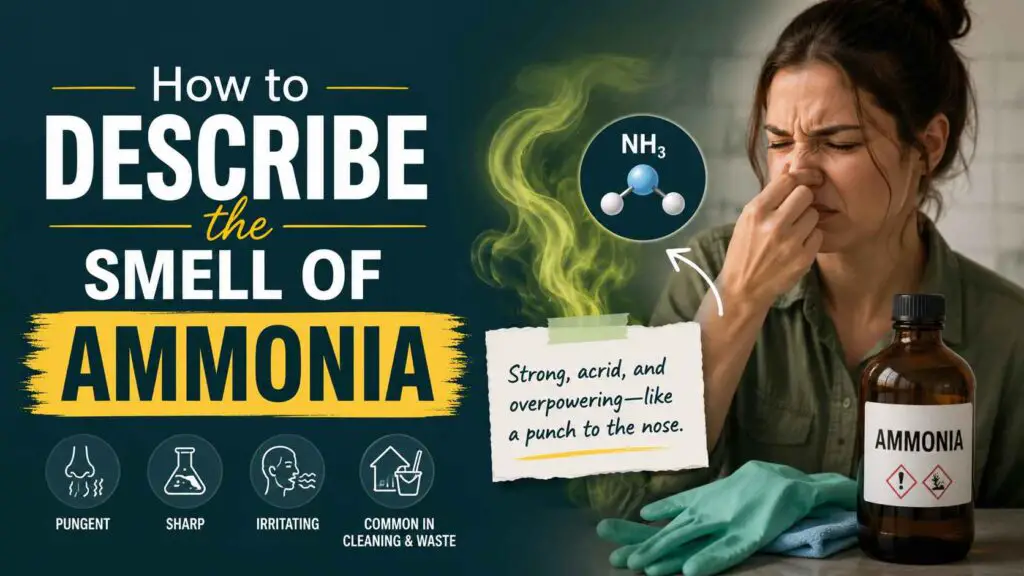
Ammonia is the anti-perfume of fiction — a smell that doesn’t drift but strikes, going straight past appreciation to the eyes, the sinuses, and the alarm centers of the brain. That directness is a gift for writers, because ammonia always means something: aggressive cleanliness or its opposite, institutions scrubbed hard, neglect left too long, smelling salts, cat territory, industry. No one smells ammonia neutrally, and no reader needs it explained. The craft is writing the strike accurately — its suddenness, its physical assault, its meanings — without falling back on the one exhausted phrase about acrid stenches.
Here’s how to handle prose’s sharpest smell.
How to Describe the Smell of Ammonia
#1. Write the Strike, Not the Scent
Ammonia doesn’t waft; it hits — eyes watering, sinuses burning, an involuntary recoil of the whole head. Describe the physical event of encountering it, in the body’s timeline, and the reader flinches with the character.
The smell met her at the door like a slap that went up the nose and behind the eyes — she was crying slightly before she’d formed an opinion.
It wasn’t a smell so much as a bright cold wire run straight up each nostril to a point exactly between his eyebrows.
One breath in the stairwell and his head jerked back on its own authority — the body filing its objection before the mind had read the case.
#2. Aggressive Clean
Ammonia is the smell of cleaning as combat — floors mopped hard, glass scoured, a home or institution scrubbed past comfort into sting. It signals effort, control, sometimes fury; a house that smells of ammonia was cleaned *at* something.
Her mother cleaned with ammonia when she was angry, and the sting in the hallway told the children everything about the phone call before a word was reported.
The stairwell smelled scrubbed to the bone — ammonia over concrete — cleanliness with its teeth bared, daring anyone to bring dirt in.
The windows squeaked under the rag and the whole kitchen stung with the sharp blue smell of glass being shown who was in charge.
#3. The Institutional Undertone
Hospitals, care homes, school corridors in summer, public restrooms — ammonia is the base note of institutions, where it means both hygiene and what the hygiene is fighting. One mention places the reader in that corridor instantly, with all its associations of care and its limits.
The care home’s corridor ran on that double smell — ammonia over something older it never quite defeated — the scent of a fight conducted twice daily with a mop.
School in August smelled of floor wax and ammonia, the halls stripped and sterile, summer’s version of the building — a school with the school removed.
He would forever associate that summer with the ward’s particular chemistry: ammonia, latex, and flowers — the flowers always losing.
#4. The Smell of Neglect
Ammonia is also what accumulates when nobody cleans — the cat-saturated house, the alley corner, the hoard behind a closed door. As evidence of neglect it’s unmatched: sharp, unarguable, and often the first thing a visitor’s body registers before their eyes confirm.
The social worker knew at the letterbox — that eye-watering sharpness leaking through the flap — and braced herself for what the file had only implied.
Seventeen cats, the neighbors guessed; the hallway said more, in a smell so dense it had texture, pressing on the eyes like weather.
Under the overpass the corner announced its regular use from ten feet — sharp, stale, human — and pedestrians’ faces did the same small calculation at the same spot daily.
#5. The Reviving Slap
Smelling salts are ammonia weaponized for wakefulness — the ringside crack, the faint restored, the powerlifter’s pre-attempt hit. As an action beat it’s ready-made: the vial snapped, the head snapping back, consciousness returning at spear-point.
The cutman snapped the capsule under his nose and the world came back all at once, rude and bright, like a door kicked open in his skull.
She fainted at the graveside, and someone’s grandmother produced salts from a handbag with terrifying readiness — one whiff, and the twentieth century hauled her back upright.
The lifter cracked the ammonia, inhaled like a man breathing fire, and approached the bar with his eyes rinsed clear of everything but the next four seconds.
#6. Grade the Intensity
Ammonia runs a scale — the faint tang near a litter box, the working sting of a mopped floor, the choking wall of an industrial leak. Calibrate the dose to the scene: trace amounts characterize a room; full strength is a physical event with safety stakes.
It was just a trace by the utility door — a thin metallic tang, there and gone — the house’s one confession about the aging cat.
Mid-mop, the bathroom hit working strength: eyes stinging, window opened, the job finished in held breaths and fast strokes.
When the tank valve failed, the smell stopped being a smell and became a wall — men doubled coughing at thirty feet, and the yard emptied at the speed of instinct.
#7. Comparisons That Actually Work
For readers who need the smell built, borrow from its real neighbors — bleach’s cousin, cold metal, hair-perm solution, the sharpness over a litter tray — and from effect-comparisons: like breathing needles, like light that’s too bright but for the nose. Anchor the exotic in the known.
If bleach is a shout, ammonia is a scream one octave higher — the same family, the worse temper.
It smelled the way a too-bright light looks — not a flavor at all, just intensity, straight to the wince.
Anyone who’d sat through a home perm in a small kitchen knew the smell already: that, but with its manners removed.
#8. Retire the Acrid Assault
“The acrid stench of ammonia assaulted his nostrils” is the phrase this smell cannot escape — “acrid,” “stench,” and “assaulted his nostrils” being three clichés holding hands. The repair: keep the violence but relocate it to specific anatomy and consequence — the eyes, the recoil, the held breath, the window flung open.
Stock: the acrid stench assaulted his nostrils. Working: two steps into the room his eyes flooded, and he finished the search squinting through tears he hadn’t consented to, breathing through his sleeve.
Nobody described the smell in the report. The report said the responding officer propped the door, stepped back out, and radioed for masks — which described it completely.
Not “assaulted his nostrils”: the first breath simply refused to finish — cut off mid-inhale by some ancient guard at the back of the throat who had seen this chemical before.
Closing Thoughts
The reframe that makes this smell useful: ammonia is information before it’s sensation. Every appearance answers a question the scene is asking — was this place scrubbed or abandoned, is this care or its collapse, who fainted, what leaked, what is this household fighting? That’s why it needs no perfume-counter vocabulary; its meanings do the describing. Choose which message your ammonia carries, write the body’s honest recoil, and skip the acrid assault entirely. A smell that makes eyes water on contact doesn’t need dramatizing — it needs witnessing, and one accurate flinch is testimony enough.