
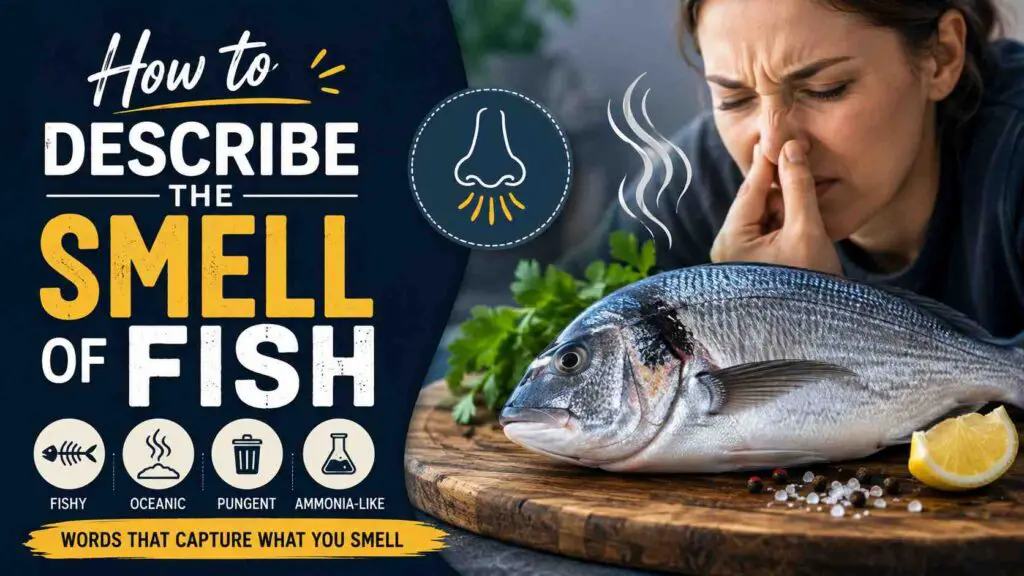
Fish carries the most misunderstood smell in the kitchen — truly fresh fish barely smells at all, just clean brine and cucumber-cold sea, while the notorious “fishy” reek is the smell of time passing. That gap between fresh and old is the whole description: fishmongers live by it, coastal towns are steeped in it, and the word “fishy” itself has leaked into the language as the official odor of suspicion. Whether your scene is a dawn dock, a market stall, or an office microwave crime, the nose does the work. Below are the techniques for describing the smell of fish, each with examples you can study and adapt.
How to Describe the Smell of Fish
#1. Split Fresh From Old — the Divide That Runs the Subject
Fresh fish smells of the sea and almost nothing else — clean, briny, faintly metallic, cold — while the ammonia-edged “fishy” smell means age, and every fishmonger’s nose is calibrated to the border. Writing the distinction correctly is instant authority; confusing them is the tell of a writer who never stood at the counter.
The fish smelled of the sea and of cold and of nearly nothing — which was the whole point, her grandfather said; fish smells of fish only once it’s sorry.
She lifted the gill flap and sniffed the way he’d taught her — clean brine, cucumber-cold — and nodded to the stallholder, who nodded back, professionals concluding business by nostril.
The moment the cooler door opened he caught the ammonia edge riding over the brine, and the delivery went back on the truck with the driver still explaining.
#2. Write the Dock and Harbor — Fish Smell as Place
Working waterfronts are steeped in the smell — fish and diesel and rope and gutting tables, hosed down nightly and never gone — and the blend is a whole economy’s signature. Harbor towns stop noticing it; visitors never do, and the difference between those two noses is a scene about belonging.
The harbor smelled of fish and diesel in a proportion that hadn’t changed in eighty years, and the returning son breathed it at the top of the gangway like the first line of an anthem.
The tourists wrinkled their noses at the quay; the locals had stopped smelling it decades ago, the way you stop hearing your own name said by family.
The gutting shed’s hose ran every evening, and every morning the smell was back at its post — not filth, the foreman insisted, but payroll: the town’s whole living, airborne.
#3. Cook It — the Smell That Takes Over Buildings
Cooking fish is a public act — frying announces itself through walls, lingers in curtains, and has ended office friendships via the shared microwave — and the smell’s territorial ambition is both comedy and domestic reality. Who cooks fish where, and who forgives it, maps a household or a workplace.
Somebody microwaved salmon at 12:40, and by 12:43 the whole floor knew, and by Friday the incident had a name, a suspect, and a new laminated sign.
Friday’s frying reached the third floor before the first fillet left the pan — the building’s oldest broadcast — and the neighbors’ children arrived at the door with plates and confidence.
She cooked the mackerel with every window open and the fan on high, and the kitchen smelled of it anyway for two days — a fish that believed in leaving a legacy.
#4. Let It Cling — Hands, Boats, and Boot Cuffs
Fish smell is adhesive — on hands through washing, in a boat’s boards permanently, in gloves and cuffs and the car that carried the catch — and the clinging marks trades and hobbies indelibly. A character who smells faintly of fish has a life the nose has already summarized.
Lemon, salt, coffee grounds — she tried the whole folklore, and her hands still carried the day’s catch to the parent-teacher meeting, where the teacher, a fisherman’s daughter, found it obscurely reassuring.
The old skiff would smell of fish until it was ash — it was in the wood past all sanding — and he wouldn’t have traded that hull for anything odorless afloat.
His truck told on him: bait cooler in July, once, years ago, and the upholstery had never fully signed the peace.
#5. Use the Market Stall’s Theater
The fishmonger’s corner is the market’s boldest smell — ice and brine and scale-shine, announcing itself aisles early — and the stall’s atmosphere (crushed ice, hosed floors, the monger’s cold red hands) is a complete setting in a few square meters. Customers navigating toward or around it sort themselves by upbringing.
You met the fish corner two aisles before you saw it — ice and brine over the vegetables’ green quiet — and the crowd split there, as always, into those who sped up and those who slowed.
The stall smelled of ice more than fish — cold, clean, faintly saline — the monger’s whole reputation resting on that almost-absence.
Her earliest market memory was at nose height with the counter: sawdust, brine, and her mother’s voice above her interrogating a man about a mackerel’s morning.
#6. Honor the Preserved — Smoked, Salted, and Fermented
Preservation transforms the smell into culture — smokehouse sweetness, salt cod’s shelf-stable pungency, the proudly ferocious fermented traditions that divide households and nations — and preserved fish smells carry heritage and argument in equal parts. One family’s delicacy is the neighbor’s opened-window emergency; write both noses.
The smokehouse breathed sweet oak and fish gone golden, a smell with centuries of winter survival in it, and the queue outside stood in the cold on purpose, inhaling.
Grandfather opened the fermented tin outdoors, by treaty, downwind — and ate it with an expression of national pride while the grandchildren watched from the porch like war correspondents.
The salt cod hung in the pantry all winter, stiff as shingles, and its dry sea-smell meant, to her, security itself — a family that would eat until spring.
#7. Spoil It — the Reek as Plot Device
Rotten fish is among the worst common smells — the forgotten bait, the failed freezer, the bin in August — and its gag-force makes it a scene-clearing device: evacuating kitchens, ending car journeys, revealing the outage that happened while the family was away. Deploy at full strength but briefly; the reader’s stomach has limits.
The freezer had died sometime in the first week of the vacation, and the kitchen’s air met them at the door like a wall — the whole holiday’s glow gone in one breath at the threshold.
The bait bag was found under the truck seat in August by smell alone, from four feet, through canvas — a discovery nobody volunteered to complete.
One prawn had escaped the cleanup and spent a warm week behind the stove, and the search for it reorganized the entire kitchen and two relationships.
#8. Use “Fishy” Itself — the Smell That Became Suspicion
Fish smell is the only odor promoted into an idiom of doubt — something “smells fishy,” a deal has “the whiff of old fish” — and fiction can play the literal and figurative registers against each other. A character who distrusts what they can’t smell, or a literal fish smell arriving during a shady negotiation, lets the language wink at itself.
The contract smelled fishy to her, said her gut — and her gut had trained at her father’s stall, where fishy was not a metaphor but a grading system, and she graded the clause accordingly.
They shook hands on the deal at the harbor office, over the day’s actual catch, and he could never afterward decide whether the smell in the room had been the mackerel or the terms.
“Something smells off,” the auditor said, and the cannery manager, standing in his own building, was unable to determine which sense she meant — which was, of course, her method.
Closing Thoughts
Fish smell runs on one axis — fresh sea to old ammonia — and everything else in the subject hangs off it: the monger’s calibrated sniff, the harbor’s payroll air, the microwave incident, the truck that never forgave the bait cooler. Get the fresh-versus-old distinction right and coastal readers will trust every page after; get it wrong and no amount of atmosphere recovers them. Use the preserved traditions for heritage, the spoiled register briefly and at full force, and the idiom for a wink when a deal needs doubting. And remember the fishmonger’s paradox, the subject’s best line: good fish smells of almost nothing — it’s time that stinks.