
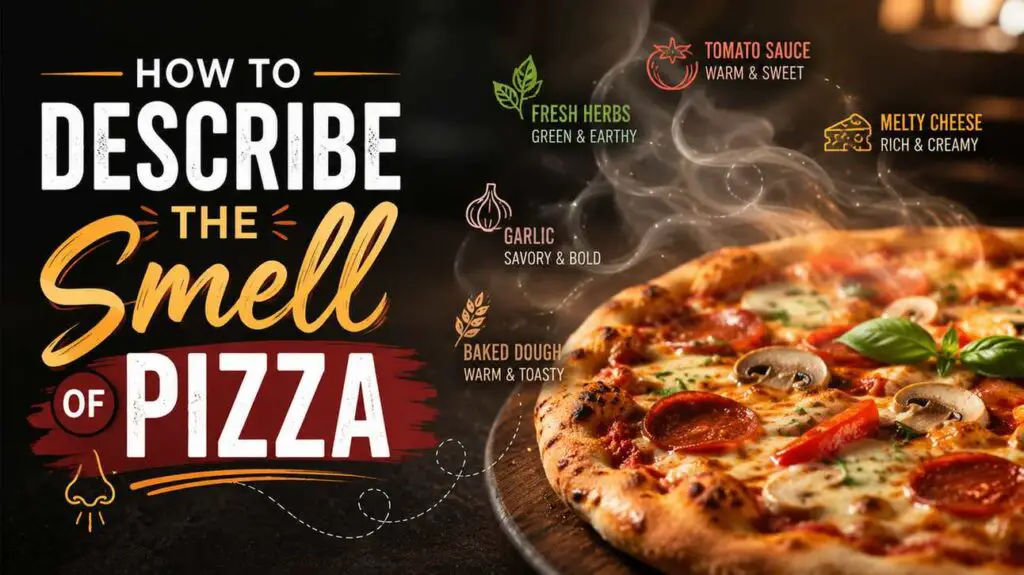
Pizza’s smell is one of the most socially powerful scents in fiction — it announces celebration, ends meetings, summons households, and turns any room it enters into a better mood — and yet it usually gets one dead phrase about melted cheese and moves on. The real smell is an ensemble: charring dough, sweet-acid tomato, oregano, hot cardboard, pepperoni’s spiced grease — arriving in famous contexts (the box at the door, the pizzeria’s oven blast, the office break room) that each mean something different. Write the ensemble and the occasion together, and the reader’s stomach joins the scene.
Here’s how to get the best-loved smell in delivery onto the page.
How to Describe the Smell of Pizza
#1. Write the Ensemble, Not the Cheese
Pizza smell is a band — char and yeast from the crust, tomato’s bright acidity, herbs, and the fat of whatever’s on top. Naming two or three players beats soloing “melted cheese,” and the mix you choose flavors the scene: more char reads artisanal, more grease reads 2 a.m.
The smell came through in sections — scorched flour first, then the tomato’s sweet acid, then oregano over everything like a signature — the whole band arriving before the box was even open.
This was the late-night register: less herb, more grease, the pepperoni’s paprika fat leading — a smell with its shirt untucked.
Under it all ran the crust’s honest bread smell, the part everyone forgets to mention and nobody’s hunger does.
#2. The Box Opening Is the Curtain Rising
The lid’s first lift releases the smell in one theatrical exhale — steam, cardboard, and dinner all at once — and every reader knows that moment. Stage it: the pause, the flip, the room leaning in. It’s the meal’s overture and deserves its beat.
He flipped the lid and the box exhaled its whole warm cargo into the kitchen — steam, char, cheese — and four people who had claimed not to be hungry rearranged their positions.
The smell had been muffled all the way up the stairs, boxed like a secret, and the opening released it the way court releases a verdict: everyone reacting at once.
Part of it, always, was the cardboard itself — hot box and dinner in one breath — a smell that meant somebody had decided tonight was not for cooking.
#3. It Travels — Map the Route
Pizza smell is famously mobile — the delivery car marinated in it, the hallway announcing it two floors down, the whole street outside the pizzeria’s fan. Writing its geography (where it reaches, who it reaches first) turns the smell into the scene’s advance messenger.
The delivery kid’s hatchback smelled permanently of his cargo — a rolling advertisement — and dogs tracked his parking with the seriousness of air traffic control.
It entered the building at the lobby and climbed ahead of him, floor by floor, so that doors were already opening hopefully on three by the time he reached two.
The pizzeria’s exhaust fan ran its propaganda over the whole block from five o’clock on, and the neighborhood’s dinner plans failed against it nightly.
#4. The Oven at Full Voice
In the pizzeria itself the smell is at maximum — wood smoke or deck-oven heat, flour dust, char blistering at 800 degrees, the paddle’s traffic. The source scene gives you the smell plus theater: fire, speed, and a craftsman feeding the town.
The wood oven roared quietly at the room’s heart, and everything the shop smelled of — smoke, char, blistered crust — came off that one glowing mouth like weather off a small sun.
Flour hung in the light and the paddle went in and out of the fire with its cargo, and standing at the counter was standing inside the smell at its birthplace, still warm from the forge.
The first blast when the door opened was furnace and bread together — a heat you smelled more than felt — and the queue inhaled as one and stopped minding the wait.
#5. Pizza Smell Means Occasion
The smell is social shorthand — payday, sleepover, moving day, the team fed after the game, the office’s apology for overtime. Attach it to its occasion and it carries the mood: the same scent is celebration in one scene and bribery in another.
Moving day ended the only correct way — boxes for chairs, the good smell rising off the one unpacked table — the new flat christened in pepperoni before it owned a single lamp.
When the smell reached the conference room, the mood shifted before the boxes did — management’s apology arriving as aroma, and accepted, resentfully, at first bite.
Her childhood filed Fridays under that smell — the knock, the box, her father counting bills — and forty years later any whiff of it made the week feel briefly finished.
#6. The Morning-After Version
Cold pizza has its own distinct smell — congealed cheese, cardboard, last night — and it narrates aftermath: the party’s residue, the studying that ran late, breakfast eaten standing at the fridge. The degraded version is often the more character-revealing one.
The morning kitchen smelled of the night before — cold cheese and box — and she ate the surviving slice at the counter, standing, as tradition and headache required.
The open box on the floor between them held the study session’s fossil record, and its cold smell said 2 a.m. more precisely than the clock had.
He recognized the smell of his son’s car immediately and completely: cold pizza, energy drinks, and freedom — the exact cologne of being nineteen.
#7. Measure It in Behavior
Pizza smell moves people — the household materializing uncalled, the meeting losing its last agenda item, strangers in an elevator going quiet with respect. Let the reactions do the describing; the smell’s power is best displayed in what it makes people do.
Nobody announced dinner. The smell went upstairs and made the announcement itself, and the thunder of teenagers followed it down within the minute.
The man in the elevator held the boxes level, and four strangers rode six floors in reverent silence, inhaling somebody else’s Friday.
The meeting had one item left, and then the smell came under the door, and the item was tabled by unanimous, unspoken consent.
#8. Retire the Mouthwatering Melted Cheese
“The mouthwatering aroma of melted cheese and pepperoni wafted through the air” — the sentence every pizza has already been served in. The repair: cut “mouthwatering” (the reader’s job), cut “wafted” (pizza travels with more purpose), and replace with one component plus one consequence — who moved, what got postponed, which diet lost.
Stock: the mouthwatering aroma wafted. Working: the char-and-oregano smell crossed the courtyard, and the vegetarian barbecue next door suffered a quiet crisis of attendance.
Nobody’s mouth was described watering; the description was Marta closing her laptop mid-sentence, which for Marta was a standing ovation.
It didn’t waft; it recruited — hallway by hallway, door by door — and by the time the box reached the kitchen it had a following.
Closing Thoughts
Here’s the whole article in one line: pizza smell is an event, so write it like one — with an arrival, an audience, and consequences. It’s the rare scent that functions as plot: it summons casts, ends scenes, marks paydays and aftermaths, and turns a hallway into a homecoming. So skip the aroma report entirely. Name two players in the ensemble, stage the box’s opening, and show one human being changing course — the closed laptop, the tabled agenda, the teenagers’ thunder on the stairs. The reader’s own appetite has been in training for this its whole life. Trust it.