
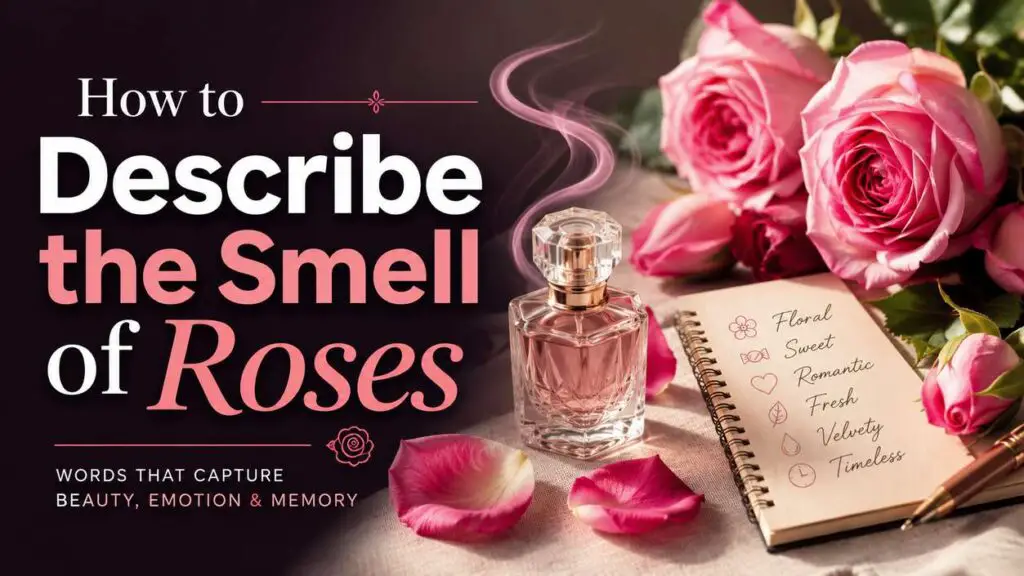
The rose’s scent has a scandal at its center: most modern roses barely smell at all — bred for vase life and flawless petals, the perfume traded away — while the old garden varieties still pour out the fragrance the poets meant. That split runs through every rose scene: the florist’s scentless dozen versus the grandmother’s rampant climber, the word “rose” promising what the flower may not deliver. Written well, rose smell carries love, funerals, gardens, and time itself. Below are the techniques for describing the smell of roses, each with examples you can study and adapt.
How to Describe the Smell of Roses
#1. Split Old From New — the Scentless Modern Scandal
Bred roses traded perfume for shelf life — the florist’s dozen often smells of nothing but refrigeration — while old garden varieties still carry the true depth, and characters who know the difference sniff before they buy. The gap between the rose’s reputation and a scentless bloom is a small betrayal fiction can spend.
She did what her mother had always done at the florist’s — bent to the dozen and inhaled — and got refrigeration and cellophane, the roses beautiful and mute as catalog photographs.
The old climber by the gate had none of the show roses’ polish and all of the smell — a sprawling, blowsy, headlong perfume — the difference between a portrait and a person.
“Smell first,” the nursery woman said, tapping her nose. “They bred it out of half of them. The pretty ones lie.”
#2. Build the Note — Sweet, Lemony, Peppery, Deep
Rose scent is a family of chords — classic damask sweetness, tea roses’ fresh lemon edge, myrrh and pepper notes in some, fruit in others — and naming a component beats the circular “smelled like roses.” One rose smells of honey and lemon, another of cloves; the specificity is the gardener’s ear for wine.
The damask by the wall poured out the old smell — honeyed, deep, almost edible — while the tea rose beside it ran brighter, lemon over sweetness, morning to the other’s evening.
There was pepper in it, and clove — a spice under the sugar that kept the sweetness honest — and she stood at the bush working the smell apart like a chord.
“Smells like roses” is no answer, her grandmother said — this one is honey and rain, that one is lemon and pepper, and the white one by the shed smells of cold cream and 1962.
#3. Time the Bloom — Warmth, Evening, and the Scent’s Hours
Rose scent keeps hours — strongest in warm morning sun and on still summer evenings, muted in cold and wind, one bloom’s perfume traveling farther at dusk than noon — and the timing gives garden scenes a schedule. The evening rose garden, pouring scent into cooling air, is one of literature’s oldest stages for a reason.
By evening the garden changed hands — the heat easing, the roses opening their accounts — and the path past the arbor became a corridor of scent that noon had only hinted at.
The morning sun had been on the climber an hour, and the warmth lifted the smell over the wall and into the lane, where the postman slowed, as he did every June, at exactly that gate.
Cut in the cool of morning, the buds held their scent back like a speech being saved; by afternoon, in the warm kitchen, they delivered it.
#4. Load the Romance — and Then Complicate It
Roses are love’s official scent — the bouquet at the door, petals on anniversaries, the perfume on a letter — but the register works best complicated: roses from the wrong person, the apology bouquet’s hopeful smell, the scent arriving after the love has gone. Straight rose-romance is a greeting card; angled, it’s a scene.
The apology roses filled the kitchen with their best behavior, and she left them to perform to the empty room — the smell trying the case he hadn’t the nerve to argue in person.
Two dozen from the wrong man, magnificent and fragrant, and the smell of them made the apartment feel rented for the whole week they took to die.
He grew her roses for forty years and never once bought her any — “shop roses don’t smell,” being, in his dialect, a complete sentence of love.
#5. Admit the Funeral Register
Roses work death’s rooms too — casket sprays, funeral-home air thick with them, petals on a grave — and for mourners the smell can permanently change teams, sweetness fused to loss. A character who can’t abide roses since a particular week carries the flower’s double life; the same scent is wedding and wake.
The funeral home smelled of roses at institutional strength, sweetness with its volume wrong, and for years afterward one warm florist’s doorway could put her back in that carpeted hush.
Roses had been her favorite until the week they lined the casket; after that the family planted lavender, by unspoken treaty, everywhere.
He laid one rose on the stone each June and let its smell say the year’s worth of things — the flower fluent, as always, in both of its languages.
#6. Keep the Garden’s Body — Thorns, Compost, and Work
Real rose scent comes with a working garden attached — thorn-scratched forearms, compost and manure under the perfume, greenfly and pruning and the smell of crushed leaves — and the labor keeps the sweetness from floating off into potpourri. A rose bed smells of roses and effort; write both.
The bed smelled of roses over manure — glory over groundwork, the garden’s honest ratio — and her scratched forearms itched pleasantly all evening, the day’s wages.
Deadheading filled the bucket with spent blooms whose smell was still half there — perfume with the volume dying — and the bucket by the compost was its own melancholy little bouquet.
You didn’t get the smell without the thorns, she told her granddaughter, in the tone of a woman handing over a general principle disguised as gardening.
#7. Bottle and Preserve It — Rosewater, Petals, and Perfume
Rose scent travels beyond the bush — rosewater in pastries and grandmothers’ kitchens, dried petals in drawers and jars, attar’s concentrated depth, the perfume that is someone’s signature — and the preserved forms carry culture and inheritance. A cuisine’s rosewater or a drawer’s petal sachet is the flower keeping house.
The pastry arrived breathing rosewater, and he was instantly in his grandmother’s kitchen two countries away — the flower’s smell having learned, centuries ago, to travel as food.
Every drawer in the old dresser held a sachet of petals gone brown and quiet — scent at a whisper, but scent — the garden of 1974 still on duty among the linens.
One drop of the attar and the room changed weather — a whole June compressed to oil — and the perfumer capped it like something that could escape.
#8. Retire “Sweet Smell of Roses” — Pick a Rose and a Moment
“The sweet smell of roses filled the garden” is potpourri prose — sweet being the least a rose smells of, and no particular rose anywhere in the sentence. The repair is one bush, one chord, one hour: the damask at dusk, the lemony tea rose at the gate, the scentless dozen betraying the florist. Roses are individuals; the description should date and name its flower.
The draft had the sweet smell of roses; the revision had the gate climber’s honey-and-pepper at seven in the evening, and the postman slowing — and the garden finally grew a particular flower.
Which rose, the note asked — the mute shop dozen, the blowsy climber, the funeral spray? The word covers three different scenes, and “sweet” covers none of them.
Name the bush and the hour, the gardener said — a rose without a time of day is a picture of a rose.
Closing Thoughts
The rose’s smell rewards a writer who treats it as particular — old variety or scentless modern, honey chord or lemon, morning gate or evening arbor — because the flower’s fame has flattened it into a synonym for “sweet,” and sweetness is the least of what it does. Let it carry love complicated, grief fused, kitchens and linen drawers, and the working garden’s manure-and-thorns honesty underneath. Then apply the nursery woman’s rule to your own draft: smell first. If the sentence would work for any rose anywhere, bend closer until it only works for the one by your character’s gate.