
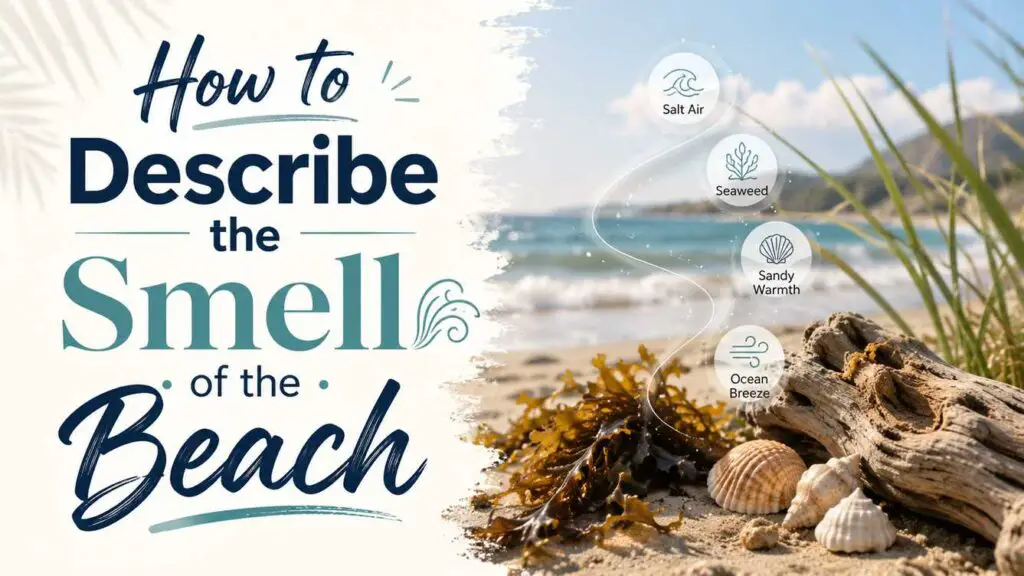
The beach smells of more than the sea — it’s a whole shoreline economy of odors: hot sand, sunscreen, seaweed drying at the tideline, fries and vinegar from the boardwalk, driftwood smoke at dusk. The ocean provides the salt base note, but the beach’s smell is the human day built on top of it, and that blend — half nature, half holiday — is what one whiff of coconut lotion can summon decades later. Vacation has a scent, and this is its address. Below are the techniques for describing the smell of the beach, each with examples you can study and adapt.
How to Describe the Smell of the Beach
#1. Layer the Blend — Salt Base, Human Top Notes
The beach smell is a stack — the sea’s salt and iodine underneath, then hot sand, then the day’s human additions: lotion, fried food, wet towels — and writing two or three layers in order builds the shore faster than any view. The ocean is the bass line; the beach is the whole song.
The smell arrived in layers over the dune — salt first, then warm sand, then the human frosting of coconut lotion and someone’s chips — the whole beach announced before a single umbrella showed.
Under everything ran the sea’s iodine line, steady as a drone note, and the day’s smells — lotion, fries, kelp — played over it in shifts.
Blindfolded, she could have graded the beach’s hour by nose alone: morning was salt and seaweed, noon added sunscreen and grill smoke, and evening closed with woodsmoke and cooling sand.
#2. Bottle the Sunscreen — Vacation’s Official Perfume
Sunscreen — especially the coconut kind — is the beach’s most portable smell, applied in ritual, carried on skin and towels, and capable of summoning entire summers from a drugstore aisle in January. The lotion smell means care, childhood, and holiday all at once; one warmed shoulder of it is a time machine.
The lotion went on cold and smelled of coconut and every summer before this one, and the child squirming under her hands was, for one whiff, herself at that age, under her own mother’s hands.
He caught the coconut smell in the drugstore in February and stood in the aisle a moment, sun-warmed out of season.
The beach bag exhaled last August when she unzipped it — lotion, salt, a ghost of wet towel — the vacation stored whole in canvas.
#3. Walk the Tideline — Seaweed, Shells, and the Low-Tide Truth
The tideline is the beach’s honest edge — kelp drying in salty heaps, shell grit and stranded jellies, the mudflat funk of low tide that visitors call a stink and locals call the sea breathing — and its rich, half-rotten note keeps beach description from going postcard. Low tide smells stronger and truer than high; write the difference.
Low tide laid the harbor’s underside out to dry — kelp, mud, and shellfish gone confident in the sun — and the visitors held their noses at the exact smell the postcards had cropped out.
The kelp heaps at the tideline smelled of iodine and green rot in honest proportion, and the children mined them for crabs regardless, connoisseurs of the beach’s least marketed perfume.
“That’s not a stink,” the ferryman said mildly, “that’s the tide out.” — the sea’s breath being, on his coast, a matter of civic pride.
#4. Heat the Sand — the Beach’s Warm Mineral Floor
Hot sand has its own smell — dry, mineral, faintly dusty, mixed with warmed shell and whatever the towels brought — and it arrives strongest at lying-down height, where beach afternoons are actually spent. The nose at towel level gets the beach’s floor-level blend: sand, lotion, salt, and proximity to a dozing companion.
Face-down on the towel, the world was reduced to warm sand’s mineral breath, coconut at close range, and the sea’s salt arriving in intervals with the breeze — the whole holiday at nose height.
The dry sand above the tideline smelled of heat itself — dusty, shell-flecked, baked since ten — and the wet sand below smelled of the sea’s cellar; the beach kept both floors.
The sandcastle moat brought up the deeper smell — cool, wet, briny — sand with the tide still in its memory.
#5. Serve the Boardwalk — Fries, Vinegar, and Sugar on the Wind
The beach’s commercial edge cooks all day — fries and vinegar, fried dough and hot sugar, grill smoke, ice cream’s cold sweetness at the counter — and the food smells riding over the sand are appetite and economy at once. Salt air famously sharpens hunger; the chip shop knows, and sites itself downwind.
The chip-shop wind worked the beach all afternoon — hot fat and vinegar drifting over the towels — and by four it had harvested every family on the sand, as it had been engineered to.
Fried dough and sugar owned the pier’s near end, grill smoke the far, and walking its length was a tasting menu conducted by nose at a stroll.
Nothing on earth smells like beach fries — the same potatoes inland are a different food — the salt air being, her father maintained, the actual seasoning.
#6. Cool It to Evening — Driftwood Fires and the Beach After Hours
The evening beach changes its smell — crowds and lotion gone, sand cooling and giving back the day’s heat, driftwood fires adding salt-sharpened smoke, the sea’s note rising as the human layers pack up. The after-hours beach smells older and wilder; bonfire scenes inherit the shore at its most honest.
By eight the beach had shed its lotion-and-fries daywear, and the old smells came back up — cool sand, kelp, the sea’s plain salt — the shore off duty and more itself.
Driftwood burns differently — salt in the wood snapping green and quick — and the bonfire’s smoke smelled of sea and cedar at once, a fire with a coastline in it.
The night beach smelled of cooling sand and far water, and the couple walking it had the whole original shoreline back — the version underneath the holiday.
#7. Pack It Home — Towels, Cars, and the Smell That Follows
The beach follows its visitors — wet towels souring sweetly in the car, salt in hair through the evening shower, sand in shoes for weeks, the cottage that smells of every summer at once — and the carried-home smells are the vacation’s echo. The car on the drive back, all brine and lotion and sleep, is the day’s closing scene.
The drive home smelled of the whole day — damp towels, lotion, salt drying in four heads of hair — and the children slept in it like the smell itself was a blanket.
Her hair kept the sea through the shower and into the pillow, and she fell asleep smelling faintly of the afternoon’s best hour.
The cottage opened each June on the same stored smell — salt, sun-warmed wood, old lotion in the hall cupboard — thirty summers deep and self-renewing.
#8. Vary the Coast — Not All Beaches Smell Alike
Beaches have accents — the cold northern shore’s clean kelp and stone, the tropical beach’s warm florals over coral, the lake beach’s freshwater green missing the salt entirely, the working harbor beach with diesel in its blend — and the accent places the scene on a map. A character noticing the wrong smell knows they’re far from their home coast.
The tropical beach smelled wrong to her northern nose — flowers and warm coral where kelp and cold stone should be — paradise, certainly, but somebody else’s.
The lake beach had the shape of the seaside and none of the salt — a green freshwater smell, weed and warm dock boards — the beach’s tune in a different key.
Home was a working shore — salt with diesel and rope in it — and the resort’s filtered perfume two weeks a year always left him faintly homesick for the tougher blend.
#9. Skip “the Salty Sea Air” — Build the Day’s Blend
“The salty sea air” is the beach’s rental description — true, thin, and owned by everyone — and it describes the ocean, not the beach. The repair is the blend: salt base plus two human layers, timed to the day’s hour and placed on a particular coast. The beach is the sea plus the people; the smell should contain both.
The draft had salty sea air; the revision had salt under coconut under the chip shop’s four-o’clock harvest wind — and the reader’s whole childhood coast arrived unbidden.
Which hour, the note asked — morning kelp, noon lotion, or evening driftwood smoke? The beach changes its shirt three times a day, and “salty air” is none of the outfits.
The sea belongs to every book, she wrote in the margin — the wet towels in the car are yours.
Closing Thoughts
The beach’s smell is a schedule and a recipe — salt and kelp in the morning, lotion and fries at noon, driftwood smoke and cooling sand at dusk, wet towels all the way home — and the craft is choosing the hour and stacking the layers. Keep the tideline’s honest funk in the blend, give your coast its accent, and let the carried-home smells close the scene the way they close the actual day. Every reader has a beach bag somewhere that still exhales last August when unzipped. Your description’s only job is to be the hand on that zipper.