
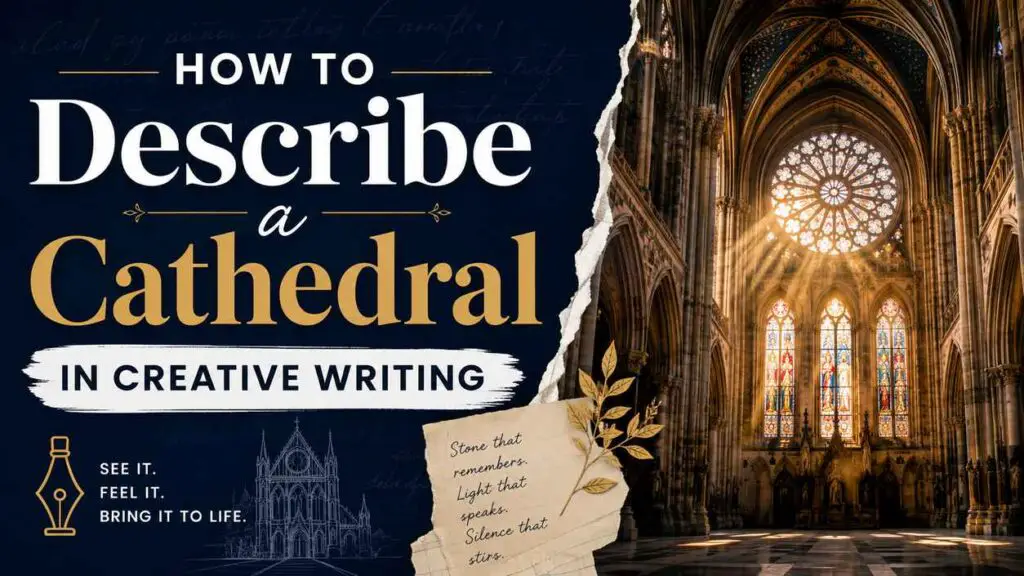
A cathedral is architecture doing theology — stone persuaded upward until the ceiling stops feeling like shelter and starts feeling like sky — and it works on everyone who enters, believer or not. That’s the description problem: the building is designed to produce awe, and “awe-inspiring” is precisely the word that fails to transmit any. The working parts are describable, though: the vertical pull on the neck, light processed through story-glass, sound with a six-second afterlife, centuries of feet in the floor. Write the mechanisms and the awe arrives in the reader as it does in the visitor: bodily, unannounced.
Here’s how to build it on the page.
How to Describe a Cathedral in Creative Writing
#1. Write the Vertical Pull
A cathedral’s first act on a body is upward — the eyes climb the piers, the head tips back, the neck reports the height before the mind does. Describe the physical looking-up, not the abstract vastness: the building is a machine for tilting chins, and that tilt is the awe.
Her eyes went up the pier like something climbing — ledge to ledge, shaft to vault — and her chin followed until she was standing in the nave in the posture of drinking rain.
The ceiling was too far away to feel like a ceiling; it was weather, stone weather, and everyone under it walked slightly differently, as if depth had been added to the air.
He came in cynical and lasted four steps, which is roughly where the vault catches everyone — the building’s oldest trick, played on him precisely as designed, seven centuries after the trap was set.
#2. Light Arrives Pre-Translated
Cathedral light comes through story — glass that turns sun into saints and spills colored patches across stone and strangers. Write the light as material: where the blue lands, what the rose window does at four o’clock, who is briefly stained crimson while checking their phone.
The afternoon came through the west window as a saint’s whole life and lay along the floor in colored panels, and tourists crossed it carefully, walking on the story.
At four the rose window found the far pillar and set it burning blue and red — ten minutes daily, an appointment the stone had kept since the masons left.
A schoolboy stood accidentally in the martyrdom’s light, checking his phone in borrowed crimson, and the nun in the side aisle smiled at something she declined to explain.
#3. Sound Has an Afterlife
Cathedral acoustics hold sound seconds after its source stops — a cough blooming, a dropped hymnal echoing like judgment, the organ’s final chord dying in stages up the vault. Write the reverberation and its discipline: everyone whispers because the building repeats.
A single cough went up into the vault and came back enlarged, redistributed, lasting long enough to embarrass its owner twice.
The organ’s last chord didn’t stop; it ascended — leaving the pipes, climbing the stone, thinning to a hum the ceiling kept for six full seconds like something it hadn’t finished tasting.
Nobody told the visitors to whisper. The building told them — repeating their first normal sentence back down the nave until they lowered the second one on their own.
#4. Centuries in the Fabric
A cathedral took lifetimes to build and shows it — styles changing mid-wall, masons’ marks, steps hollowed by feet, the crypt’s older church under the church. Write the layered time: your characters stand in a building that outlasted its every architect and intends to outlast them.
The nave changed accents halfway down — round arches giving way to pointed, one century handing the job to the next mid-sentence — a building that had outlived its own blueprints twice.
The steps to the chapter house dipped like poured wax, eight hundred years of feet in each hollow, and her boots fit the erosion exactly, as everyone’s did — the stair’s one size.
High on the third pier, where only scaffolders ever go, a mason had cut his mark and his year — 1214 — the small permanent signature of a man whose name went nowhere else.
#5. The Working Church Under the Monument
Between the tour groups, the cathedral still works — evensong for eleven attendees, a verger’s rounds, candles lit for private reasons, a cleaner dusting tombs. Writing the small living rituals inside the enormous fabric gives you scale contrast and the building’s beating heart.
Evensong drew eleven people to a quire built for a hundred and sixty, and the choir sang to the empty stalls anyway, at full and ancient strength — the building’s pulse, taken daily, regardless.
The candle stand held forty small flames, each one somebody’s unexplained business, and a woman in a work uniform added the forty-first on her lunch break, quickly, like posting a letter.
The cleaner ran her cloth along a crusader’s marble nose with weekday tenderness — someone had to — and the tomb, seven centuries into its wait, was dusted by half past nine.
#6. Filter It Through the Visitor
The same nave is workplace to the verger, homework to the choirboy, grief’s harbor to the widow, architecture to the tourist, and complicated ground to the lapsed. Choosing whose cathedral you’re describing decides every detail; the building is a mirror wearing buttresses.
To the verger it was a workplace with drafts and a rota; he could walk the whole miracle without looking up, and did, except — everyone noticed — on the darkest mornings of December.
The widow came Tuesdays, sat always by the third pillar, and the cathedral did for her what it was built to do: made her sorrow feel appropriately housed, neither too big for the room nor alone in it.
He hadn’t believed in thirty years, and the nave didn’t care — it worked on him anyway, upward and quieting — and he stood at the crossing like a man visiting a language he used to dream in.
#7. The Climb and the Roof
The tower climb is the cathedral inverted — spiral stairs, the bell chamber, walking above the vault’s back among lead and pigeons, then the city suddenly below. The ascent gives your scene effort, vertigo, and the building’s secret upper world that tourists queue for and masons owned.
Two hundred and thirty steps of tightening spiral, hand on the ancient rope, and then the door opened onto wind and the whole city lying at the cathedral’s feet like a congregation.
Between the vault below and the roof above ran a hidden attic of stone ribs and lead walkways, and the guide crossed the ceiling’s back casually, a man strolling on the sky’s other side.
In the bell chamber the great tenor hung in its wheel, dented by four hundred years of its own voice, and the whole tower — you could feel it through your palms on the rail — leaned faintly into every swing.
#8. Retire the Awe-Inspiring Soaring
“The awe-inspiring cathedral soared majestically heavenward” — the guidebook kit, which reports the intended effect and produces none of it. The repair: awe is a result, so write causes — the neck’s tilt, the six-second echo, the hollowed step — and one human-scale detail the guidebooks skip. The reader assembles the soaring themselves, which is the only way anyone ever has.
Guidebook: the cathedral inspired awe. Working: she noticed she had removed her hat without deciding to, and was holding it to her chest like a man in an old photograph, and put it back on, and took it off again.
Nothing soared. Stone stood on stone in perfect tension, exactly as the dead had stacked it, and the only thing that actually rose was every eye that entered.
What broke him wasn’t the vault; it was the kneeler’s small embroidered cushion — stitched by some parish hand, worn threadbare at the knees — the enormous building resting its whole point on that.
Closing Thoughts
If there’s a cathedral, minster, or great church within reach of you, go once as a writer: enter, and for ten minutes describe only causes — what your neck does, where the light lands, how long the sounds last, what the floor’s hollows say about feet. Then find the smallest human thing in the building — a cushion, a candle, a mason’s mark — and write that against all the height. Those two lists, the mechanisms and the miniature, are the entire craft of this subject. The building has been rehearsing its effect for centuries; your job is only to transcribe the performance accurately.