
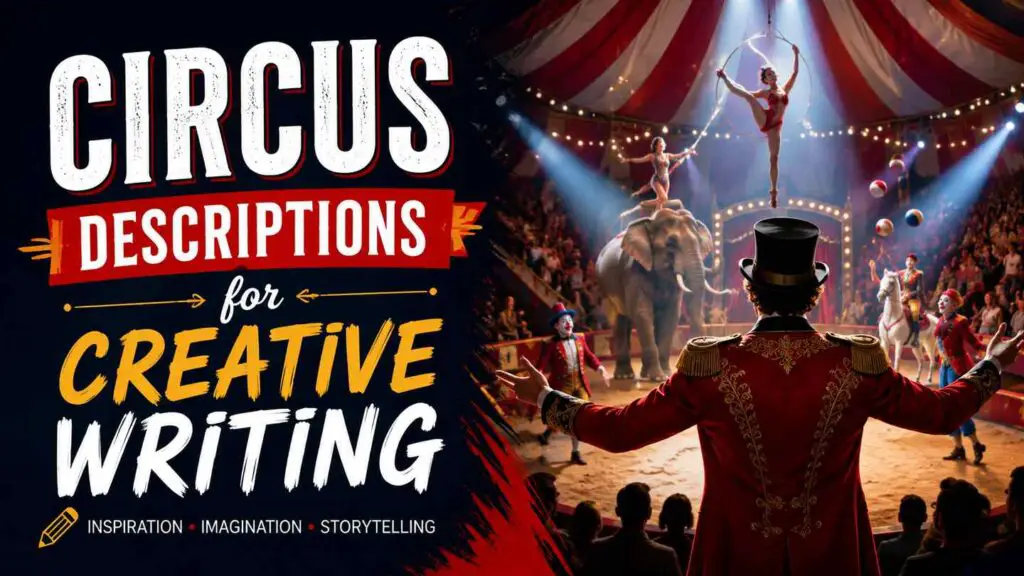
The circus is fiction’s most portable world — a whole town of spectacle that arrives overnight, runs on sawdust and nerve, and vanishes leaving a yellow rectangle in the grass. It comes pre-loaded with wonder and, lately, over-loaded with clichés: the “magical” big top on one side, the creepy carnival on the other, both worn to cardboard. The working circus between those poles is the describable one — rigging and rehearsal, spangles with mended seams, performers who are athletes with tax problems, and an audience gasping in the dark. Write the labor under the glitter and the wonder comes back honest.
Here’s how to raise the tent on the page.
Circus Descriptions for Creative Writing
#1. The Arrival Is the First Act
The circus’s overnight materialization — trucks at dawn, the tent rising like a breaching whale, posters appearing on every pole — is a spectacle before any ticket is sold. Write the town watching the assembly; the transformation of an empty field is the show’s true opening number.
The field was empty Thursday and a city by Friday noon — the big top hauled up its masts in slow heaves while half the town found reasons to drive past twice.
The posters went up overnight on every pole and shopfront, red and gold and shouting, and the school’s attention span was ruined for a week.
Boys on bikes patrolled the perimeter all day, reporting developments — the generator trucks, a man carrying a unicycle like firewood — spies for a town that already planned to surrender.
#2. The Tent Is a Building Made of Weather
The big top is architecture that breathes — canvas booming in wind, guy ropes humming, light glowing through the skin at night, the smell of hot canvas and trampled grass inside. Describe the tent as a live structure and every scene inside it gains a faint, thrilling precariousness.
Inside, the tent was its own sky — canvas ribs converging far overhead, daylight coming through the weave as a dim gold dusk that made noon feel like evening and evening feel like church.
The wind arrived mid-show and the whole building breathed — canvas bellying, poles creaking, ropes singing one low note — and the audience felt the weather the way sailors do, through the hull.
At night the tent glowed from within like a paper lantern the size of a church, and moths and teenagers circled it by the same instinct.
#3. The Smell Is Sawdust, Sugar, and Animal
The circus’s scent signature is unduplicated — sawdust and crushed grass, popcorn and frying sugar, canvas, diesel, and the warm barn note of the animals. Layer two or three and the reader is inside the gate; the smell is the ticket their memory already owns.
The gate’s smell hit in layers — popcorn first, then sawdust, then the warm animal undertone that raised the hair on city children who had never smelled a large creature in their lives.
Frying sugar ran the midway like a current, and under it the honest smells of the working circus: grass dying under boards, diesel, canvas cooking in the sun.
Fifty years later, sawdust anywhere — a lumberyard, a hamster cage — returned him instantly to a July night, age nine, holding his father’s hand in the greatest place on earth.
#4. Write the Act Through the Audience
The trapeze is hard to describe directly; the gasp isn’t. Route the spectacle through the crowd — the collective inhale, the silence at the top of the swing, a thousand heads tilting together — and the reader sits in the stands instead of reading a stunt report.
At the top of her swing the entire tent inhaled at once — a thousand people becoming one held breath — and the catch, when it came, released them all with a sound like surf.
He watched the wire act through his daughter instead: her mouth open, her hands white on the seat edge, her whole seven-year-old soul forty feet up with a stranger in spangles.
The drumroll cut out — the oldest trick — and in the manufactured silence the tent’s thousand small sounds surfaced, and then the somersault, and then the roar that made the canvas shiver.
#5. Backstage Is the Better Story
Behind the curtain the glamour is labor — acrobats taping ankles, sequined costumes hung between generator cables, the strongman doing accounts. The gap between front-of-house shine and backstage economy is the circus’s richest seam; one glimpse behind recalibrates all the glitter.
Behind the curtain the trapeze goddess sat on a feed bucket taping her wrists, spangles thrown over a folding chair, running the night’s rig checks in a language older than the sequins: rope, bolt, rope.
The ringmaster’s velvet coat was magnificent to the tenth row and honest up close — mended at both elbows, smelling of diesel and forty years of other towns.
Between shows the impossible family ate ordinary soup at a plastic table — the flyer, the catcher, the girl who bent like rope — passing bread, discussing tires.
#6. The Performers Are Athletes With Bruises
Circus bodies are working bodies — chalked hands, taped joints, the catcher’s forearms, careers measured in shoulders. Writing the physical cost under the grace honors the craft and gives your performer characters depth the spotlight version can’t.
Her palms were a rigger’s palms, callused past manicure’s reach, and the glitter went on over old tape lines like paint over a working boat’s patches.
The catcher’s shoulders had ten years left, the physio said, and he spent them nightly, two shows Saturdays, buying flight for other people.
After the triple, backstage, she pressed a bag of frozen peas to her hip with one hand and signed a program for a trembling child with the other — both, equally, the job.
#7. Night Lights and the Midway
After dark the circus becomes electricity — strings of bulbs, the wheel’s slow rotation of colored light, faces lit greenish at the games, moths in the floodbeams. Night is when the circus does its deepest work on visitors; write the light and what it makes people briefly believe.
After dark the midway ran on bare bulbs and promises — every stall a small lit stage, every face passing through three colors of light between the ring toss and the candy floss.
From the hill the circus was a bowl of light in the dark fields, faint music leaking upward, and teenagers navigated toward it like ships taking a bearing.
Moths mobbed the floodlights above the entrance, a second circus performing for free, and the ticket line watched both.
#8. The Leaving Is the Last Scene
The circus’s departure is its saddest magic — the tent down by dawn, trucks gone, a yellow rectangle of pressed grass and a lost ribbon proving it happened. Write the morning after; the vacancy where wonder stood is one of fiction’s cleanest images of time passing.
By Monday the field was a field again — a great yellow rectangle pressed into the grass, tent-peg holes in rows — and the town went back to itself the way a room does after a party.
She walked the empty ground at dawn and found the week’s archaeology: a sequin, half a ticket, one red ribbon trodden into the mud like a flag of a fallen country.
The convoy took the north road before light, and the boy woke to find the glow gone from the window — his first lesson, gently delivered, in how wonderful things leave.
#9. Skip the Magical Wonderland and the Creepy Clown
The circus’s two ruts — breathless “magical wonderland” copy and the horror-stock sinister carnival — both replace the real place with a preset. The repair is the working detail: one honest particular of labor, repair, or economy (the mended coat, the rig check, the soup) grounds either wonder or menace in something the reader hasn’t already dismissed.
Not magical: specific. The flyer missed her first catch of the season, dropped safe into the net, climbed the ladder, and did it again — and that, not the spangles, was the thing the boy in row three never forgot.
The clown at the fence wasn’t sinister; he was fifty-nine and on a smoke break, wig off, half his face still white, discussing diesel prices — which unsettled the passing teenagers far more than menace would have.
If the circus was mysterious, its mysteries were practical: how the tent rose in a night, how eleven people slept in the silver trailer, and how the ancient lion of a truck made every town in the country on time, year after year, for sixty years.
Closing Thoughts
Hold the closing image every circus story is secretly about: dawn on the fairground, the tent already down, and one child standing at the edge of the yellow rectangle in the grass, holding a ribbon that has stopped being ordinary because of where it was found. Everything in this article converges there — the arrival’s miracle, the labor under the sequins, the night of light, and the leaving that makes it all retroactively precious. The circus is time’s own show: it comes, it astonishes, it goes. Write the pressed grass, and the wonder proves itself.