
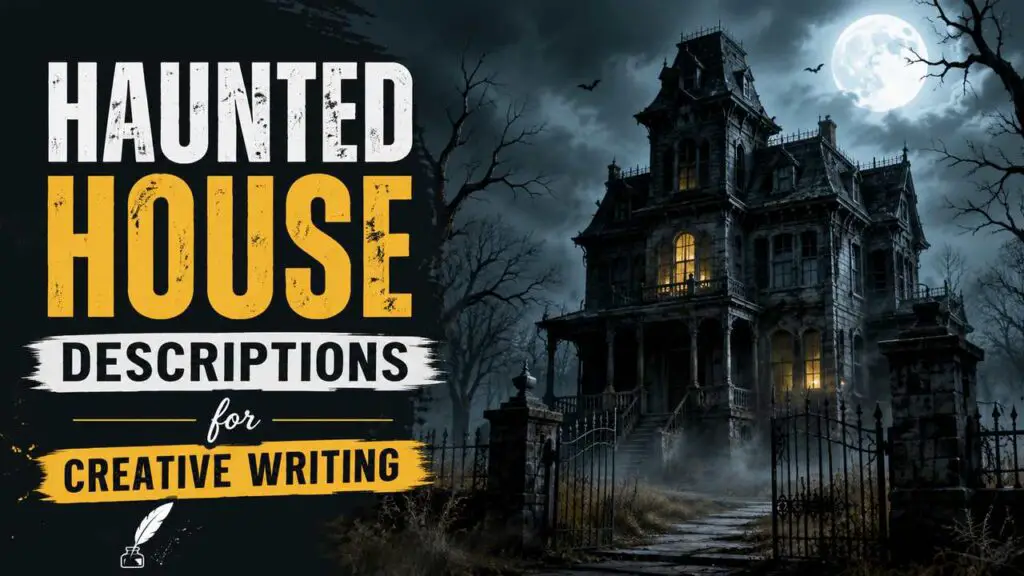
The haunted house is horror’s oldest instrument, and like all old instruments it’s mostly played badly — cold spots, slamming doors, and a pale face at the window, the whole kit deployed on page one until nothing frightens because everything announces. The houses that actually haunt readers work differently: they’re wrong before they’re scary, domestic before they’re demonic, and patient above all — escalating by inches, corrupting the familiar, and saving their worst for the moment the family has finally relaxed. Dread is architecture plus timing; this article is about building both.
Here’s how to make a house genuinely unquiet.
Haunted House Descriptions for Creative Writing
#1. Wrong Before Scary
The best haunted houses begin with faint wrongness no one can name — proportions slightly off, a hallway longer than the floor plan allows, rooms that face the wrong way for their light. Sub-threshold wrongness unsettles readers before anything happens, so the first slammed door lands on nerves already primed.
Nothing was wrong with the house, exactly — the hallway was just longer than it had any right to be, by a margin you’d need a tape measure and more nerve than anyone had to confirm.
The parlor faced east and somehow held its light till evening, and the kitchen faced south and was dim at noon, and after a month Dana stopped mentioning it, which was not the same as getting used to it.
Guests always paused at the same spot on the stairs — mid-flight, seventh step — with the look of people trying to remember an appointment; nobody had ever explained it, and the family had privately stopped counting the steps, which numbered thirteen going up and, they did not discuss, twelve coming down.
#2. Corrupt the Domestic
Horror’s best material is the household’s own inventory turned slightly — the rocking chair mid-rock with nobody, the child’s toy answering itself, family photos whose faces have moved a fraction. The familiar made wrong outperforms any monster: readers own these objects, so the corruption follows them home.
The rocking chair was moving when she came in — gently, decently, the way a chair rocks when someone has just left it — except she had been alone in the house for three days.
The toy phone rang at 3 a.m. — a toy, batteries removed, ringing — and the worst part was the pause after Milo answered it, in his sleep, politely: the pause of someone listening.
In the hallway photograph of the picnic, summer of ’61, everyone smiled at the camera except — and she checked this against her mother’s album, twice — the aunt at the edge, who now faced the house’s staircase instead.
#3. Sound Design Beats Special Effects
A haunted house is heard more than seen — footsteps overhead in an empty upstairs, water running in a bathroom nobody’s in, a voice one room away that stops at the threshold. Sound haunts best because it can’t be confronted: the reader’s imagination staffs every noise.
The footsteps upstairs were unremarkable in every way but one — the family was all in the kitchen, all four of them, looking at the ceiling together.
From the nursery, faintly, the sound of someone singing to the baby — the same three notes, patient and low — and the baby monitor’s little light glowing green, and the baby, that week, at her grandmother’s.
The house’s night sounds had a schedule she learned despite herself: the landing at one, the cellar door testing its latch at two, and at some hour she never let herself confirm, the sound — brief, unmistakable — of the dining chairs being counted.
#4. Escalate by Inches
Hauntings work on a slow dial — first explicable, then coincidental, then undeniable — and each stage must be small enough that staying in the house remains plausible. Rushing to the spectacular kills both dread and believability; the craft is patience, and the family’s rationalizations are the pacing device.
October was keys moving and doors ajar — old house, they said. November was the cold in the nursery and the dog’s new refusal of the stairs — drafts, they said, vet visit. By December they had stopped offering each other explanations, which was itself the milestone neither mentioned.
It never did anything large. That was its genius — a photograph face-down each morning, a single chair pulled out, her hairbrush in the wrong bathroom — small enough to doubt, regular enough to keep her doubting for a year.
The night it finally used her name, it had been eight months of patience — and the name, spoken once, gently, from the empty landing, spent all eight months in one syllable.
#5. Give the House a History and an Appetite
A haunting needs a why — the thing that happened in the house, discovered in deeds, clippings, and neighbors’ evasions — and a want: what the house is trying to keep, repeat, or take. Motive turns phenomena into story; a haunting with logic frightens longer than random spookery.
The deeds went back two centuries and skipped eleven years — 1907 to 1918 simply absent, pages razored out at the county office itself — and the archivist’s face, when she asked, was its own document.
The house didn’t want them gone; that was the slow, cold realization — the locked doors opening, the warm rooms, the crib assembled in the attic no one had assembled — the house wanted them settled. The house wanted them staying.
Every family that fled left something behind and none would say what, and when the Delgados finally ran in March, the neighbors watched them go and counted heads in the car with an attention that had nothing polite about it.
#6. The Skeptic Carries the Dread
Every haunted house needs its unbeliever — the spouse with explanations, the engineer with a meter — because dread peaks when the skeptic’s face changes. Their conversion is the story’s barometer: rationality holding, straining, and breaking measures the haunting better than any apparition.
Tom had an explanation for everything — settling joists, thermal bridging, the dog’s nerves — and his explanations got faster and thinner through the winter, until the night the piano played and he offered none at all, and that silence scared her worse than the music.
The surveyor went into the cellar with a moisture meter and professional boredom, and came up eleven minutes later with the meter in his coat pocket, declining tea, writing nothing down.
“There’ll be a draft doing it,” her mother said of the swinging lamp, in the firm voice she used for things she needed to be true, and moved her chair, all the same, to face the stairs.
#7. Map the Cold Geography
Hauntings localize — one room the family stops using without discussing, the stair everyone unconsciously skips, the corner even the removal men avoided setting boxes in. The house’s avoided places, mapped by behavior rather than announcement, let the reader learn the danger zones the way the family does: by watching feet.
Nobody had declared the sewing room off-limits; the family had simply rerouted, the way a tongue avoids a cracked tooth, until the corridor’s far end became a place the vacuum cleaner turned around.
The removal men, strangers to the house and its stories, stacked boxes along every wall of the cellar except the north one — and when pressed for a reason, the foreman looked at the wall in question and discovered he didn’t have one.
The dog’s map of the house was the honest one: he drank in the kitchen, slept on the landing, and had not put one paw in the blue bedroom since the day they moved in — a floor plan drawn in refusals.
#8. Daylight Hauntings Hit Harder
Midnight is the haunting’s home turf; 10 a.m. is its ambush. Wrongness in full sunlight — the figure in the garden at noon, the cold pocket in a bright kitchen — violates the reader’s safety rules and denies characters the comfort of dawn. Use daylight sparingly and it becomes your sharpest knife.
It was a bright Tuesday morning, radio on, kettle going, when she turned from the sink and the cellar door stood open — sunlight on the top three steps, the rest declining comment — and morning, which had always meant safety, quietly resigned the post.
The figure stood at the garden’s end at noon, in full sun, casting its shadow the correct direction — every rule obeyed but the main one, which was that the garden had a wall and no gate.
Night fears fade at breakfast; the thing about the house was that breakfast stopped helping — the wrongness sitting at the sunny table with them like a guest who had stayed past every hint.
#9. Retire the Cold-Spot Kit
Creaking doors, slamming shutters, flickering candles, “a chill ran down her spine” — the kit announces HAUNTED so loudly that no haunting can occur. The repair is subtraction: fewer phenomena, smaller and more particular, spaced further apart. One toy phone ringing without batteries outweighs a whole poltergeist’s furniture-throwing — restraint is the genre’s rarest and sharpest tool.
Kit version: doors slammed and a chill ran down her spine. Rebuilt: nothing slammed, ever — doors she left open were simply, later, closed, with the soft click of consideration — and it was the politeness, in the end, that broke her nerve.
The house had no cold spots. It had one warm one — the exact center of the empty nursery, blood-warm in January — which the heating engineer measured three times and then, apologizing, declined the job.
No candles guttered; the lights worked perfectly, every one — except that lately, coming up the drive at dusk, the windows were already lit before her hand reached the switch, the house done waiting for her to get home.
Closing Thoughts
The reframe that governs the genre: a haunted house is a home where the domestic contract is broken — the one deal every reader lives inside, that your own rooms will not act. That’s why the kit fails and the small wrongness works: slamming doors belong to storms, but a chair pulled out, a name from the landing, thirteen steps up and twelve down — those breach the contract, and the reader feels their own house shift around them as they read. Haunt the home, not the night. The night was never safe anyway; the kitchen was, and that’s exactly where to set the knife.