
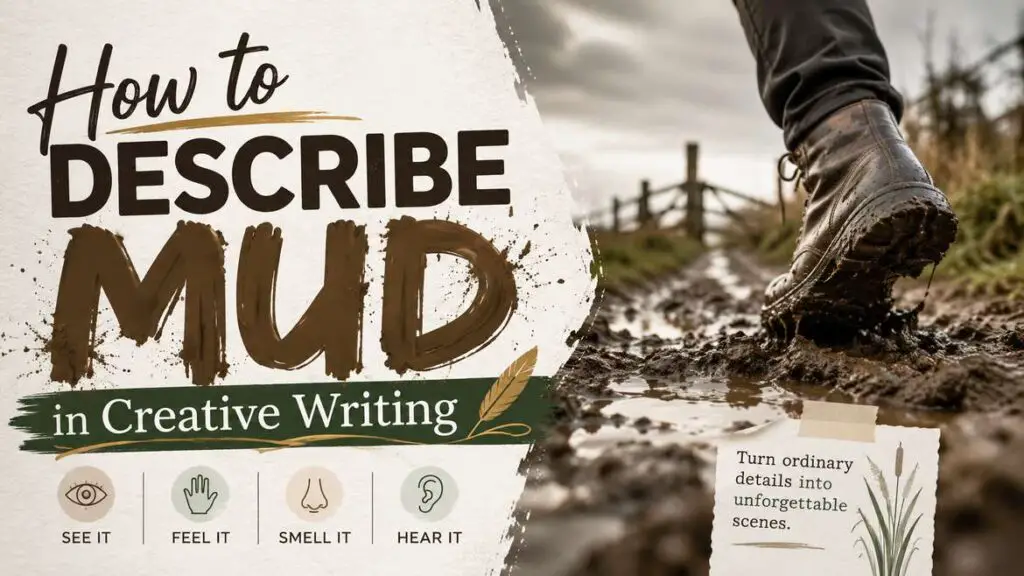
Mud is the least glamorous substance in literature and one of the hardest working — it slows armies, swallows boots, ruins weddings, delights children, and clings to everything it touches, including the memory of every reader who has ever lost a shoe to it. It’s texture, obstacle, class marker, and comedy all at once, which is why war novels, farm novels, and love stories in the rain all end up ankle-deep in it. The craft is specificity: mud has kinds, sounds, and appetites, and generic muck describes none of them. Below are the techniques for describing mud in creative writing, each with examples you can study and adapt.
How to Describe Mud in Creative Writing
#1. Name the Kind of Mud You’re Dealing With
Mud is a family, not a substance — the slick film that skates boots downhill, the deep clay that swallows and keeps, the churned soup of a gateway, the sucking estuary flats — and each kind behaves differently under a character’s weight. Choosing the species tells the reader exactly what kind of trouble is underfoot.
This wasn’t honest field mud; it was potter’s clay, gray and jealous, and it took her boot at the second step and negotiated for the sock.
The lane wore a skin of slick over hardpan — mud you didn’t sink into so much as skate on, every step a small vote of confidence the surface kept counting against you.
The gateway had been churned to brown soup by forty cattle twice a day, a porridge with hoofprints for a pattern.
#2. Write the Sounds — Suck, Slap, and Squelch
Mud is loud — the gasp of a boot pulled free, the slap of a step landing, the squelch that announces every movement to the whole field — and its sound effects are among the most physically evocative available to prose. The suck of deep mud releasing a heel makes readers’ own feet flinch.
Each step came free with a gasp, the mud giving up his boot reluctantly, like a handshake held too long.
The yard announced her progress to the whole farm — squelch, squelch, squelch — privacy being one more thing the wet spring had canceled.
Somewhere behind him a boot came out without its owner attached, and the sound — a long, satisfied sluuck — was followed by language unsuitable for the church picnic they were late to.
#3. Make It an Obstacle That Taxes Every Step
Mud converts distance into labor — doubling the cost of every yard, stealing balance, exhausting legs that expected a simple walk — and journeys through it become endurance scenes with built-in pacing. The wagon axle-deep, the stretcher-bearers in the churned field: mud has stopped more plans than any villain.
The half mile to the barn took twenty minutes and everything his thighs had, the mud charging its toll at every step and making no change.
The cart sank to its axles at the ford, and the afternoon’s plans quietly reorganized themselves around that fact.
They carried the stretcher across the churned field a yard at a time, four men fighting the ground for possession of every step.
#4. Let It Climb — Mud’s Slow Conquest of Clothes and Rooms
Mud travels — up boots to hems, from hands to face with one wipe, off the dog onto every lower cabinet, through the scrubbed kitchen on one forgotten sole — and tracking its migration is both comedy and characterization. Who fights the mud’s advance and who surrenders to it maps the household.
By the third field the mud had claimed her to the knee, and by the gate it had annexed one cuff and was reviewing the other.
The dog came in at speed, decorated to the shoulder, and redistributed the farmyard across the hall with the generosity of its kind.
He wiped his brow with the back of his glove and completed the transfer — a man now wearing the field on his face, and past caring.
#5. Use the Boot-Room Border — Mud as Social Line
Mud draws boundaries — the boot room, the newspaper by the door, the “not past the kitchen” law, clean hands versus working hands — and a household’s mud protocol encodes class, labor, and respect. The visitor who tracks mud in, and the one who automatically removes boots, are instantly sorted.
The farmhouse had a strict constitution, and its first article was the boot room — mud had rights as far as the bench, and none beyond it.
The salesman crossed her scrubbed floor in his street shoes, leaving a line of brown commas, and whatever he was selling, the answer became no at the second comma.
You could read the town’s two halves at the diner door: the boots that had earned their mud by seven a.m., and the shoes that had never met any.
#6. Let Children and Lovers Enjoy It
Mud isn’t only misery — children treat it as a material and a destination, puddle-stomping is a developmental stage, and adults released from dignity (mud runs, downpours, harvest festivals) rediscover the joy. Joyful mud humanizes characters instantly; the man who lets the toddler jump is being described, not the puddle.
The boy regarded the puddle with the seriousness of a man reviewing a contract, then signed it with both feet.
They came back from the mud run unrecognizable and delighted, two respectable accountants wearing the earth like children who had finally been given permission.
Grandpa’s one rule was no mud in the house, and his one exception was made annually, wordlessly, on the first warm rain of June.
#7. Give It Memory — What Mud Records and Returns
Mud is a recording medium — tracks that tell who passed and when, the print hardened since spring, the thing the receding flood left in the yard — and reading mud is how rural characters and detectives alike do their work. What the mud preserves, or gives back, can carry a whole plot beat.
The gateway held the night’s news in perfect type: one set of truck tires, in and out, and boot prints that stood a long while facing the house.
A child’s handprint had dried into the dam’s clay forty years ago, and he visited it every summer the way other men visit graves — his brother, age six, pressed into the county forever.
When the flood went down, the mud gave back a bicycle, a ladder, and one thing that sent the sheriff’s office wading in with tape.
#8. Skip the Generic Muck — Write Mud With an Appetite
“Thick mud” and “muddy ground” are labels, not descriptions — they carry no suction, no sound, no cost. The upgrade is behavioral: give the mud appetite and personality — what it takes, what it charges, what it refuses to return — because mud that acts is mud the reader’s boots remember. Every veteran of one wet field trip knows mud is a character; write it like one.
The draft said the field was muddy; the revision said the field kept a boot, a glove, and very nearly the vet’s confidence, in that order.
It wasn’t thick mud. It was mud with opinions — about speed, about dignity, about the wisdom of the shortcut — and it published them all over his good trousers.
Don’t tell me the ground was soft, the note said. Tell me the mud held the tractor until three neighbors and a chain had apologized to it.
Closing Thoughts
Mud is proof that no subject is too low for good prose — the whole craft of description is visible in it. You name the species, score the sounds, charge the toll, track the migration, draw the boot-room border, and let somebody love it who’s six years old. Then you give it appetite, because mud that merely lies there is scenery, and mud that takes a boot and negotiates for the sock is a character. The next wet week, go stand in some. Note what it charges you for the crossing and what it keeps as commission. That invoice is your description, itemized.