
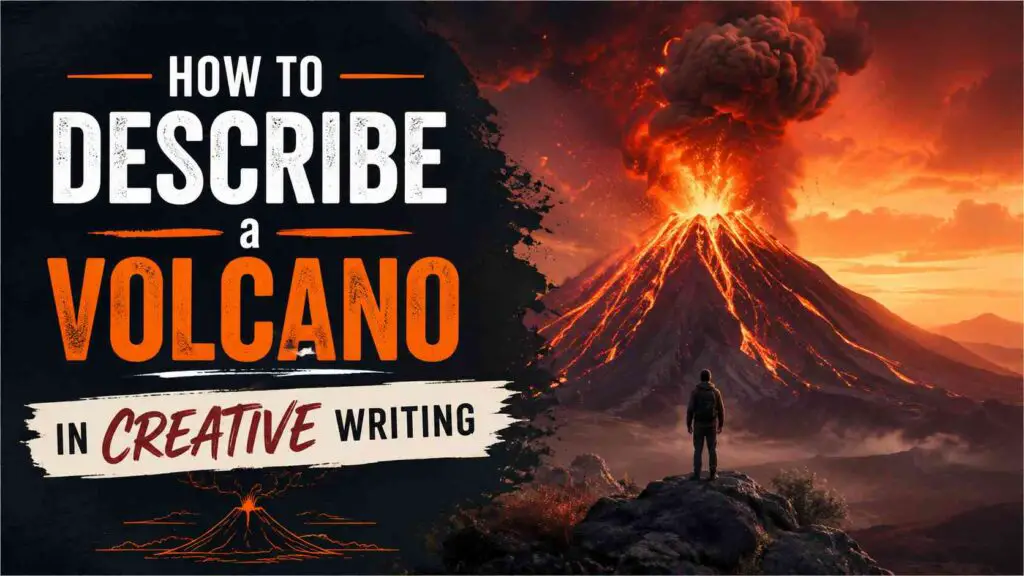
A volcano is the rare setting that is also a countdown. Whether it erupts in your story or merely stands there, every scene beneath one borrows its tension: the mountain on the horizon is a loaded gun on the wall, and the reader knows it. Yet most volcano writing spends everything on the eruption — fire, fury, boom — and nothing on the stranger material: the long dormancy, the town that farms the slopes anyway, the science of watching, the fall of ash like gray snow. The eruption is one chapter; the volcano is a relationship.
Here’s how to write the whole of it.
How to Describe a Volcano in Creative Writing
#1. The Dormant Neighbor
Most volcanoes spend your story asleep — a symmetrical presence over the town, snow-capped, on postcards, in the corner of every window. Writing the mountain as a neighbor the locals half-ignore and half-watch builds dread through domesticity: the more ordinary its presence, the louder its potential.
The mountain stood at the end of every street like a relative at the back of every photograph — so constant that visitors gasped at it and locals checked it the way you check a sleeping baby: briefly, in passing, every single day.
They grew coffee to its very hem, and the mountain permitted it, and the word for that arrangement — everyone knew, nobody said — was so far.
On clear mornings it wore its little flag of steam, and the bakery talked about it the way other towns talk about rain: casually, and never quite casually.
#2. Go Up and Look In
The crater rim is one of Earth’s strangest standpoints — sulfur stink, warm ground, a lake of acid green or a floor of black slag, steam hissing from vents like the mountain breathing through its teeth. A visit up top gives your reader the volcano as a place, not just a threat.
At the rim the wind brought the smell up to meet them — struck matches and rotten eggs — and the crater lake below sat unnaturally green, a color with no references outside chemistry.
The ground near the vents was warm through her boot soles, faintly, horribly domestic — a kitchen floor with the oven on, except the oven was the planet.
Steam left the fumaroles with a pressure-cooker patience, hissing threads of it stitched all across the black floor, and Aldo understood that the mountain was not asleep so much as breathing slowly on purpose.
#3. The Warnings Come First
Eruptions announce themselves — swarms of small quakes, wells going warm or dry, dogs and birds unsettled, the seismograph’s handwriting turning jagged. Writing the prelude builds suspense the eruption itself can’t, and it stages the human drama that matters most: who believes the mountain, and who doesn’t.
The tremors were nothing — cups chattering briefly in cupboards, a picture going crooked — but there had now been forty of them since Tuesday, and the vulcanologist had stopped answering questions in complete sentences.
The hot spring on the Ferro land went from bathwater to scalding in a week, and old Ferro, who had argued with the evacuation map for years, quietly began crating his tools.
It was the birds she remembered afterward — the slopes going silent, the sky over the cone empty of them for two days — the mountain’s tenants leaving before the landlord’s notice went up.
#4. Eruption: Write the Stages, Not the Blast
A real eruption is a sequence — the first dark cauliflower of ash, the column climbing miles, lightning inside the plume, the roar arriving late across the distance. Slowing the spectacle into stages keeps it legible and lets your characters react beat by beat instead of drowning in one paragraph of fury.
The plume went up wrong for a cloud — too fast, too vertical, boiling upward in gray cauliflower heads — and it had climbed higher than any weather before the sound of it finally crossed the valley and arrived as a long tearing of cloth.
Inside the ash column, lightning began — dry, branching, continuous — a storm the mountain was manufacturing out of its own violence.
From the ferry, thirty miles off, it looked stately — a gray tree growing in slow motion on the horizon — and that stateliness, the captain said later, was the most frightening thing he had ever seen.
#5. Lava Moves Like Time
Lava is rarely fast — it advances at a walking pace, a glowing hedge eating fences, orchards, and kitchens one at a time, unstoppable but not sudden. That slowness is its horror and its poetry: people stand in the road watching their house wait its turn. Write the pace, the creak and tinkle of the cooling front, the heat that arrives before it does.
The flow came down the lane at the speed of a funeral, black crust over orange seams, clinking like a slow avalanche of broken plates, and it took the Morell place after lunch with no malice whatsoever.
You felt it a street away — a wall of bread-oven heat — and then you saw it: the garden fence igniting politely, picket by picket, as if being lit for a ceremony.
They had four days’ warning and used them, and on the fifth they stood at the barricade drinking thermos coffee while the lava shouldered through the vineyard, slow as a glacier’s furious cousin.
#6. Ashfall Is Weather From Underground
Downwind, an eruption becomes ash — gray snowfall that doesn’t melt, grit in teeth and engines, day turned to sepia dusk, roofs creaking under the weight. Ashfall lets you write the volcano’s reach into ordinary kitchens hundreds of miles away, where the drama is a broom and a ruined harvest.
The ash came down like snow that had forgotten everything good about itself — gray, warm, whispering — and by evening the cars wore it an inch thick and nobody’s footsteps made a sound.
Noon went the color of old photographs. The chickens, fooled, put themselves to bed.
Grit found everything — teeth, hinges, the butter dish — and for weeks after, the whole valley chewed a little when it spoke.
#7. The Long Bargain
People live on volcanoes for a reason: the soil is black gold, the slopes grow the best coffee and vines, and generations accept the wager. Writing this bargain — fertility against catastrophe, memory against convenience — gives your volcano its human dimension and your characters their central argument.
The vines did better on the mountain than anywhere in the province — everyone said so — and every family that said so had a grandmother’s story about the year the sky went black, told at harvest, like grace.
“Move where?” her father said, spreading the black soil in his palm like coin. “This is the mountain’s rent to us. We pay ours when it asks.”
The village had been buried twice in four centuries and rebuilt twice, each time a little higher up its own history, the new church standing on the old church’s shoulders.
#8. Skip the Angry Mountain
“The volcano awoke in fury,” “the mountain’s wrath,” “nature’s rage unleashed” — the anger kit turns geology into a tantrum and wastes the truth, which is worse: total indifference on a planetary timescale. Write process, not temper — pressure, physics, patience — and let any anger belong to the humans arguing in its shadow.
The mountain was not angry. It was busy — had been busy for ten thousand years — and the town’s whole history fit inside one of its pauses.
It erupted the way a ledger balances: pressure in, pressure out, the arithmetic complete, and whether a village stood in the sum was not a variable the equation carried.
Afterward the priest and the geologist agreed, for once, on the sermon: the mountain had not chosen them, had not spared them, had not noticed them — and both men found their congregations preferred the fury.
Closing Thoughts
The reframe that unlocks volcano writing: it’s not a disaster, it’s a clock — one that runs on centuries, planted in the middle of lives that run on seasons. Everything worth writing lives in that mismatch of timescales: the farmer’s forty harvests inside one geological breath, the evacuation argument between a grandmother’s memory and a seismograph’s morning, the town rebuilt on its own burials. The eruption, when you write one, is simply the two clocks striking together. Keep your eye on the mismatch and the volcano will give you tension in every chapter — even the ones where it only steams.