
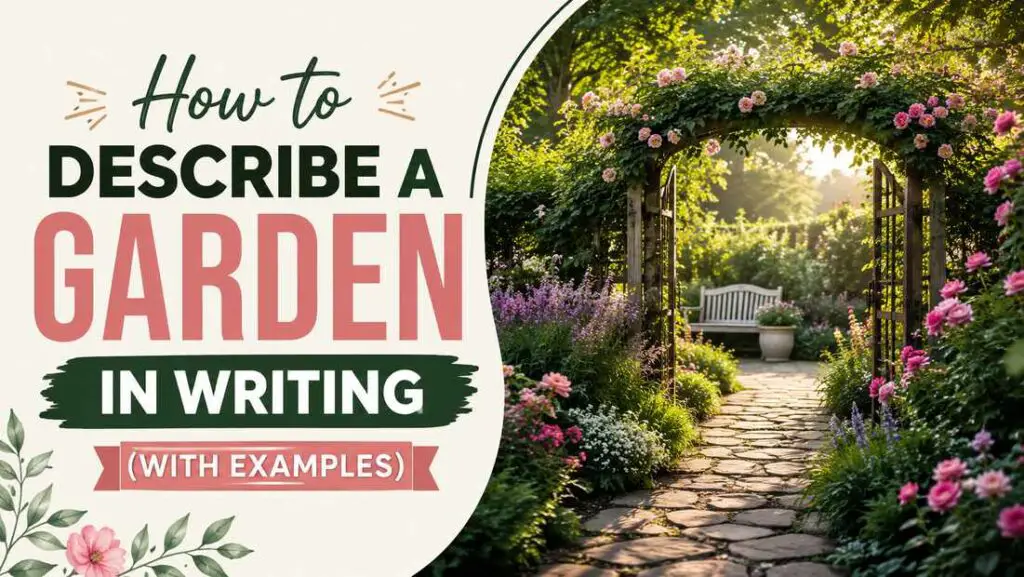
A garden is never just plants arranged in a yard — it’s a record of decisions, priorities, and care, or the lack of it, made visible over time. Two gardens can hold the exact same flowers and read completely differently depending on their layout, upkeep, and the person behind them. Below are the techniques for making a garden feel specific and purposeful in your writing, each with examples you can study and adapt.
How to Describe a Garden in Writing
#1. Establish the Garden’s Purpose Before Its Appearance
A garden grown for food reads differently than one grown purely for beauty, and establishing that purpose early shapes how the reader interprets everything that follows. Function — practical, ornamental, memorial — gives a garden context before a single flower is described.
The garden existed to feed six people through winter, and every row reflected that math exactly.
It wasn’t a garden meant to be walked through so much as looked at from the parlor window, arranged entirely for effect.
They’d planted it the year after the funeral, and everyone in the family understood, without saying so, what it was actually for.
#2. Use the Garden to Reflect Its Keeper
A garden’s condition — meticulous rows, chaotic abundance, total neglect — mirrors the person who tends it as clearly as a room in their house would. This makes garden description an efficient form of characterization.
Every row was perfectly straight, weeded within an inch of its life, exactly the kind of garden you’d expect from a man who alphabetized his spice rack.
Her garden was a glorious, unplanned mess, and she seemed to genuinely prefer it that way.
The garden had clearly been someone’s pride once, though it had been three summers, at least, since anyone had touched it.
#3. Layer Sensory Detail Beyond Sight
A garden offers sound, smell, and texture just as readily as color — bees humming, mint crushed underfoot, the specific coolness of soil after rain. Including these senses makes a garden feel immersive rather than merely pictured.
Bees moved steadily between the lavender rows, a low, constant hum that filled the whole afternoon.
The smell of wet soil rose up the moment the sprinklers kicked on.
Crushed mint released its scent underfoot before she even realized she’d stepped on it.
#4. Show the Garden Across Seasons
A garden changes dramatically across the year, and describing it at different seasons — bare in winter, riotous in summer — can mark time passing within a story while also shifting its emotional tone. The same plot of land can carry entirely different meanings depending on when a character encounters it.
By January the garden was nothing but bare stalks and frozen dirt, unrecognizable from the riot of color it had been in July.
Spring brought the first green shoots up through soil that had looked, all winter, like it might never grow anything again.
The garden peaked in August, heavy and almost too abundant, before the first frost took all of it at once.
#5. Use Structure and Layout to Guide the Reader’s Eye
The physical arrangement of a garden — winding paths, geometric beds, a single overgrown corner — shapes how a reader moves through the description. Describing layout deliberately, rather than listing plants at random, mirrors how a visitor would actually experience the space.
A gravel path wound from the gate through the roses before opening onto the vegetable beds at the back.
The beds were arranged in strict, geometric rows, nothing left to chance or accident.
One corner of the yard had clearly been left to grow however it wanted, in stark contrast to everything else.
#6. Contrast Wild and Manicured Sections
A garden that’s partly cultivated and partly left wild creates a natural point of contrast within a single setting, hinting at competing values or a change in ownership over time. This juxtaposition can carry meaning without a single line of explanation.
The front beds were clipped and orderly, but the back half of the yard had clearly been surrendered to whatever wanted to grow there.
Someone had once maintained the whole property with obvious care; now only the section nearest the house showed any sign of upkeep.
Roses in careful rows gave way, past the hedge, to a stretch of grass no one had mowed in what looked like years.
#7. Use the Garden as a Setting for Private Conversation
Gardens offer a natural setting for intimate or difficult conversations, since they’re private enough for honesty but public enough to interrupt an argument before it escalates. The physical activity of gardening — weeding, pruning — can also give characters something to do with their hands while they talk.
She kept pulling weeds the whole time he talked, as if staying busy might make the conversation easier to survive.
They’d always had their hardest conversations out here, hands busy, eyes on the tomatoes instead of each other.
He waited until they were alone among the roses to finally say what he’d been avoiding all week.
#8. Show Signs of Neglect or Overwork
A garden left untended for too long, or one clearly overworked past the point of enjoyment, both reveal something about the person responsible for it. Small, specific signs — cracked terra cotta pots, exhausted soil, blistered hands — communicate that history without narration.
Cracked terra cotta pots lined the porch, most of them holding nothing but dry soil and old stakes.
Her hands had blistered weeks ago, and still she kept going, as if stopping would mean admitting something she wasn’t ready to.
The soil in the raised beds had gone gray and exhausted, overworked for one too many seasons without rest.
#9. Use Weather to Change the Garden’s Mood
The same garden can feel entirely different in bright sun versus fog or rain, and using weather deliberately lets a writer reuse a setting across a story while shifting its emotional register each time. Weather also affects how a garden physically behaves — flowers closing, leaves flattening under rain.
Fog settled low over the garden that morning, turning even the familiar rows of vegetables into something unfamiliar.
Rain flattened the peonies overnight, heads bowed low the next morning as if in apology.
In full sun, the garden looked almost aggressively cheerful, nothing like the version he remembered from that gray November.
#10. Avoid Listing Every Plant — Choose What Matters
Not every flower bed or vegetable row needs to make it onto the page. Selecting the two or three plants that carry the most meaning or sensory weight keeps a garden description vivid without turning into an exhaustive, forgettable catalog.
She didn’t need to describe the whole garden — the single dead rosebush by the gate said enough.
He skipped past most of the vegetable beds and let the reader see only the tomatoes, heavy and cracking, no one left to pick them.
The garden could have taken a page to describe; instead, all she offered was the empty birdbath, and it was enough.
Closing Thoughts
A garden becomes memorable on the page when it’s treated as more than scenery — when its layout, upkeep, and seasonal changes reflect the people who tend it and the events unfolding around it. Choose the details that carry meaning rather than cataloging every plant, and your gardens will feel as specific and alive as the characters who walk through them.